
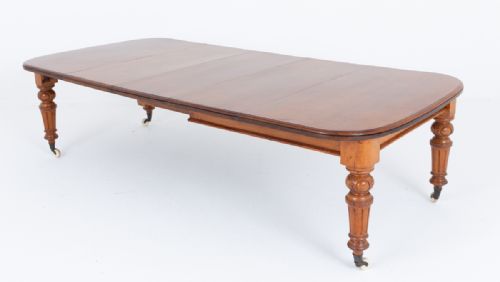
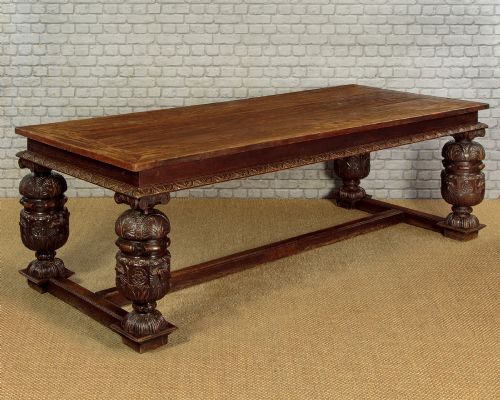


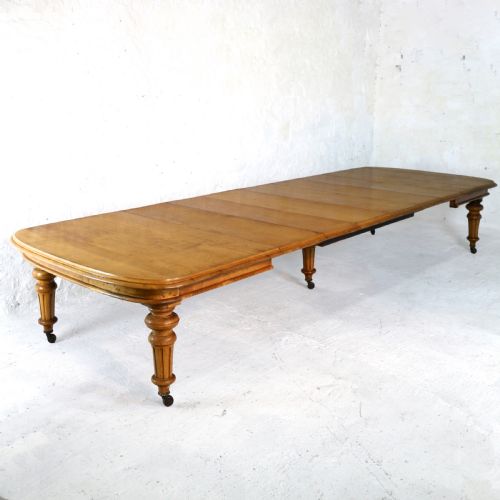

Victorian Oak Banquet Table
These robust victorian oak banquet table examples bring historic scale and solid timber presence to grand dining rooms.
Victorian Oak Banquet Table
A victorian oak banquet table provides substantial dining space, frequently seen in forms such as expansive extending tables, refectory designs, and circular formats. These pieces originate from the nineteenth century, including specific dates like eighteen sixty and eighteen ninety, alongside broader Victorian classifications.
Buyers encounter revival aesthetics heavily represented among these listings, spanning Gothic Revival, Elizabethan Revival, and Jacobean Revival styles. Such large furniture serves grand interiors, accommodating numerous guests through multiple leaves or impressive eight-foot diameters.
Origins trace back to British workshops and estate commissions, evidenced by pieces bearing crown estate stamps. The selection balances long refectory formats with practical extending mechanisms designed for large gatherings.
How they were made
Makers utilised primary structural timbers of oak and pollard oak, complemented by secondary woods like pine for internal elements. Metal components including brass, bronze, and ceramic appear in feet, castors, and mechanical hardware.
Carving defines the decorative approach, seen in heavily carved surfaces and architectural revival detailing. Tables incorporate clever extending engineering alongside cruciform bases and robust refectory supports.
Listings feature nineteenth-century dates including eighteen sixty and eighteen ninety alongside general Victorian periods.
What varies in quality
The sophistication of the revival carving and the selection of figured pollard oak veneers dictate the visual distinction at the upper end of the scale. Plain timber constructions sit alongside richly ornamented Gothic and Elizabethan Revival showpieces.
Engineering complexity separates standard refectory formats from multi-leaf extending tables equipped with robust mechanisms and stable cruciform or leg supports. Stamped provenance marks, such as crown estate stamps, elevate the historical interest of specific pieces.
The Victorian Oak Banquet Table Glossary
- Refectory table
- A long, narrow dining table traditionally used in communal dining halls. Nineteenth-century revival versions adopt this historic format for domestic banquet use.
- Extending table
- A dining table designed with removable leaves or internal mechanisms to expand its length. These accommodate large dinner parties before returning to a compact size.
- Gothic Revival
- An architectural and decorative style drawing on medieval forms, featuring pointed arches and heavy carving. This aesthetic defines several large nineteenth-century tables.
- Cruciform base
- A central support structure arranged in a cross shape. This configuration provides stability for large circular dining tables.
Victorian Oak Banquet Table: Frequently Asked Questions
How many people do these tables seat?
These large tables accommodate substantial gatherings, with specific examples measuring up to eighteen feet in length.
Many listings include multiple leaves or extensive seating capacities, such as tables designed to seat eighteen guests comfortably.
What styles are available?
The inventory spans Victorian production alongside distinct revival movements.
Buyers encounter Gothic Revival, Elizabethan Revival, and Jaceronian Revival aesthetic influences applied to heavy oak frames.
How do extending mechanisms function?
Nineteenth-century extending tables utilise internal tracks and removable leaves to expand the surface area.
Operators insert additional timber sections to lengthen the table for banqueting use.
Are these tables suitable for daily use?
Built from durable oak and pollard oak, these tables provide sturdy surfaces for regular dining.
Their robust construction and historic hardware handle the demands of large household meals.