


Victorian Mirror Whatnot
These Victorian mirror whatnot pieces combine display shelving and reflective glass into a functional multi-tier furnishing that organises decorative objects.
Victorian Mirror Whatnot
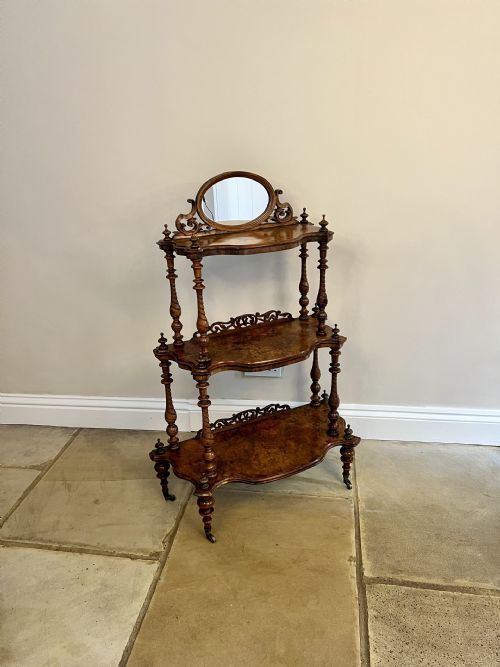
A Victorian mirror whatnot is a multi-tiered display unit designed to hold ornaments while incorporating a mirror panel into its structure. These pieces function as both a set of open shelves and a small cabinet or sideboard.
The versions most commonly met on this page span the mid to late nineteenth century, including specific dates such as eighteen-sixty, eighteen-seventy, and around eighteen-eighty. Forms range from simple three-tier shelving to elaborate combinations featuring drawers, side cabinets, and chiffonier bases.
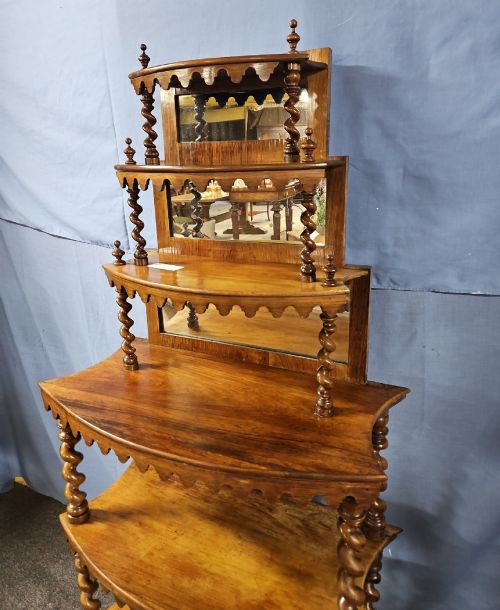
Makers and cabinetmakers of the period produced these furnishings in various configurations, including Canterbury styles and hollow barley twist supports. The integration of mirror glass creates a sense of depth behind the displayed objects.
How they were made
Cabinetmakers utilised dense timbers such as mahogany, rosewood, and burr walnut to construct the framework of each whatnot. Burr walnut surfaces frequently feature marquetry inlay work to enhance the visual texture of the wood.
Structural elements incorporate carved details, brass fittings, and turned uprights such as barley twists to support multiple tiers. Mirror glass is set securely into carved wooden backboards to complete the display area.
The recorded forms span simple open display shelves, three-tier étagères, and complex chiffonier sideboards with integrated drawers.
What varies in quality
The refinement of the timber selection dictates the overall standard of the piece, with richly figured burr walnut and rosewood representing the upper echelon. Plain mahogany constructions offer a more austere finish compared to heavily inlaid or carved examples.
The Victorian Mirror Whatnot Glossary
- Whatnot
- An open shelving unit designed for displaying ornaments and small decorative objects. These pieces typically feature multiple tiers supported by turned uprights.
- Etagere
- A piece of furniture consisting of a set of open shelves for displaying small articles. The term is often used interchangeably with whatnot.
- Burr walnut
- A prized timber harvested from the wart-like growths on walnut trees, displaying intricate swirling grain patterns. Cabinetmakers used veneers of this wood on prominent surfaces.
- Canterbury
- A low stand featuring slatted partitions originally designed for holding sheet music or portfolios. Some whatnot designs incorporate a Canterbury section at the base.
- Chiffonier
- A small sideboard or cabinet featuring shelves or a mirror superstructure. Examples on this page combine this form with a traditional whatnot.
Victorian Mirror Whatnot: Frequently Asked Questions
What is a Victorian mirror whatnot?
A Victorian mirror whatnot is a multi-tiered display shelving unit that incorporates a mirror into its backboard. These furnishings were built during the nineteenth century to exhibit decorative objects in domestic rooms.
They combine open tiers with practical additions like drawers, cupboards, or chiffonier bases. The reflective glass panel serves to brighten the displayed items and visually expand the surrounding space.
How were these pieces used originally?
Households utilised these units in reception rooms and parlours to display porcelain, small sculptures, and framed photographs. The graduated shelves allowed owners to arrange items by size and prominence.
Lower sections equipped with drawers, cabinets, or partitions offered enclosed storage for books, papers, or household sundries. The combination of display and storage made them versatile additions to Victorian interiors.
What woods appear most often?
Burr walnut, mahogany, and rosewood form the primary timbers seen across these listings. Walnut veneer frequently displays decorative marquetry inlay work.
Mahogany appears in both plain and carved mirror-back configurations, whilst rosewood provides a dark, polished finish. Brass components and mirror glass complete the material palette.
How do I identify the period?
Evidence points to nineteenth-century manufacturing techniques, specifically within the Victorian era from eighteen-sixty to eighteen-eighty. Stylistic markers include turned barley twist supports, marquetry inlay, and carved mirror frames.
Construction methods reflect the hand-finishing practices of Victorian cabinetmakers. The presence of specific wood types like burr walnut further aligns these objects with mid-nineteenth-century British furniture production.
Where should I place a whatnot?
These units suit living rooms, hallways, or dining spaces where vertical display space is preferred over wide cabinets. Their shallow depth allows them to sit against walls without encroaching heavily on floor space.
Placing the unit near a light source enhances the effect of the mirror glass. They function effectively as focal points for curated collections of small antiques.