


Victorian Mirror Back Dresser
A victorian mirror back dresser combines substantial storage with polished glass, reflecting light and shifting the scale of a room.
Victorian Mirror Back Dresser
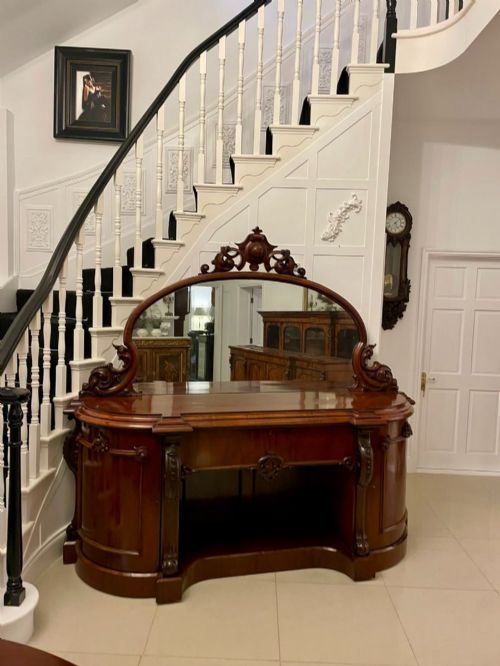
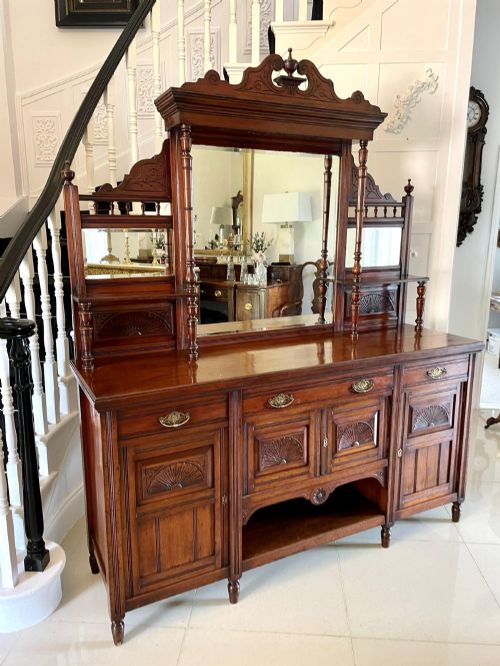
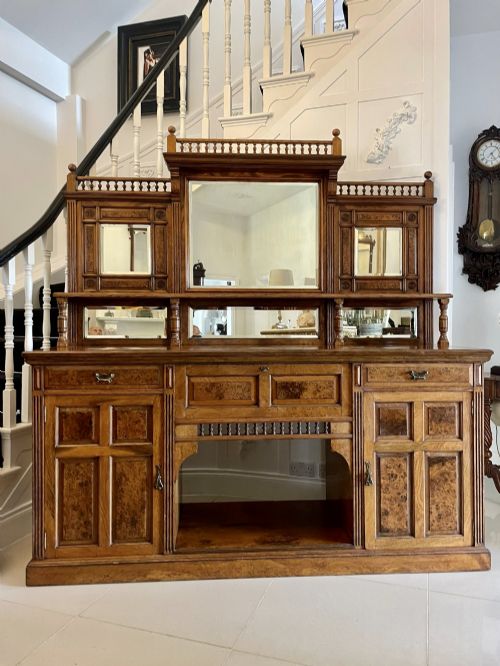
A victorian mirror back dresser typically takes the form of a large sideboard or buffet fitted with an upright mirror section at the rear. These pieces combine heavy base cabinets with decorative upper frames designed to display ceramics and brighten nineteenth-century interiors.
The versions most commonly found here date from the mid to late nineteenth century, spanning from the eighteen-fifties through the Edwardian transition. They appear in styles ranging from standard Victorian and Gothic Revival to Arts and Crafts and Aesthetic Movement interpretations.
Materials and construction
Makers relied heavily on solid hardwoods and veneers, selecting oak, mahogany, walnut, and pollard oak for their rich grain and durability. These timbers formed the structural carcass of the base cabinets and the decorative surrounds of the tall mirror frames.
Surface ornamentation often involved detailed hand carving, boxwood or specialist wood inlay, and applied brass or glass elements. Mirror glass was securely fitted into shaped wooden backplates, frequently accompanied by marble tops or decorative ceramic panels.
Listings demonstrate a strong preference for oak and mahogany, with cabinet forms spanning the Victorian, Edwardian, and Arts and Crafts periods.
Assessing craftsmanship and finish
Quality depends upon the selection of timber and the precision of the cabinetmaker's joinery in both base and superstructure. Superior pieces utilise figured pollard oak, burr walnut, or dense mahogany, displaying tight dovetail joints and crisp, deep carving rather than shallow machine moulding.
The execution of decorative details such as boxwood inlay, custom brass hardware, and the clarity of the original mirror glass separate standard production from exceptional examples. Workshop attribution to notable makers also elevates the standing of a piece within the range.
T Simpson and Son·Shapland & Petter·Maple & Co
The Victorian Mirror Back Dresser Glossary
- Pollard oak
- A timber obtained from pollarded trees, noted for its highly figured, clustered knot formation. It provides a distinctively mottled surface pattern prized by nineteenth-century cabinetmakers.
- Mirror back
- An upright wooden frame holding a glass mirror attached to the rear of a sideboard or credenza. This component reflects interior light and displays decorative objects placed on the shelf below.
- Pedestal sideboard
- A heavy storage unit featuring twin columnar cupboard pedestals flanking a central section. These forms often incorporate drawers and deep compartments for dining silver and linens.
- Gothic Revival
- A nineteenth-century design style drawing on medieval architecture and motifs. Pieces in this idiom utilise pointed arches, heavy linenfold carving, and structural tracery.
- Inlay
- A technique where pieces of contrasting wood, such as boxwood or various specimen timbers, are inserted into recesses in the primary surface to create geometric or floral patterns.
Victorian Mirror Back Dresser: Frequently Asked Questions
How are mirror backs attached?
Mirror backs are usually secured to the base sideboard using heavy wooden supports and robust metal brackets screwed into the rear framework. This method ensures the tall, heavy glass structure remains stable during daily use.
Some larger pieces were constructed in two distinct sections to simplify transport and installation in nineteenth-century dining rooms.
What woods were used most?
Oak and mahogany dominate the surviving examples, alongside significant numbers of walnut and pollard oak cabinets. Rosewood and pine also appear occasionally in specific regional or later pieces.
Cabinetmakers selected these timbers for their structural strength and capacity to take deep polish and intricate carving.
How do I spot Arts and Crafts style?
Arts and Crafts pieces emphasise visible hand craftsmanship, honest construction methods, and simpler geometric lines rather than heavy ornamentation. They often feature exposed joinery, hammered copper hardware, and minimal carving.
These designs reject mass-produced revivalism in favour of straightforward utility and natural wood finishes.
Are the mirror plates original?
Original mirror plates frequently display subtle silver oxidation, slight foxing, or minor surface marks gained over more than a century. These signs of age help confirm the authenticity of the glass.
Clear, unblemished mirror glass in an antique frame often indicates a later replacement.