
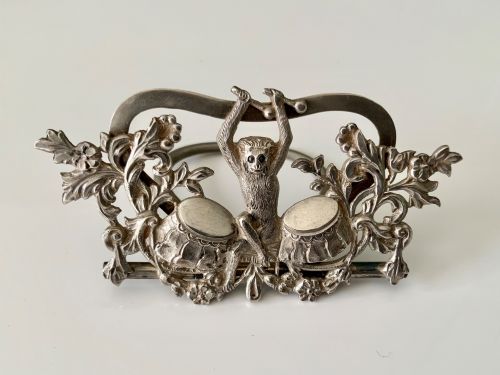


Victorian Menu Holder
These Victorian menu holder pieces bring silver, porcelain and character to a formal dining table with ingenious miniature forms.
Victorian Menu Holder
A Victorian menu holder sits upon the dining table to display the evening meal's courses to guests in miniature architectural or figural forms.
The pieces on this page appear most frequently in sterling silver, alongside parian porcelain and novelty designs depicting animals, cherubs and sentry boxes.
Makers produced these items in pairs or larger sets, often incorporating Scottish agate or regional motifs like Anglo-Indian Madras silver.
Making the pieces
Silversmiths shaped sterling silver through casting and chased intricate details into figures like monkeys, owls and bulldogs.
Potters utilised parian porcelain to model matte biscuit figures such as John Bright, while other pieces combined leather, velvet and enamel.
Hinged mechanisms and card slots were soldered to sturdy weighted bases to keep menus upright during dinner.
Materials across these listings range from sterling silver and silver plating to parian porcelain, velvet, leather and agate.
Judging quality
The crispness of the chasing on silver figures separates standard examples from works by skilled silversmiths.
Quality rests in the weight of the metal and the precision of the hinge mechanism that holds the card secure.
Novelty pieces derive their standing from the rarity of the subject, whether an Alice in Wonderland character or a drumming monkey.
Sampson Mordan·Lawrence Emanuel·John Bright
The Victorian Menu Holder Glossary
- Sterling Silver
- An alloy consisting of 925 parts of silver per thousand by weight, forming the primary metal for these table accessories.
- Parian Porcelain
- A fine white biscuit porcelain resembling marble, used for figural menu holders during the nineteenth century.
- Agate
- A decorative quartz variety featuring natural bands of colour, utilised in Scottish revival pieces on this page.
- Chasing
- A metalsmithing technique where the artisan punches details into the front surface of the metal rather than carving away material.
- Novelty
- A collectible item designed in a humorous or unusual shape outside standard tableware forms.
Victorian Menu Holder: Frequently Asked Questions
What is a Victorian menu holder used for?
These table accessories held printed cards detailing the courses of a formal meal for seated guests to read.
Hosts placed pairs or sets of them along the dining table so everyone could view the menu without passing a single card.
How do I display menu holders today?
You can place them on a dining sideboard or within a display cabinet to showcase their miniature sculptural details.
They also function well on a desk or mantelpiece holding small cards or photographs.
Are these pieces made of solid silver?
Many examples are fashioned from solid sterling silver bearing hallmarks for British assay offices like Birmingham, Chester, Sheffield and London.
A few items utilise other materials including parian porcelain, silver plating, velvet and agate.
How do I distinguish Edwardian from Victorian pieces?
Victorian items date from the reign of Queen Victoria up to 1901, whilst Edwardian pieces fall into the early twentieth century.
Both periods share similar novelty and figural designs, so hallmarks and registration marks provide the exact date.