



Victorian Mantel Garniture
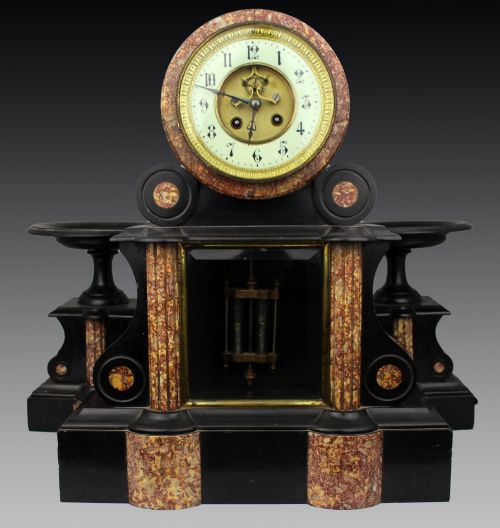
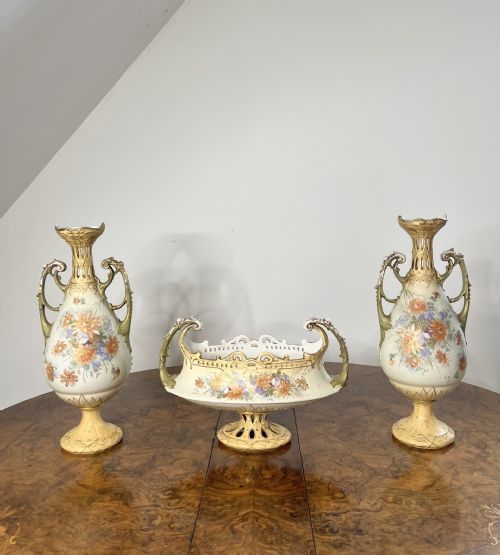
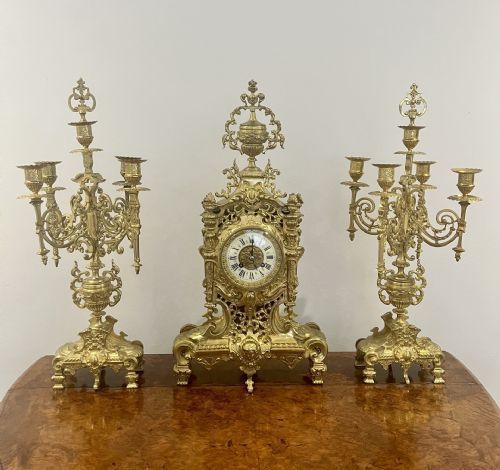
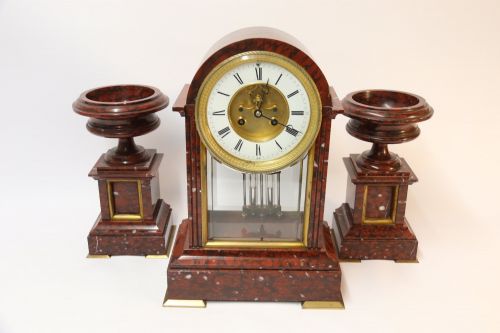
A victorian mantel garniture brings a grand matching ensemble of a central clock flanked by twin urns or vases to a fireplace.
Victorian Mantel Garniture
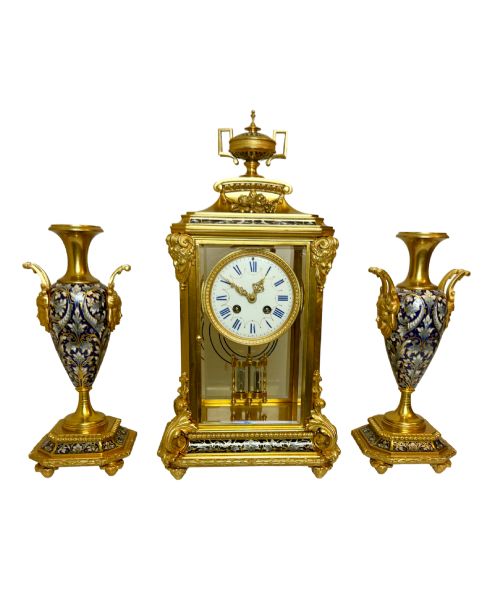
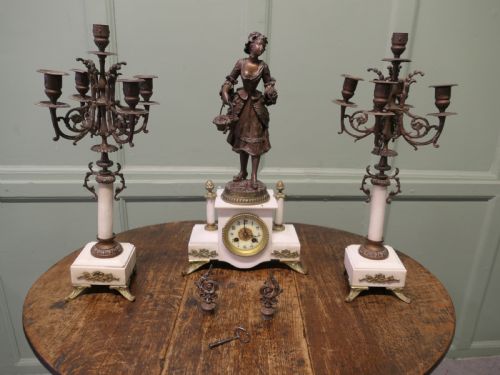
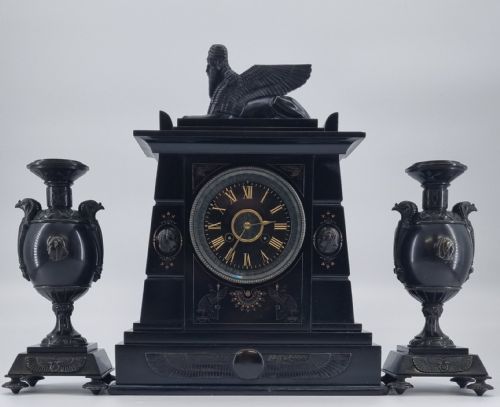
A victorian mantel garniture comprises a matching three-piece set designed for a fireplace, featuring a central clock paired with matching side vases, urns, or cassolettes. Buyers searching this phrase meet matching French and English decorative ensembles spanning the nineteenth century.
The common form on this page pairs a central mantel clock with two matching side pieces, often cast in metal or carved from stone. These sets provide symmetry and visual weight above a fireplace or across a large sideboard.
Sets frequently draw on continental influences, notably French styles such as Rococo Revival, Second Empire, and Napoleon III. Alongside clocks, the listings include mantel lustres and decorative urns created as balanced decorative groups.
What varies in quality
Quality rests in the crispness of the metal chasing and the depth of the gilding on bronze and ormolu mounts. Finer sets show precise hand-finishing in the cast foliage and figures, whereas simpler examples rely on standard commercial castings with minimal hand-tooling.
The selection of materials creates a distinct tier in the pieces, moving from standard slate and brass toward richly detailed onyx, champlevé enamel, and hand-painted porcelain panels signed by notable makers. The integration of the side pieces with the central clock determines the overall coherence of the garniture.
Object forms span mantel clocks, clock garniture sets, mantel lustres, decorative urns, and cassolettes.
Japy Frères·Samuel Marti·A.D Mougin·Royal Vienna·KPM Berlin·Mason’s Ironstone·Meissen
The Victorian Mantel Garniture Glossary
- Garniture
- A set of matching decorative objects for a mantelpiece, typically comprising a central clock and two side vases or urns.
- Ormolu
- Gilded bronze used extensively for decorative mounts on nineteenth-century clocks and decorative objects. The technique involves applying a mercury and gold amalgam to bronze before heating.
- Champlevé
- An enamel technique where troughs or cells are hollowed out of a metal surface and filled with vitreous enamel before firing.
- Cassolette
- A decorative vessel that can function as a vase or be inverted to serve as a burner, often forming part of a garniture set.
- Lustre
- A decorative glass or porcelain vase hung with cut glass prisms that refract candlelight or daylight.
Victorian Mantel Garniture: Frequently Asked Questions
What is a mantel garniture?
A mantel garniture is a matching set of three decorative objects designed to sit together on a fireplace shelf. It typically consists of a central clock accompanied by two matching side urns, vases, or cassolettes.
The concept originated to create visual balance and symmetry in formal nineteenth-century interiors. The side pieces echo the materials and decorative motifs of the central clock.
How do you style a garniture set?
Garniture sets work best placed centrally on a mantelpiece, with the clock in the middle and the matching side pieces flanking it at equal distances. They provide a strong focal point for a room and require sufficient surface depth to sit securely.
Because these sets are visually heavy, they pair well with simple stone or wood fireplaces. Keeping the surrounding mantel surface clear lets the matching details of the brass, marble, or porcelain stand out.
Who made these clock sets?
Many sets were produced by prominent French clockmakers and foundries, who supplied movements and cases to the retail market. Names such as Japy Frères, Samuel Marti, and A.D. Mougin frequently appear alongside porcelain factories like Sevres and Meissen.
Retailers often imported these movements and porcelain bodies to assemble complete garnitures for British and continental buyers. Signatures on dials or bronze mounts help identify the original makers.
What materials were used?
Nineteenth-century makers utilised a wide variety of materials, pairing heavy stones like black marble, slate, and onyx with metals such as gilt bronze, ormolu, and brass. Decorative surfaces frequently feature champlevé enamel, cloisonné, and hand-painted porcelain.
Glass also appears in the form of Bohemian glass trios and ruby lustres hung with glass prisms. These diverse materials allowed makers to match varied interior design tastes from the Victorian period.