

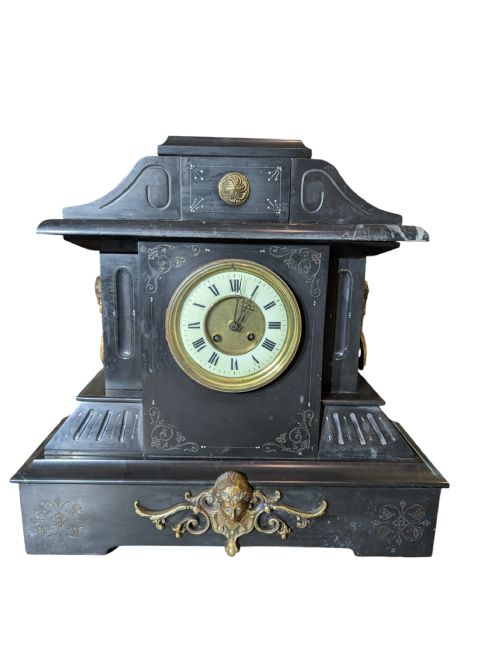


Marble Mantle Clock
When you search for a marble mantle clock, you are looking at substantial timepieces of weight and presence designed to anchor a room.
Marble Mantle Clock
A marble mantle clock is a heavy domestic timepiece designed to stand upon a fireplace shelf or sideboard, utilising dense stone to create a substantial architectural presence. The pieces seen here span from the 19th century through the Victorian era and into the Art Deco period, incorporating French workshops and British retailers alike.
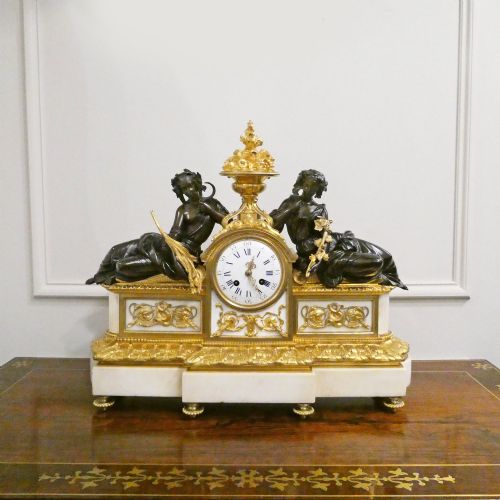
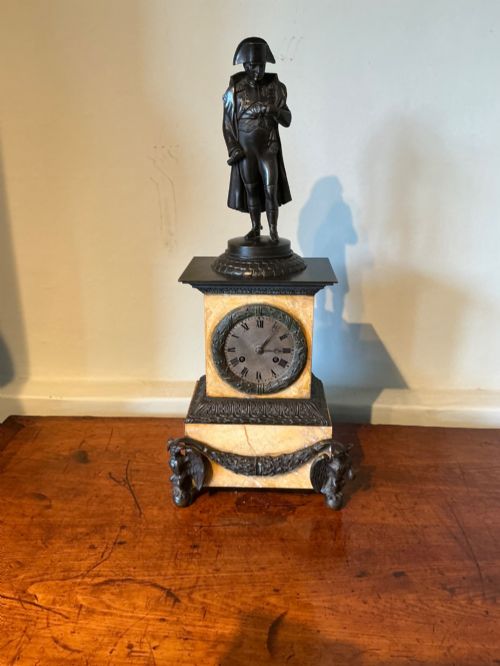
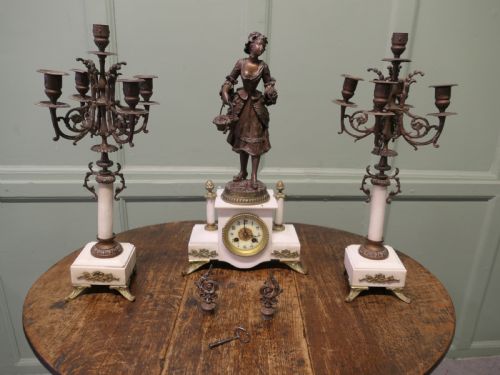
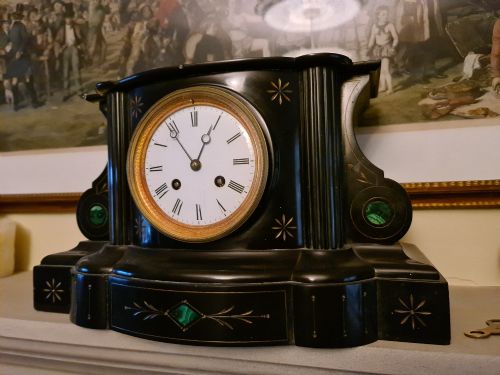
The most common examples on this page are Victorian block marble or slate clocks, often housing eight-day striking movements alongside classical or architectural garnitures. You will also encounter French mantel clocks featuring bronze figures, ormolu mounts, and specialised designs such as portico clocks, drum heads, and matching garniture sets.
Later expressions shift into the 1930s with Art Deco marble and chrome designs, sometimes integrating onyx, panthers, or modernist geometric lines. Whether austere black slate or variegated sienna marble, these objects combine mechanical timekeeping with sculptural display.
Materials and construction
The primary material is heavy stone, specifically black slate, white marble, sienna marble, and green onyx, shaped into substantial architectural blocks or drum heads. These stone housings are frequently fitted with inlaid panels of contrasting marble, brass bezels, and glazed dials featuring enamel chapters.
Metal ornamentation plays a major role, utilising cast bronze, brass, ormolu, and spelter to create figures, feet, handles, and garniture candelabras. Movements are mechanical, predominantly eight-day striking systems driven by springs, often signed by French and British makers on the backplate.
Listings feature marble alongside slate, brass, glass, enamel, gilt bronze, and ormolu across the Victorian and Art Deco periods.
Quality variations
Quality in a marble mantle clock rests in the ambition of the stone cutting and the integration of the metal mounts. Better examples feature crisp, finely chiseled ormolu, robust heavy marble cases without clumsy repairs, and signed movements by known makers.
The presence of matching side pieces, known as clock garnitures or candelabras, elevates a piece from a simple timekeeper to a grand garniture set. Simpler drum head clocks rely on the natural figuring of the marble and the clarity of the enamel dial rather than elaborate bronze sculpture.
Vincenti·Philippes Paris·Baby and Jannings·Guilmet·Achille Brocot·Auguste Moreau·P L Hausburg Paris·Swinden Birmingham
The Marble Mantle Clock Glossary
- Garniture
- A set of matching decorative ornaments, typically a central clock accompanied by side pieces such as urns or candelabras.
- Ormolu
- Gilt bronze decoration applied to furniture and clocks, created through a mercury gilding process.
- Portico clock
- A mantel clock styled like a classical temple with supporting columns, popular in the French Empire and Directoire periods.
- Spelter
- A zinc alloy commonly used as a less expensive substitute for bronze in casting figural clock mounts.
- Drum head
- A clock design where the dial housing takes the distinct shape of a circular drum resting upon a stone base.
Marble Mantle Clock: Frequently Asked Questions
What is a clock garniture?
A clock garniture is a matched set consisting of a central mantel clock flanked by two matching decorative pieces, such as urns, vases, or candelabras.
These sets were designed to sit symmetrically on a fireplace mantel or sideboard as a unified decorative scheme.
How do I tell Victorian marble clocks from Art Deco ones?
Victorian marble clocks tend to feature heavy architectural shapes, classical revival details, incised gilt patterns, and contrasting stone inlays. Art Deco models from the 1920s and 1930s adopt modernist geometric lines, stepped cases, and chrome or exotic animal figures.
The materials also shift, with earlier pieces relying heavily on black slate and sienna marble, while later ones incorporate green onyx and streamlined metals.
Were these clocks made in France or Britain?
A large proportion of these marble and bronze clocks originate from French workshops and Parisian makers, often featuring eight-day striking movements imported by British retailers or signed directly on the bronze.
At the same time, many pieces reflect Victorian production in Britain, utilising imported continental stone combined with local movement assembly.
What is an eight day movement?
An eight day movement is a mechanical clockwork system that requires winding only once every eight days.
This was a standard convenience for domestic mantel clocks, driven by mainsprings housed within the movement plates.