


Victorian Loch Oil Painting
A Victorian loch oil painting captures the dramatic light and weathered beauty of Scottish waters.
Victorian Loch Oil Painting
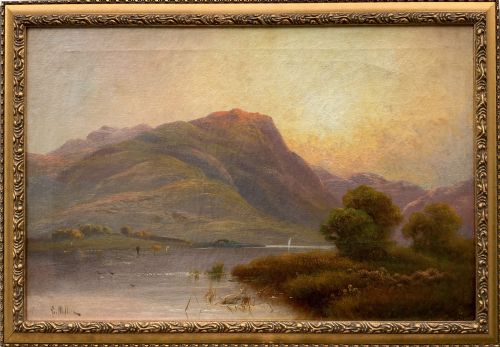
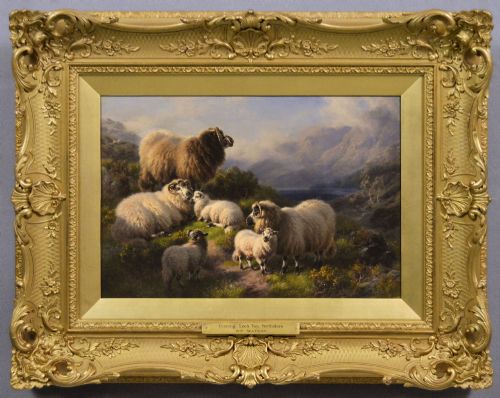
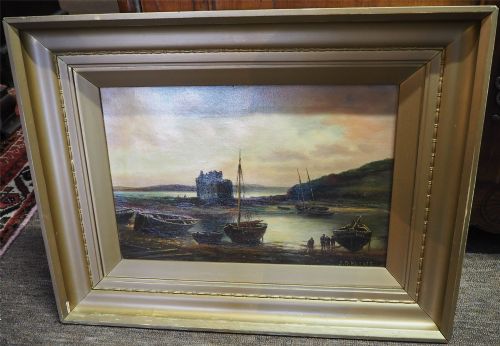
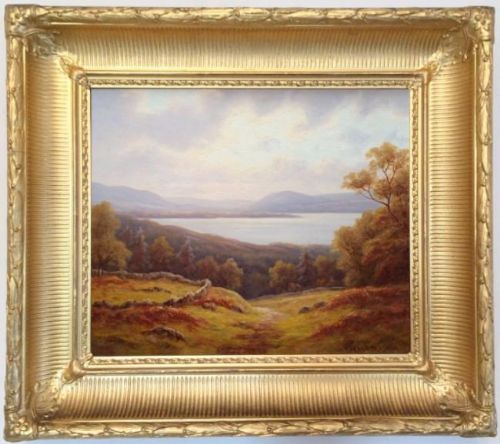
A victorian loch oil painting depicts the mountainous lake scenery of Scotland, frequently featuring highland cattle, sheep, or solitary bothies along the shoreline. These works emerge primarily from the nineteenth century, spanning periods from eighteen eighty to nineteen hundred, alongside Edwardian examples.
The compositions on this page lean heavily towards Scottish landscape realism and nineteenth century British realism. Buyers encounter named artists such as William Watson Jnr, Henry Robinson Hall, and Alfred de Breanski Snr, whose canvases focus on atmospheric morning mists and sunset views over waters like Loch Tay, Loch Lomond, and Loch Etive.
Judging Quality
Quality rests upon the handling of light and atmosphere across the water and the surrounding peaks, distinguishing skilled artists from routine studio output. The depth of the landscape, the naturalism of cattle and figures, and the preservation of the original giltwood and gesso frame all elevate a piece.
Works by established named painters demonstrate superior control of pigment and perspective compared to anonymous or derivative pictures. The harmony between the canvas and its period frame indicates the overall care the object has received across generations.
Highland cattle stare from misty shores with a stoic patience that survived every artistic movement.
William Watson Jnr·Henry Robinson Hall·Everett Watson Mellor·Henry Hillier Parker·Frank Hider·Daniel Sherrin·Alfred de Breanski Snr·George Cole·Gustave De Breanski·E. M. Seaton·F. E. Jamieson·F W Bartholomew
The Victorian Loch Oil Painting Glossary
- Oil on Canvas
- Pigments bound in a drying oil, typically linseed, applied to a woven fabric support stretched over a wooden frame. This medium allows for rich blending and deep tonal graduation.
- Gesso
- A plaster mixture applied to wooden frames as a smooth base for subsequent gilding. It provides the crisp relief work found on period frames.
- Giltwood
- Timber carved and coated with gold leaf or metallic powder. It forms the traditional ornate framing for nineteenth-century fine art.
- Bothy
- A small stone shelter or cottage found in remote highland landscapes. These structures frequently appear in nineteenth-century Scottish views as focal points.
- Realism
- An artistic movement focused on depicting subjects truthfully without artificiality. In these paintings, it manifests in accurate rendering of highland topography and weather.
Victorian Loch Oil Painting: Frequently Asked Questions
What subjects appear in these paintings?
The canvases predominantly depict Scottish highland lochs surrounded by mountains, often populated with grazing cattle or sheep.
Scenes also incorporate elements like coastal bothies, sunrise mists, and moonlight reflections upon the water.
How do I identify the period?
Dating relies on stylistic markers of nineteenth-century realism, frame construction methods, and artist signatures or archival records.
Victorian works typically display detailed brushwork and original giltwood frames characteristic of the later eighteen hundreds.
Are the frames original?
Many pieces retain their period wooden frames adorned with gesso and gold leaf, which match the age of the canvas.
The condition of the gilding and the fit of the stretcher frame provide clues to the history of the piece.
Where were these artists active?
Painters travelled extensively through the Scottish Highlands to record specific locations such as Loch Tay, Loch Lomond, and Loch Etive.
Their studios produced finished works based on field sketches captured during these highland expeditions.
How should I hang an oil painting?
These heavy framed canvases require secure wall fixings suited to the combined weight of wood, gesso, and stretched canvas.
Positioning should avoid direct sunlight and rapid temperature shifts to protect the oil paint and canvas substrate.