
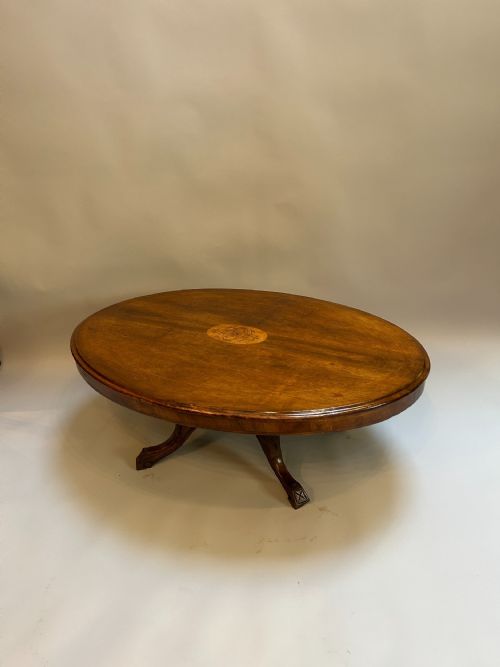


Victorian Inlaid Low Table
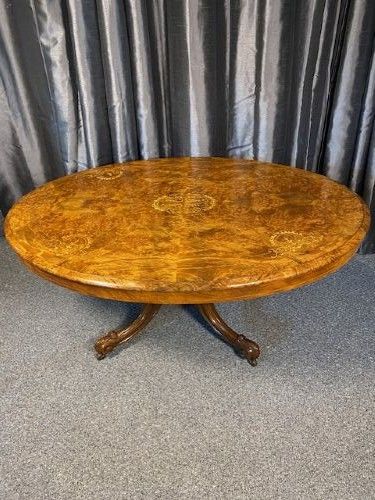
A victorian inlaid low table brings warmth and rich timber grain to a room, offering a low surface with decorative marquetry.
Victorian Inlaid Low Table
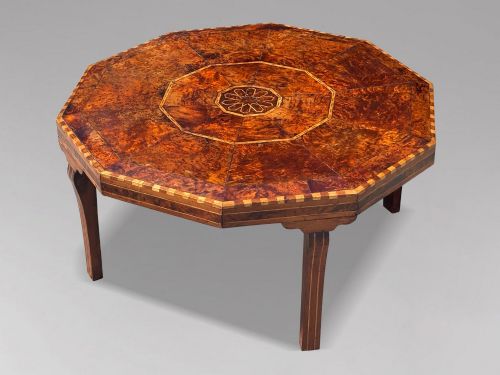
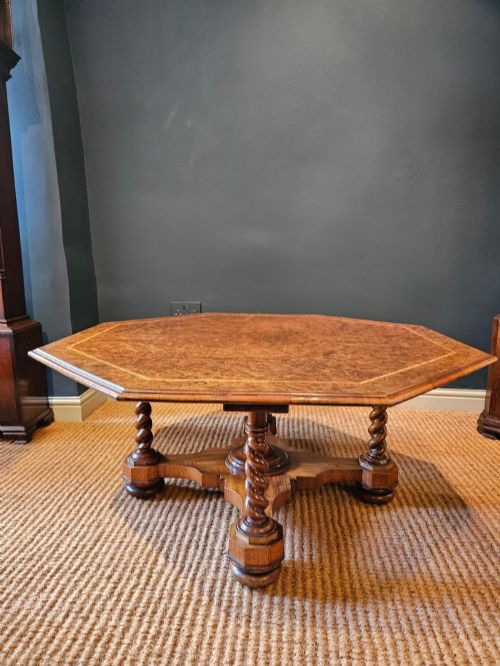
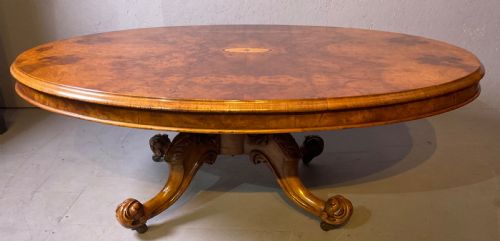
A victorian inlaid low table typically takes the form of a coffee table or a low centre table, often adapted from earlier heights or built low for nineteenth-century reception rooms. You will most frequently encounter walnut, burr walnut, and rosewood examples bearing intricate marquetry and boxwood details.
The forms span octagonal, round, and rectangular shapes, frequently set upon carved bases or fitted with castors for ease of movement. Many pieces date from the mid-nineteenth century, around eighteen-sixty to eighteen-eighty, reflecting Victorian and Sheraton Revival tastes.
While most listings comprise coffee tables, variations include games tables and occasional low tables with detailed wood inlay. The combination of figured timbers and contrasting boxwood stringing defines the visual character of these low tables.
How they were made
Cabinet makers utilised choice veneers such as burr walnut, burr yew, figured walnut, and satinwood over solid secondary timbers to create rich, patterned top surfaces. These figured veneers were selected for their natural grain movement and book-matched symmetry.
Wood inlay and marquetry employed contrasting species, notably boxwood, cut precisely and set flush into the primary timber to form geometric or floral motifs. Hand-carving was applied to the walnut and rosewood bases, supporting the heavier tops often fitted with brass castors.
Some nineteenth-century tables cleverly doubled as games boards, hiding leisure beneath the tea things.
What varies in quality
The standard of a victorian inlaid low table rests heavily on the choice of timber figure and the precision of the marquetry. Superior examples display dense, highly figured burr walnut or satinwood with crisp, tightly fitted boxwood inlay rather than painted or superficial decoration.
Construction details also separate workshop tiers, seen in the depth of hand-carving on the base and the integration of substantial timber framing. Pieces bearing documented maker attribution or refined proportions command greater appreciation among collectors.
Edwards and Roberts·Gillows
The Victorian Inlaid Low Table Glossary
- Marquetry
- Decorative wood inlay forming pictorial or geometric patterns. It uses thin veneers of various coloured timbers fitted together precisely.
- Burr Walnut
- Timber taken from a growth on a walnut tree, yielding a swirling, highly figured grain pattern. Cabinet makers prize it for tabletops.
- Boxwood
- A dense, pale yellow wood frequently used for contrasting stringing and fine inlay work. It highlights the darker surrounding veneers.
- Castors
- Small wheel attachments fitted to the feet of heavy tables. They allowed nineteenth-century furniture to be moved easily across carpets.
- Sheraton Revival
- A late nineteenth-century design movement inspired by eighteenth-century neoclassical furniture. It favours satinwood, delicate inlay, and refined proportions.
Victorian Inlaid Low Table: Frequently Asked Questions
What is a victorian inlaid low table?
A victorian inlaid low table is a nineteenth-century surface featuring decorative marquetry, typically constructed from walnut, rosewood, or satinwood.
These pieces were made in various shapes including round, octagonal, and rectangular forms, often resting on carved wooden bases with castors.
How were these low tables used?
Original nineteenth-century low tables served various functions in reception and drawing rooms, ranging from tea and coffee service to games.
Many examples found today function as central coffee tables in contemporary sitting rooms, combining period character with low proportions.
How do I date a victorian inlaid low table?
Dating relies on timber choice, construction methods, and stylistic cues such as Victorian Revival or Sheraton Revival influences.
Evidence from the period points toward dates spanning the mid to late nineteenth century, notably between eighteen-sixty and eighteen-eighty.
How do I care for burr walnut and marquetry?
Burr walnut and inlaid surfaces require stable indoor humidity away from direct sunlight and heat sources to prevent veneer lifting.
Regular dusting with a soft, dry cloth maintains the polished finish without risking moisture damage to the delicate boxwood stringing.