
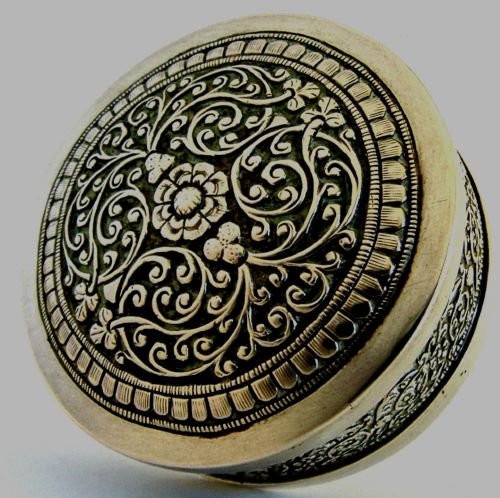
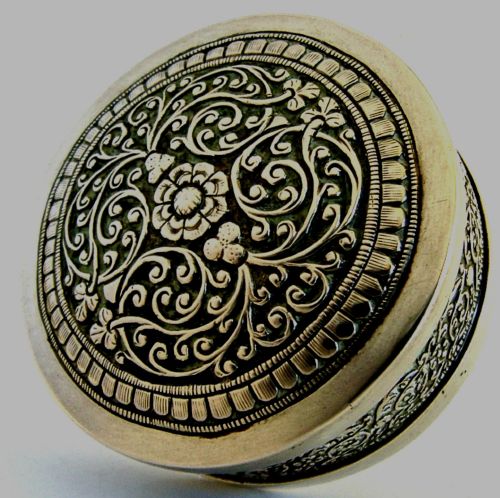
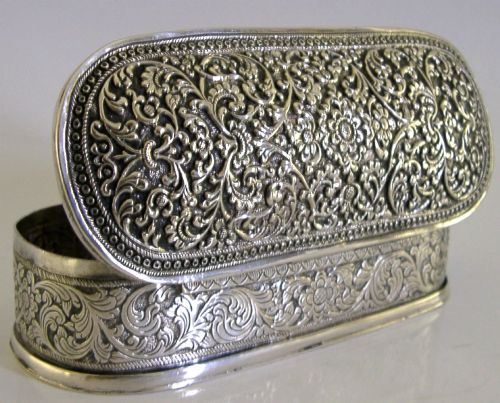


Victorian Indian Trinket Box
These Victorian Indian trinket box examples bring intricate colonial craftsmanship straight to a dressing table, offering small-scale storage with deep historical resonance.
Victorian Indian Trinket Box
A victorian indian trinket box represents a fascinating crossover of British utility and subcontinent artistry, typically appearing in forms designed for desktop use or personal adornment. The items gathered here span the nineteenth century, taking shape as small chests, workboxes, and dedicated trinket holders.
Beyond standard timber construction, certain examples incorporate solid silver jars or feature distinctive porcupine quill work and mosaic patterns. These portable containers served both domestic and travel purposes, aligning with Victorian campaign styles or stationary desk arrangements.
How they were made
Makers utilised exotic timbers such as ebony, teak, and sandalwood as the foundational structure for these containers, shaping the dense woods to withstand intricate carving and inlay. These natural materials provided a stable canvas for the detailed ornamentation characteristic of nineteenth-century workshops.
Surface embellishment relied heavily on specialised regional techniques, including Sadeli mosaic work involving micro-mosaics of bone and horn, alongside delicate porcupine quill arrangement. Metal elements were formed from solid silver, while other pieces received deep relief carving directly into the timber body.
Porcupine quills make an unexpected appearance as decorative box veneer.
What varies in quality
The precision of the surface inlay and the complexity of the carved motifs dictate the upper tiers of quality, where individual mosaic tiles remain tight and uniform. Simpler constructions rely solely on the natural grain of woods like teak or sandalwood without supplementary embellishment.
Condition of the delicate quill work and the integrity of internal compartments also separate standard examples from superior survivals. Boxes retaining their original fitted interiors and secure silver components demonstrate greater fidelity to their original workshop output.
The Victorian Indian Trinket Box Glossary
- Sadeli mosaic
- A complex form of micro-mosaic ornamentation utilising tiny geometric pieces of bone, horn, and metal to create intricate patterns on wooden boxes. This technique requires immense patience and specialist skill.
- Porcupine quill work
- Surface decoration utilising trimmed quills arranged in geometric bands, characteristic of Ceylonese nineteenth-century production. It creates a striking striped texture across the lid and sides.
- Campaign trunk
- A portable storage form engineered with brass corners and recessed handles for military transport. Miniature versions appear among nineteenth-century Anglo-Indian items.
- Coromandel
- A dense, heavy tropical timber featuring dark brown or black grain with lighter streaks, prized for high-end nineteenth-century workboxes. It takes a high polish and provides a stable base for fine inlay.
Victorian Indian Trinket Box: Frequently Asked Questions
What are Victorian Indian trinket boxes made from?
These boxes are constructed from regional timbers such as sandalwood, teak, ebony, and coromandel, frequently decorated with bone, horn, and solid silver.
Workshop methods varied across regions like Ceylon, Kashmir, and South India, resulting in diverse material combinations within the nineteenth-century group.
How do I care for a sandalwood box?
Keep the timber away from direct sunlight and fluctuating humidity to prevent the natural oils from drying out and the wood from splitting.
Avoid using modern liquid polishes, as these can damage delicate mosaic inlays and soften the carved surface details.
What is Sadeli mosaic work?
Sadeli is a micro-mosaic technique involving geometric arrangements of minute pieces of bone, horn, and metal applied to wooden surfaces.
Craftsmen assembled these tiny fragments into long rods before slicing them to create repeating decorative bands on boxes.
How do I distinguish regional styles?
Ceylonese pieces often feature distinctive porcupine quill patterns, while Kashmiri items typically display painted or papier-mâché finishes.
South Indian and Anglo-Indian workshops leaned heavily toward deep relief carving and complex mosaic inlay on dense hardwoods.