

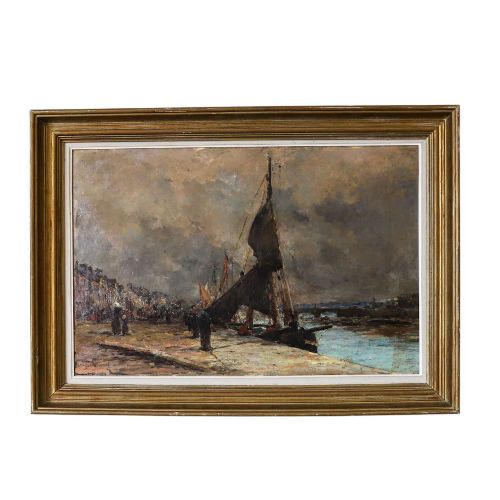


Victorian Harbour Landscape
When you search for a victorian harbour landscape, you find coastal and river scenes rendered in oil and watercolour during the nineteenth and early twentieth centuries.
Victorian Harbour Landscape
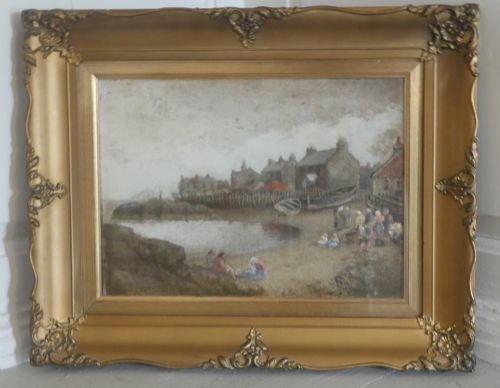
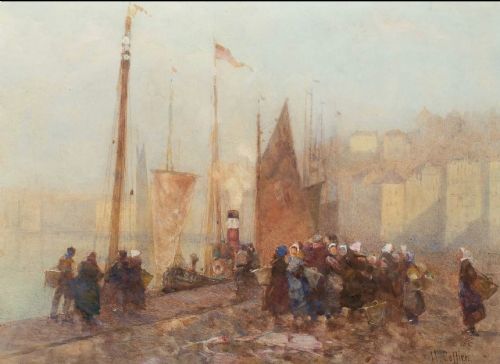
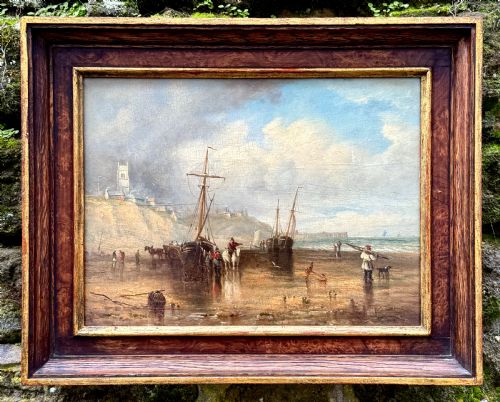
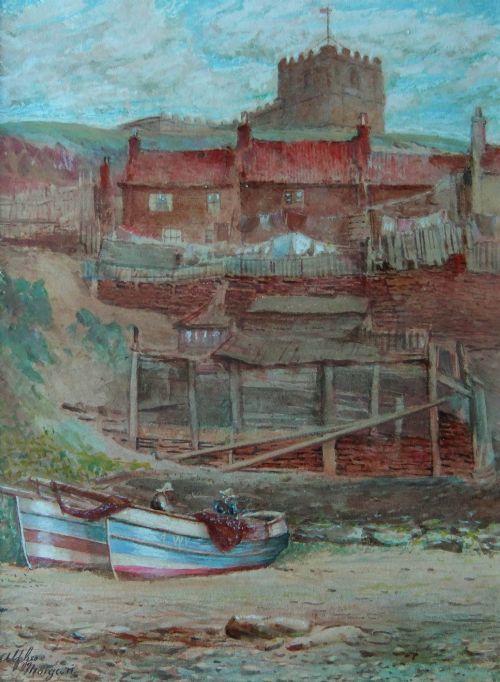
A victorian harbour landscape captures maritime activity, coastal towns, and river views from the nineteenth and early twentieth centuries. The selection includes oil on canvas and watercolour paintings set in giltwood frames, depicting locations from British ports to continental waters.
Most examples date from the Victorian period through to the Edwardian era, showing bustling quaysides, moored sailing vessels, and tidal estuaries. Artists record specific sites such as Whitby, St Ives, the River Thames, and foreign harbours like Venice and Boulogne.
The objects take the form of framed wall art, ranging from intimate watercolours on paper to large oil paintings. These works document the maritime commerce, fishing fleets, and coastal architecture of the era through realist and impressionist approaches.
How they were made
Painters utilised oil paint on canvas or watercolour applied to paper, mounted within wooden and giltwood frames. Some watercolours are preserved behind glass within hand enamelled polychrome frames.
Pigments were handled either with the rich layering characteristic of nineteenth-century oil painting or the translucent washes typical of British watercolour traditions. Canvases are stretched over wooden supports, while watercolours rely on paper sheets prepared for pigment absorption.
Listings span the nineteenth and early twentieth centuries, featuring paper, oil on canvas, and giltwood materials across various maritime styles.
What varies in quality
The calibre of a victorian harbour landscape depends on the artist's handling of light, atmosphere, and maritime detail. Works by established painters demonstrate a secure command of perspective, architectural precision, and the movement of water.
The quality of the surrounding frame, particularly original giltwood or decorative surrounds, contributes to the overall integrity of the piece. Finer examples capture the specific atmospheric conditions of dawn, dusk, or moonlight with considered brushwork and tonal harmony.
Edward Mills·William Banks Fortescue·Hector Caffieri·Thomas Creswick·Alfred G. Morgan·Charles William Wyllie·William Edward Webb·Stanley Leader·T.S. Wallis·James Webb·James Thomas Watts·Kate E Booth·Jan van Couver·William Wyld·Alfred Henry Vickers·Gustave de Breanski·Frank Wasley·Harry Wanless·Edward Henry Holder·Thomas Clavering Alder·William Langley·Jane Vivian·Lennard Lewis·Charles Euphrasie Kuwasseg·Robert Anderson
The Victorian Harbour Landscape Glossary
- Oil on canvas
- Pigment mixed with drying oil applied to a woven fabric stretched across a wooden frame. This medium allowed artists to build rich textures and deep tonal ranges.
- Watercolour
- Pigments suspended in a water-soluble vehicle applied to paper. It permits delicate washes and luminous effects well suited to coastal light.
- Giltwood
- Wood carved and coated with a thin layer of gold leaf or gilt finish. Frames of this material were designed to complement and protect the painting within.
- Seascape
- A work of art depicting the sea, coastal views, ships, or maritime activity. These compositions often focus on tidal changes and shipping traffic.
- Impressionism
- A style of painting that focuses on capturing the visual impression of a moment, paying attention to shifting light and unblended brushstrokes.
Victorian Harbour Landscape: Frequently Asked Questions
Where were these harbour scenes painted?
Artists recorded scenes across British coastal towns such as Whitby and St Ives, alongside London river views and continental ports like Venice and Boulogne.
These locations reflected the bustling maritime trade and fishing industries of the nineteenth century.
How should I display an oil painting?
Hang your painting away from direct sunlight and damp environments to protect the canvas and original wooden frame.
Ensure the wall fixings can support the weight of the heavier giltwood frames often found on these works.
What is the difference between oil and watercolour?
Oil paintings utilise pigment bound in drying oil on canvas, offering rich textures and deep tones. Watercolours use water-soluble pigments on paper, creating translucent effects.
Watercolours require protection behind glass, while oil canvases are displayed open to the room.
How do I identify the period of a painting?
Examine the materials, stretcher frames, and stylistic markers such as Victorian maritime realism or early impressionism. Signatures, dates in the titles, and framing techniques also help confirm the era.
Documentation on the reverse or historical dealer labels can provide further context for dating.