

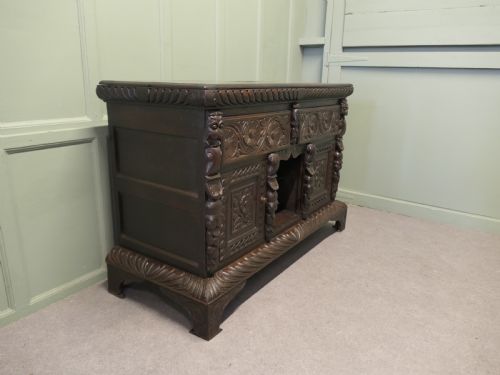


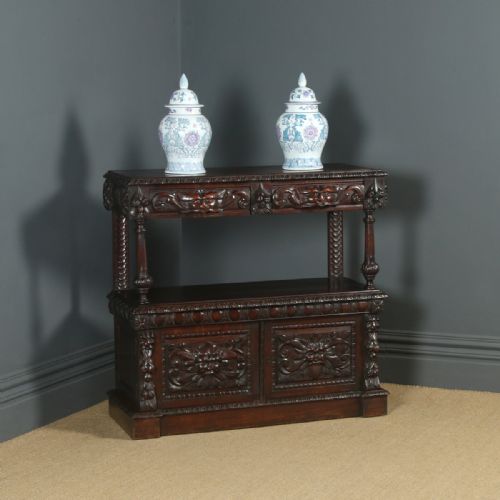


Victorian Green Man Sideboard
A victorian green man sideboard brings imposing architectural presence and folkloric carved detail into a dining room.
Victorian Green Man Sideboard
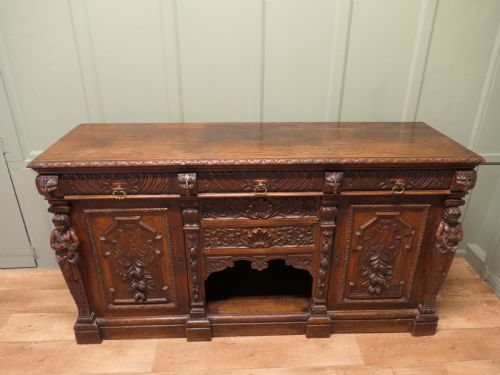
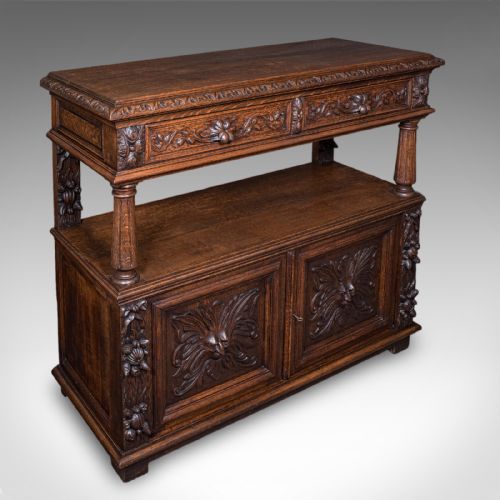
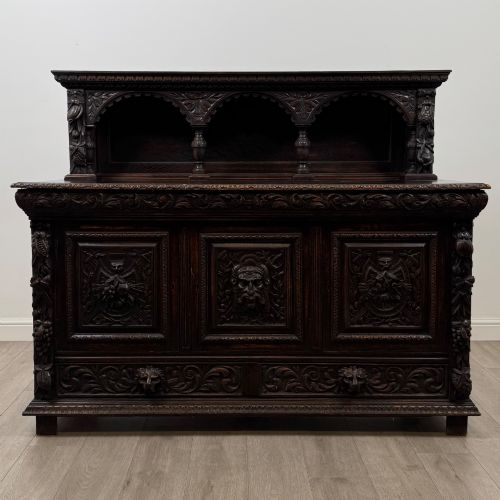
A victorian green man sideboard is a substantial dining room furnishing defined by deeply carved foliate mask imagery. These pieces span the nineteenth century, with particular concentration in the decades around eighteen eighty.
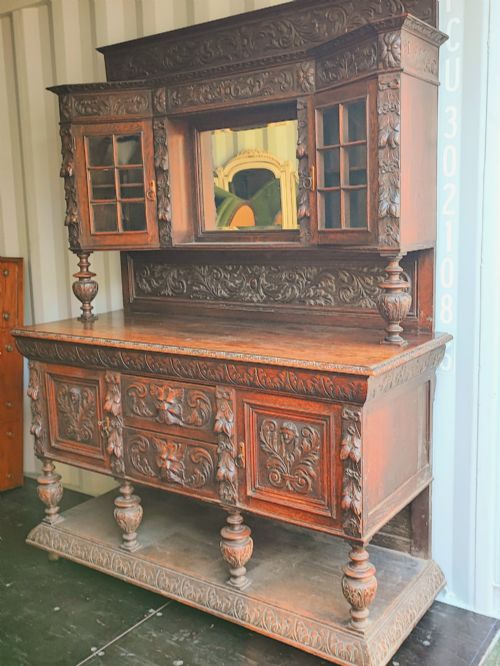
Forms range from large servers and buffets to dresser bases and side cupboards. Oak serves as the primary structural and carving material across nearly every example recorded in this inventory.
Stylistic influences lean heavily into Gothic revival, Renaissance revival, and Jacobean revival aesthetics. Carvings frequently incorporate lion masks alongside the central green man motif.
How they were made
Construction relies upon solid oak timbers chosen for their capacity to take deep, sculptural carving. Joinery methods include heavy framing and panel construction to support massive proportions.
Surface ornamentation is achieved through manual chiselling to create high-relief foliage and expressive faces. Brass hardware and bevelled glass mirrors appear selectively as secondary functional and decorative elements.
Several Victorian pieces in the archive are specifically noted as pussy oak alongside their green man carvings.
What varies in quality
Proportion and timber selection also determine standing. Dense, figured oak and balanced architectural composition elevate certain sideboards well above standard utility furniture.
The Victorian Green Man Sideboard Glossary
- Green man
- A sculptural architectural motif depicting a human face emerging from or entwined with foliage. It symbolises rebirth and spring in traditional folk ornamentation.
- Gothic revival
- An architectural and decorative style drawing inspiration from medieval design. It employs pointed arches, heavy mouldings, and structural solemnity.
- Dresser base
- The lower section of a traditional dresser, constructed as a low sideboard with cupboards or drawers. It provides substantial surface and storage capacity.
- Bevelled glass
- Glass with edges cut and polished at an angle to catch the light. This technique adds decorative refinement to mirror plates inset within sideboard superstructures.
Victorian Green Man Sideboard: Frequently Asked Questions
Where did they place sideboards?
These pieces traditionally stood against the dining room wall to hold serving dishes and silverware during meals.
They also functioned as display surfaces for decorative ceramics and glassware in formal Victorian households.
How do I care for oak?
Keep the timber away from direct heat sources and sudden humidity shifts to prevent wood movement and splitting.
Feed the surface periodically with traditional beeswax to maintain the grain depth and natural lustre.
Are all green man carvings old?
Authentic examples date from the Victorian period, utilising period construction techniques and mature oak timber.
Later revivals and marriages of old panels exist, requiring close inspection of joint work and timber oxidation.
What styles accompany them?
These sideboards frequently incorporate Gothic revival, Jacobean revival, and Renaissance revival design vocabulary.
Carvers mixed these influences freely, often combining foliate masks with lion masks and strapwork.