
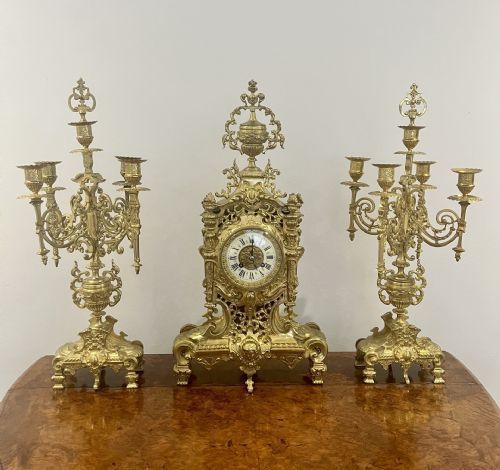

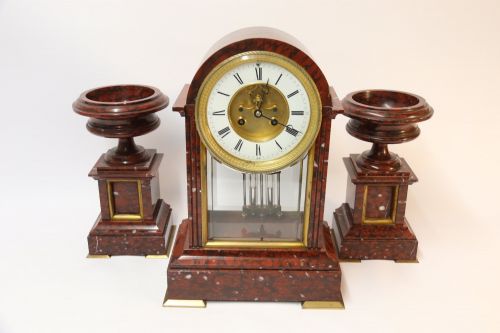


Victorian French Clock Set
A victorian french clock set brings striking architectural presence and precise timekeeping to a mantelpiece, combining a central clock with matching garnitures.
Victorian French Clock Set
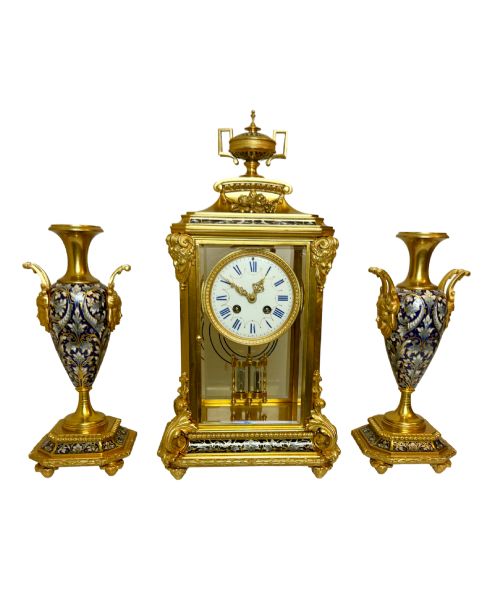
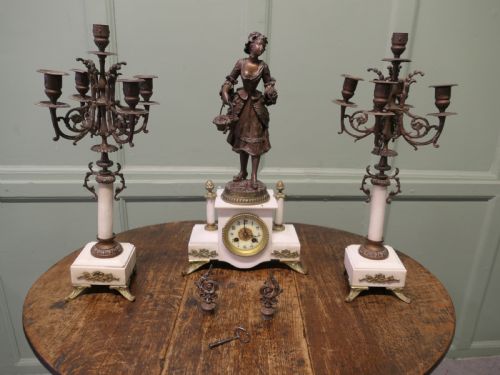
A victorian french clock set typically consists of a central mantel clock accompanied by a matching pair of side garnitures, such as candelabras, urns or vases. These three-piece ensembles originate from 19th-century workshops and share unified decorative motifs across all components.
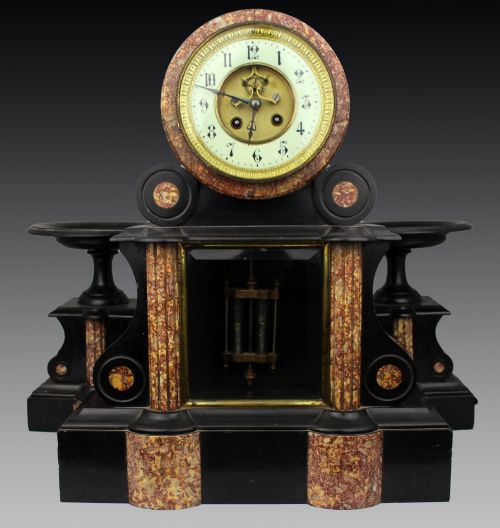
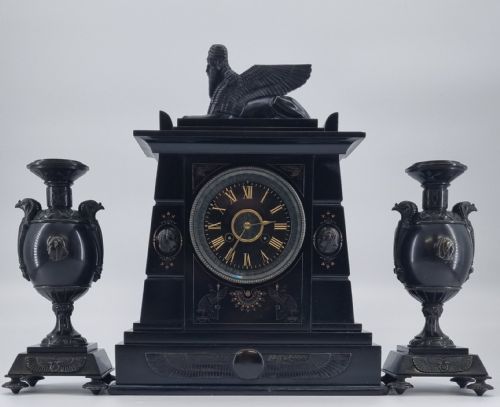
The most common variations on this page include marble and black slate bodies paired with gilt bronze mounts, alongside porcelain-faced designs. Architectural forms and classical revivals dominate the selection, often reflecting Rococo, Second Empire or Napoleon III styles.
Materials and construction
Maker workshops utilised dense stones like black slate, marble and onyx for the structural bodies, shaping them into substantial architectural cases. These heavy mineral bases were then fitted with mechanical brass movements designed for reliable eight-day timekeeping.
Surface ornamentation relied heavily on cast ormolu, gilt bronze, and champleve or cloisonne enamel work. Porcelain panels, frequently executed in Sevres or Meissen styles, were integrated alongside hand-painted glass components to complete the decorative scheme.
Listings feature materials spanning gilt bronze, champleve enamel, porcelain, marble, and black slate across the nineteenth century.
Distinctions in quality
The hierarchy of quality rests on the crispness of the bronze casting and the depth of the gilding across the mounts. Superior sets display finely hand-chiseled details and substantial weight, whereas lesser examples rely on simpler, factory-cast finishing.
Signed movements by known makers and complex dial work, such as penny moon phases, elevate a piece above standard production. The integration of high-grade porcelain panels and harmonious matching garnitures further separates premier items from basic configurations.
Japy Freres·Samuel Marti·A.D Mougin·KPM Berlin·Raingo Fres Paris
The Victorian French Clock Set Glossary
- Garniture
- A set of matching decorative objects, usually comprising a central clock flanked by two matching vases or candelabras to form a balanced mantel display.
- Ormolu
- Finely ground high-carat gold applied to a bronze base using a mercury-gilding technique, producing a rich metallic lustre.
- Champleve
- An enamelling technique where troughs are scooped out of a metal surface and filled with vitreous enamel before firing.
- Slate
- A fine-grained metamorphic rock utilised extensively for heavy, durable clock bodies during the nineteenth century.
- Escapement
- The internal mechanical linkage that regulates the release of power in a clock movement to ensure steady timekeeping.
Victorian French Clock Set: Frequently Asked Questions
How do I wind my clock?
Most mechanical clocks from this era utilise an eight-day movement requiring a winding key inserted into specific dial holes. Turn the key gently until you feel resistance, ensuring you do not overwind the internal springs.
If the clock has a pendulum, ensure it hangs freely and the case stands completely level on the mantelpiece. Regular gentle winding keeps the movement tension even and maintains accurate timekeeping.
Where should I place a heavy marble clock?
Heavy marble and slate clocks require a sturdy, level surface capable of supporting substantial weight without sagging. A robust mantelpiece or a dedicated console table provides the ideal stable foundation.
Avoid placing these dense stone pieces near direct heat sources or damp areas, as fluctuating room temperatures can affect the internal brass mechanism. Ensuring a vibration-free location protects both the delicate escapement and the stone case.
How do I identify a 19th-century French clock?
Nineteenth-century French clocks typically feature cast brass movements stamped with maker marks, serial numbers or foundry medals on the backplate. The case materials, such as Ormolu-mounted marble, slate, or gilt bronze, reflect characteristic period revival styles.
Examining the dial construction, hand-painted enamel numbers, and overall casting quality helps confirm the nineteenth-century origin. Signed dials and matching numbered garniture components provide further confirmation of authenticity.