


Gilt Bronze Candelabra Clock
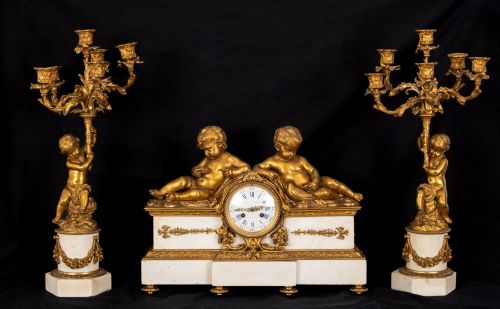
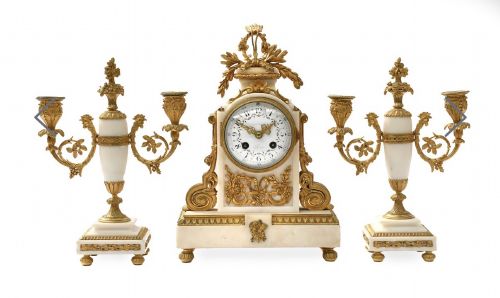
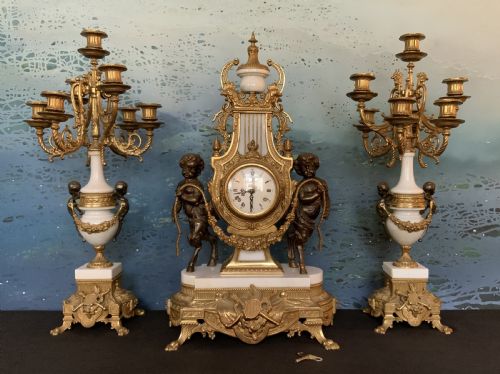
These gilt bronze candelabra clock sets combine timekeeping with matching ornamental lights, dominating a mantelpiece with heavy metalwork and marble.
Gilt Bronze Candelabra Clock
A gilt bronze candelabra clock search brings up monumental three-piece sets designed for central placement on a salon or parlour mantelpiece. These groupings typically comprise a central clock flanked by matching candelabras, creating a unified decorative scheme for grand interiors.
The objects stem predominantly from the nineteenth century, reflecting French tastes in periods spanning Louis XVI revival, Empire, and Second Empire styles. Buyers encounter combinations of bronze, marble, and porcelain structured as complete garniture sets rather than standalone timepieces.
The primary forms balance height and mass, incorporating cherubs, classical motifs, and porcelain panels alongside functional eight-day striking movements. Such pieces served both practical timekeeping and high-status display within nineteenth-century domestic architecture.
Materials and Construction
Maker workshops cast components in bronze, applying mercury gilt or ormolu finishes to create brilliant golden surfaces that contrast with patinated dark bronze elements. Artisans combined these metals with carved white, red, or onyx marble bases and columns.
Many items integrate ceramic elements, utilising Sevres style porcelain, Imari porcelain, and enamel dials inscribed with numerals. Complex sets brought together glass domes, brass movements, and intricate cast metal candelabra branches holding multiple candles.
Listings feature nineteenth-century French and Italian works combining gilt bronze, ormolu, marble, enamel, and porcelain.
Evaluating Execution and Scale
Quality reveals itself in the crispness of the bronze chasing and the depth of the gilding across the clock and its matching candelabras. Finer examples display meticulous hand-finishing on cast figures such as cherubs or classical deities, avoiding the soft edges found in later or lesser castings.
The choice and mass of supporting materials heavily influence distinction, separating standard brass-mounted timber from dense white or red marble fitted with porcelain plaques. Comprehensive sets retain their original matching components and undamaged glass domes, maintaining visual harmony across all three pieces.
Henry Dasson·H Luppens Paris·Raingo Fres Paris·AD Mougin Paris·Deniere Paris
The Gilt Bronze Candelabra Clock Glossary
- Garniture
- A matching set of ornamental objects designed for display together, typically comprising a central clock and two side candelabras or vases.
- Ormolu
- Finely ground high-carat gold mercury-gilded onto a bronze base, producing a durable golden lustre characteristic of luxury French metalwork.
- Patinated bronze
- Bronze treated with chemical solutions to darken the surface metal, creating contrast against gilt highlights on figural decorations.
- Eight-day movement
- A mechanical clock movement requiring winding roughly once a week, standard for reliable mantel clocks of the nineteenth century.
Gilt Bronze Candelabra Clock: Frequently Asked Questions
How do I place a three-piece set?
Position the central clock in the exact centre of the mantelpiece, flanked symmetrically by the two matching candelabras to maintain visual balance.
Ensure the supporting surface is sufficiently sturdy to bear the substantial weight of marble and bronze components.
What periods do these sets represent?
The majority date from the nineteenth century, spanning Victorian production and French revivals of Louis XVI and Empire styles.
Stylistic cues include classical urns, symmetry, and decorative mounts referencing eighteenth-century French royal courts.
Are these clocks suitable for daily use?
Most house an eight-day mechanical movement driven by a spring or pendulum, requiring professional setup and occasional servicing to keep accurate time.
Treat them primarily as decorative objects while enjoying their functional striking capabilities.
What distinguishes a garniture set?
A garniture set includes auxiliary items like candelabras or urns manufactured alongside the clock using identical materials and decorative motifs.
This unified design philosophy ensures the metal patination, marble colour, and sculptural style match across all three pieces.