



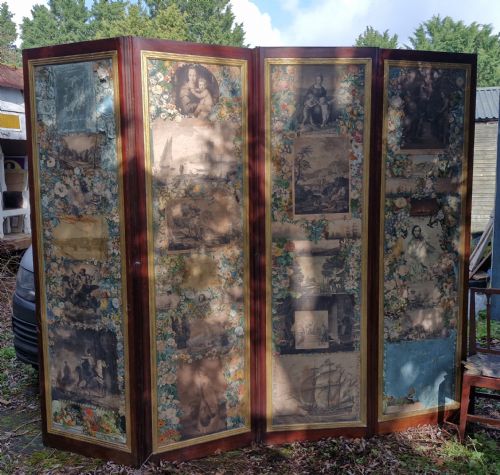


Victorian Four Panel Screen
These victorian four panel screen examples bring historic division and colour to a room, offering height and flexible privacy that modern partitions simply lack.
Victorian Four Panel Screen
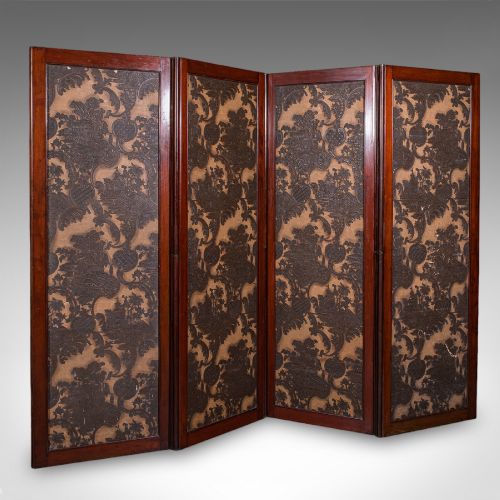
A victorian four panel screen is a folding room divider designed to partition spaces, block draughts, or create privacy in large rooms. These pieces appear in forms ranging from heavy mahogany and cast iron to lighter canvas, leather, and papier mâché.
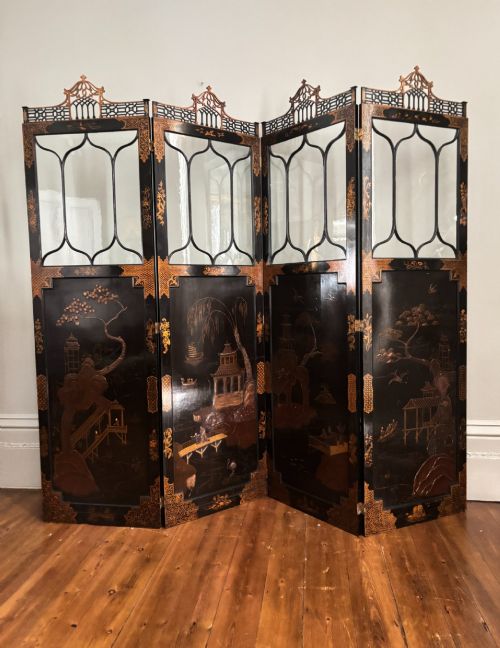
You are most likely to encounter fourfold examples on this page, often spanning large dimensions suitable for country houses or generous reception rooms. The selection includes Chinoiserie lacquered surfaces, needlepoint panels, scrap work, and photographic props.
How they were made
Makers utilised sturdy timbers such as mahogany and general wood for the foundational frames, hinged to allow folding across four sections. Iron and brass also feature heavily in architectural panels and folding fireguards.
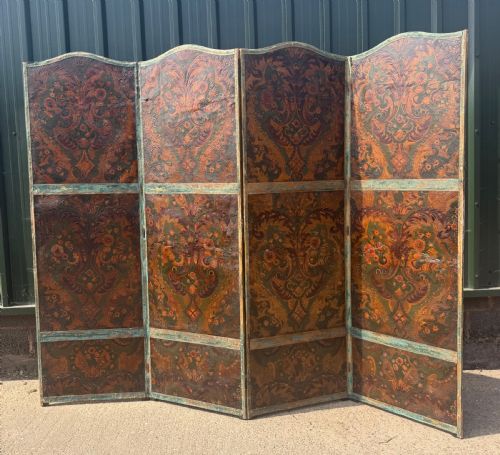
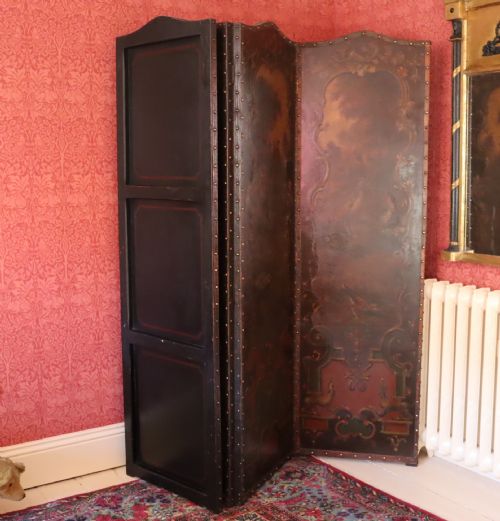
Surfaces were finished with diverse decorative techniques, including black lacquer, polychrome paintwork, needlepoint, silk cotton, and tooled leather. Papier mâché and canvas stretched over frames provided lightweight alternatives to solid timber.
Victorian Four Panel Screen Retail Price Guide 2026
Typical asking prices for victorian four panel screen among the pieces listed under this phrase on Sellingantiques today, from the lower quarter to the upper quarter. They describe what is for sale here now, not the wider market.
Periods represented span from the Regency era through the Victorian period and into Edwardian times.
What varies in quality
Quality rests in the execution of the surface decoration, whether that is intricate Chinoiserie lacquer, hand-worked needlepoint, or finely painted polychrome scenes. Lesser examples rely on plain timber or basic fabric without artistic depth.
The integrity of the hinges and the weight of the frame separate standard room dividers from grand country house screens. Substantial mahogany or heavy lacquered papier mâché indicates a higher grade of manufacture intended for prominent display.
The Victorian Four Panel Screen Glossary
- Chinoiserie
- European imitation of Chinese and East Asian artistic traditions. This style frequently appears in lacquered black finishes with gilt detailing.
- Scrap work
- A decorative technique involving the application of numerous printed paper scraps onto a surface. Victorian screens often feature this layered collage method.
- Papier mâché
- A composite material made of paper pulp or reinforced paper sheets pressed and lacquered. It provides a smooth, dark surface suited to detailed painting.
- Needlepoint
- Embroidery stitched on canvas mesh to form pictorial or geometric patterns. These textiles provide tactile panels within wooden folding frames.
Victorian Four Panel Screen: Frequently Asked Questions
How do I use a four panel screen at home?
These screens divide open-plan spaces, conceal storage areas, or block draughts near doorways and windows.
Position them folded slightly in a zig-zag pattern to ensure stability on the floor.
Are these screens heavy to move?
Weight depends entirely on the materials used in construction. Mahogany and cast iron frames require two people to relocate safely.
Canvas, silk cotton, and papier mâché versions are lighter and easily repositioned across rooms.
What is the difference between Chinoiserie and painted screens?
Chinoiserie screens specifically employ East Asian motifs, black lacquer, and gilt decoration popular in elite European interiors. General painted screens feature Dutch tooled leather styles, polychrome artwork, or photographic backdrops.
How do I care for antique leather and canvas panels?
Keep painted and leather surfaces away from direct sunlight and damp conditions to prevent cracking or warping. Dust gently with a dry cloth rather than using liquid cleaning products.