
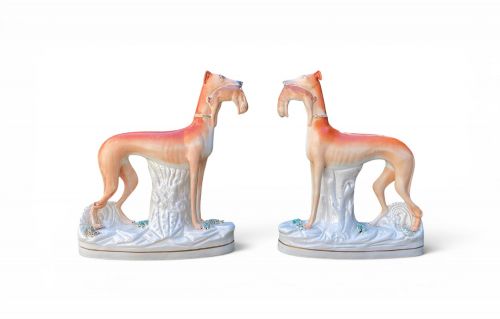


Victorian Earthenware Greyhounds
These Victorian earthenware greyhounds are enduring Staffordshire mantelpiece ornaments that bring instant nineteenth-century character to a room.
Victorian Earthenware Greyhounds
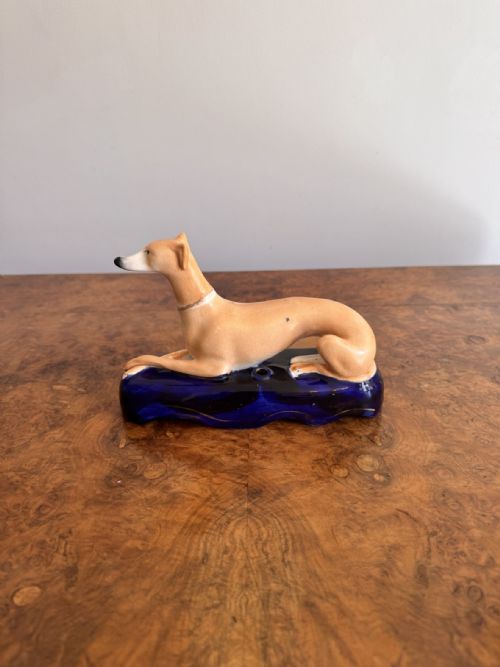
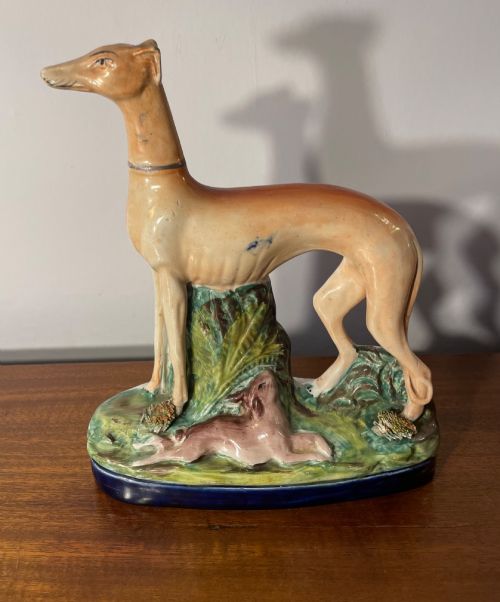
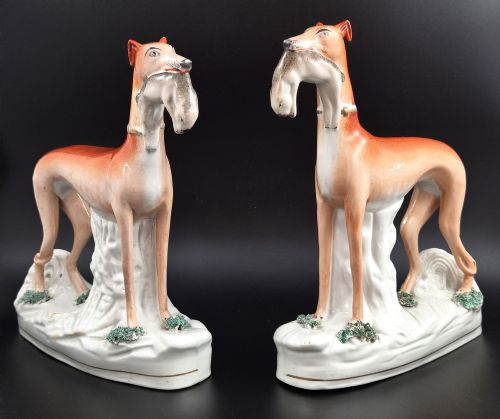
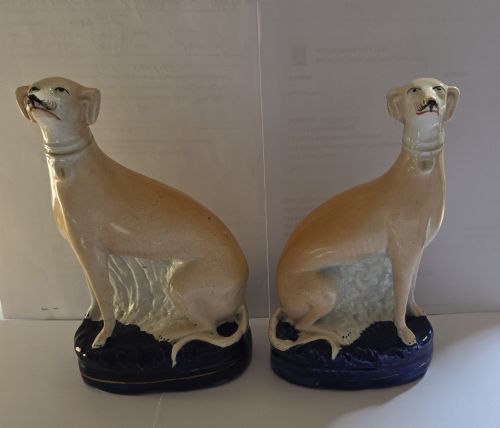
Victorian earthenware greyhounds are sculptural ceramic figures produced across the nineteenth century, most commonly encountered as decorative pairs seated upon glazed bases. These mantelpiece ornaments frequently incorporate hares or act as practical quill holders alongside standard decorative figurines.
The objects listed on this page span the Victorian era, utilising traditional earthenware pottery techniques originating from Staffordshire workshops. Collectors encounter both single figures and matched pairs, capturing the distinctive silhouette of the hound in various seated and recumbent poses.
Materials and construction
Makers formed the hollow bodies using pottery moulds typical of nineteenth-century Staffordshire production, producing sturdy decorative ornaments designed for domestic display.
Current listings exclusively feature nineteenth-century pieces incorporating earthenware, lead glaze, and enamel paint.
Assessing quality
Scale also distinguishes the range, as unusually large figures and matched pairs demand greater technical skill during the pottery firing process than smaller individual pieces.
Thomas Parr
The Victorian Earthenware Greyhounds Glossary
- Earthenware
- A porous pottery body fired at lower temperatures, standard for nineteenth-century Staffordshire figures. It requires a glaze to hold liquids and achieve a finished sheen.
- Lead glaze
- A shiny glass coating applied to pottery before firing that gives Victorian figures their characteristic smooth finish. This glaze protects the underlying enamel paint.
- Enamel paint
- Coloured glass paste applied over the fired glaze and fixed with a gentle secondary heat. It provides the vibrant red, black, and gold details on the dogs.
- Quill holder
- A hollow ceramic base or companion piece designed to hold writing feathers on a desk. These utilitarian items double as decorative sculptures.
- Staffordshire pottery
- Ceramic wares produced in the English county of Staffordshire, renowned for animal figures and mantel ornaments. This region dominated nineteenth-century figure production.
Victorian Earthenware Greyhounds: Frequently Asked Questions
What are greyhound figures?
These ceramic sculptures depict slender hounds, often posed with hares or acting as desk accessories during the Victorian period.
Potters modeled them to satisfy a nineteenth-century domestic appetite for animal ornamentation.
How were they used?
Owners placed them on mantelpieces, side tables, or writing desks as decorative ornaments to display canine affection.
Certain models served a dual purpose as quill holders for holding writing feathers.
How do I date them?
Dating relies on stylistic clues, glaze characteristics, and potting techniques associated with nineteenth-century Staffordshire production.
Pieces often date from the mid to late Victorian decades between eighteen fifty and eighteen eighty.
Are they sold in pairs?
Many listings feature matched pairs designed to sit symmetrically on either side of a fireplace or shelf.
Single figures also appear, representing individual dogs or surviving separated partners.