


Pair of Ceramic Greyhounds
These pair of ceramic greyhounds bring the distinct character of nineteenth-century mantlepieces straight into a modern room.
Pair of Ceramic Greyhounds
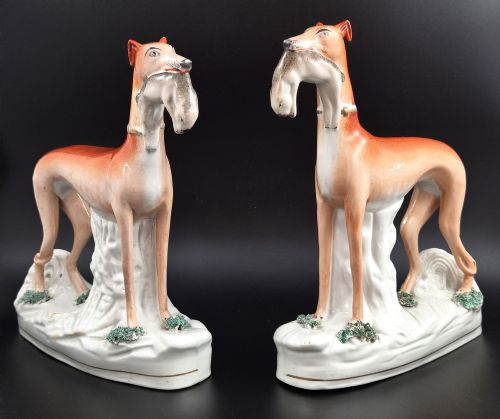
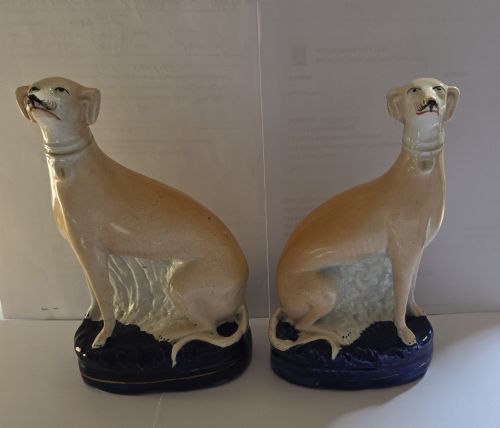
A pair of ceramic greyhounds typically takes the form of seated or recumbent figures produced during the Victorian era. These decorative ornaments often incorporate functional elements such as inkwells, quill holders, or include hares at the base.
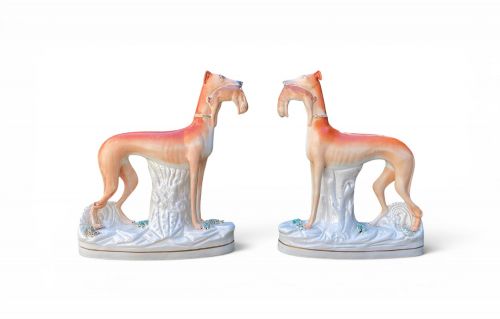
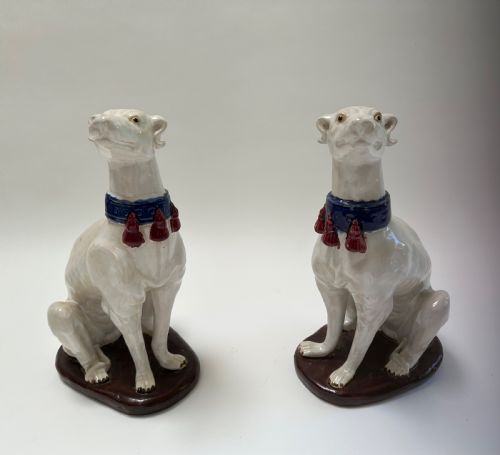
Most examples encountered on this page stem from nineteenth-century Staffordshire potteries, capturing the Victorian fascination with hunting dogs and domestic animals. Other variations include Italian Majolica and Chinese porcelain cups, though Staffordshire earthenware dominates the selection.
Makers shaped these figures as symmetrical pairs intended to flank a fireplace or centrepiece. The styling ranges from naive country pottery to more elaborate Italian Renaissance Revival interpretations.
How they were made
Moulds enabled Staffordshire and regional potteries to produce consistent dog forms which workers then painted by hand before firing. Inkwells and quill holders required additional hollow compartments formed during the initial moulding process.
Several greyhounds sit patiently guarding hares, proving that Victorian mantelpieces loved a canine success story.
What varies in quality
Quality rests primarily in the crispness of the moulding and the control of the hand-painted enamel colours. Superior examples display sharp facial expressions and careful detailing around the fur rather than muddy or runny glazes.
The presence of original decorative elements, such as accompanying hares or intact inkwell inserts, elevates a pair. Finer pieces also show more sophisticated anatomical modelling of the whippet or greyhound form.
Thomas Parr
The Pair of Ceramic Greyhounds Glossary
- Staffordshire
- Pottery manufactured in the Stoke-on-Trent region of England, known for popular animal figurines and figures. This area produced the majority of Victorian dog ornaments.
- Earthenware
- Porous pottery fired at relatively low temperatures, requiring a glaze to become impermeable. It serves as the primary body for most nineteenth-century figures.
- Lead glaze
- A glossy coating containing lead oxide applied to pottery before firing to give a smooth finish. It creates the characteristic sheen on Victorian earthenware.
- Enamel paint
- Opaque vitreous colours fused to the surface of ceramic pieces during a secondary firing. It provides the bright coats and facial markings on the dogs.
- Quill holder
- A desk accessory featuring small apertures designed to hold writing feathers. Greyhound figures were frequently adapted for this desktop purpose.
Pair of Ceramic Greyhounds: Frequently Asked Questions
How old are these ceramic greyhounds?
Most pieces date from the nineteenth century, specifically around the middle and late Victorian period between eighteen-fifty and eighteen-eighty. A few examples extend into the early twentieth century or earlier.
Potters in Staffordshire produced the bulk of these figures during the height of the Victorian era, utilising traditional earthenware methods.
Were these dogs used for writing?
Certain examples incorporate practical desktop functions alongside their decorative role. Makers designed specific pairs to serve as inkwells or quill holders.
These functional pieces held writing equipment on nineteenth-century desks while maintaining the symmetrical canine design favoured by Victorian buyers.
Why do some dogs have hares?
The inclusion of hares reflects the hunting associations of greyhounds and whippets during the nineteenth century. Staffordshire modellers often placed a captured hare beneath the dog or at the base of the figurine.
This imagery tied the decorative ornaments to rural field sports popular among the owners of the period.
How do I care for antique ceramic figures?
Keep these glazed earthenware pieces out of direct sunlight to protect the enamel paint and gold leaf details. Dust them gently with a soft dry cloth.
Avoid using water or liquid cleaners on nineteenth-century enamel surfaces, as moisture can damage the hand-painted decoration.