
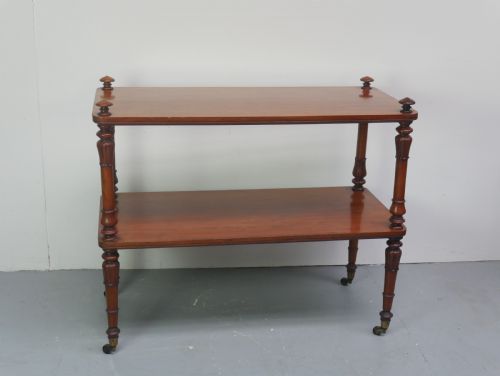
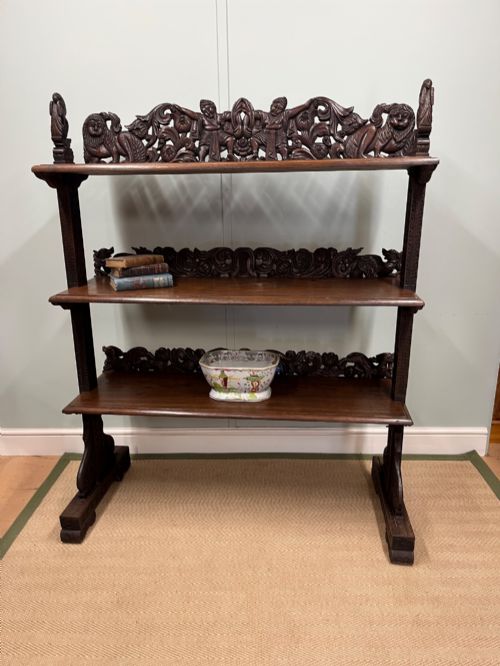


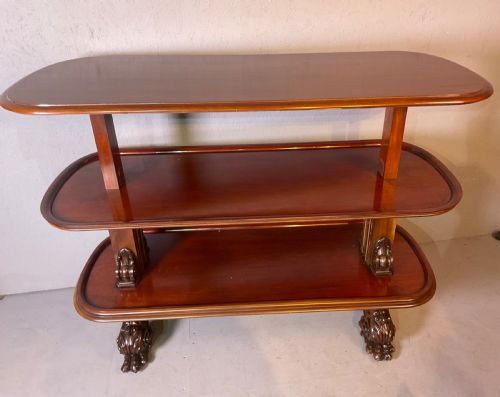


Victorian Dumbwaiter Table
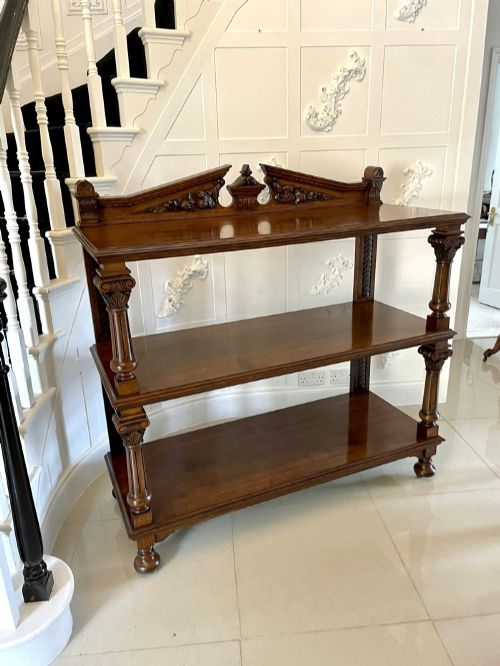
A victorian dumbwaiter table serves dining rooms and drawing rooms with tiers of timber, offering both practical surface space and mechanical ingenuity.
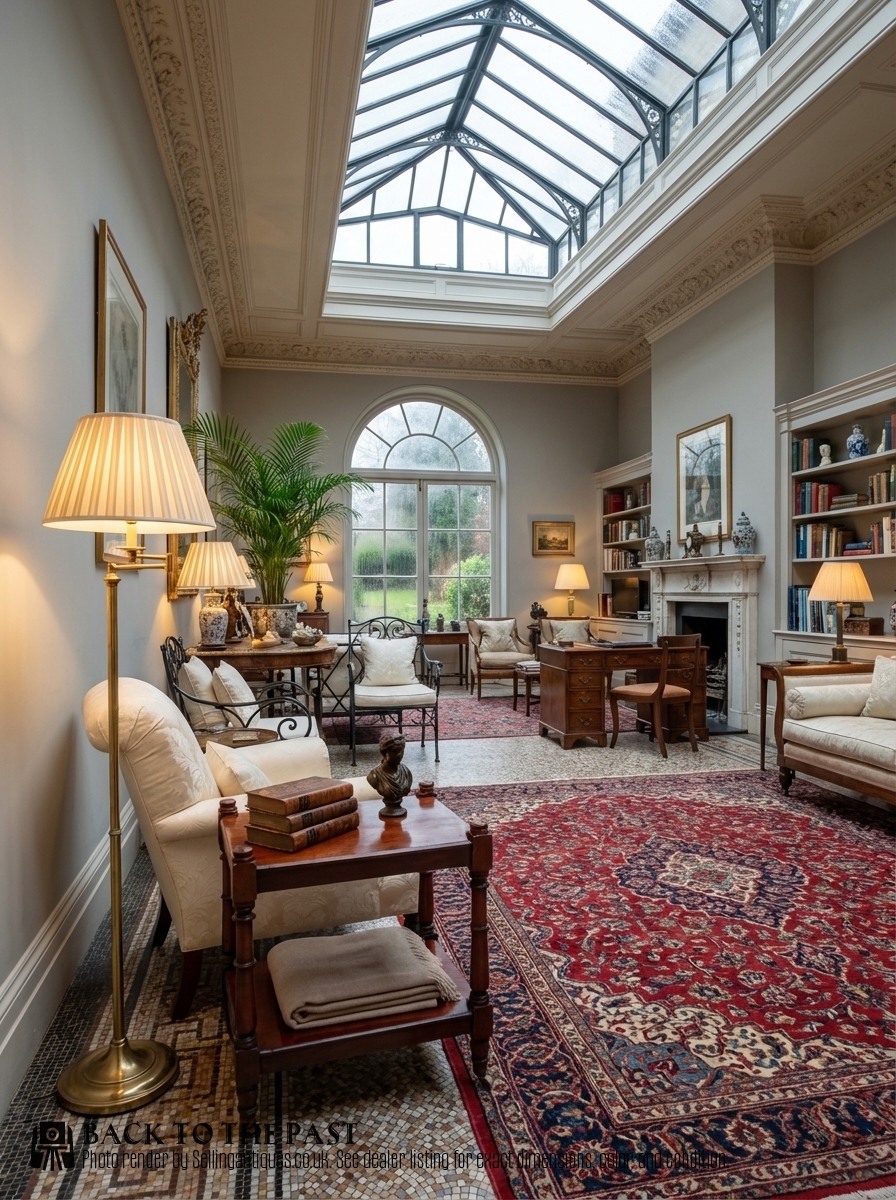
Victorian Dumbwaiter Table
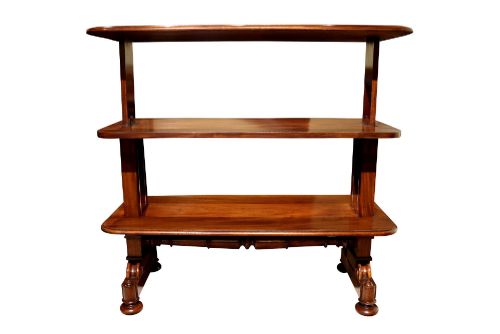
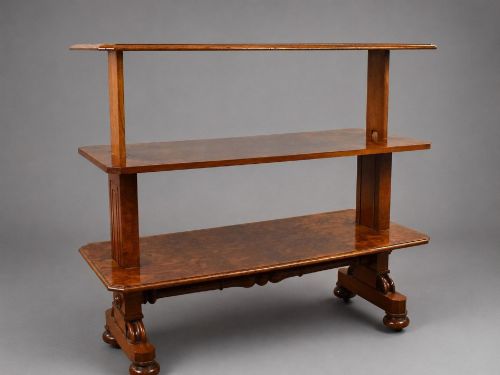
A victorian dumbwaiter table brings tiered shelving and serving utility into domestic spaces, appearing most often as a three-tier buffet, revolving stand, or metamorphic server in mahogany, walnut, or oak. These pieces span the nineteenth century, drawing on Georgian foundations while introducing mechanical movement, rise-and-fall mechanisms, and folding designs suited to changing dining customs.
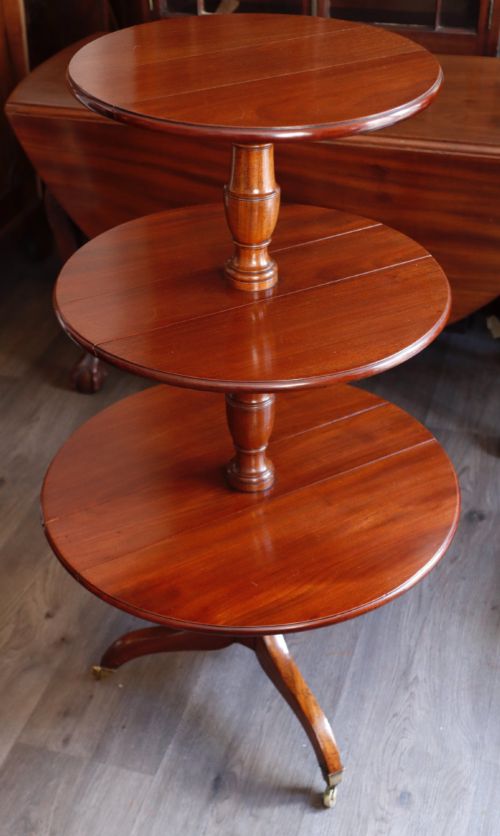
The selections on this page range from compact tripod pedestal tables to large carved oak buffets and burmese padauk wood tiers. While the majority anchor themselves firmly in the Victorian era, examples stretch from earlier Georgian roots into the early twentieth century, incorporating styles such as William IV, Regency, and Anglo-Indian carving.
Materials and Construction
Cabinetmakers constructed these pieces primarily in solid and veneered timbers, selecting dense woods like mahogany, walnut, rosewood, and teak to support multiple heavy tiers. Burr walnut veneer and carved oak appear alongside exotic woods, while brass mountings provide structural reinforcement and operate the telescopic or rise-and-fall mechanisms.
Joinery techniques ranged from standard pedestal pillar supports with tripod legs to complex mechanical ratchets, brass castors, and rotating pivots. Carved details, such as green man motifs or geometric edgings, required skilled hand-chiselling, while revolving sections relied on turned wooden or metal pivots to ensure smooth rotation.
Victorian Dumbwaiter Table Retail Price Guide 2026
Typical asking prices for victorian dumbwaiter table among the pieces listed under this phrase on Sellingantiques today, from the lower quarter to the upper quarter. They describe what is for sale here now, not the wider market.
Listings feature woods including mahogany, walnut, burr walnut, oak, rosewood, teak, padauk, and amboyna alongside brass mounts.
Evaluating the Build and Mechanism
Quality rests heavily on the execution of the mechanism, whether it is a smooth-operating telescopic rise-and-fall action, a stable revolving tier, or a rigid folding frame. Superior pieces maintain structural integrity across all tiers without wobble, utilising substantial timber thickness and well-fitted joints rather than relying on later tightening.
The selection of timber grain and the crispness of any hand-carved ornamentation separate standard utility pieces from finer salon examples. Original components, such as brass castors and mountings, contribute significantly to the integrity of the piece.
Maple & Co
The Victorian Dumbwaiter Table Glossary
- Dumb Waiter
- A tiered serving table designed to hold dishes or books without the need for a human servant. These items evolved from static multi-tiered stands into sophisticated revolving and height-adjustable furniture.
- Metamorphic
- Furniture designed to change shape or function through folding, rising, or expanding mechanisms. In these tables, tiers often elevate or lower to transform a compact stand into a tall serving buffet.
- Rise and Fall
- A mechanical action allowing shelves or tiers to adjust vertically via a central shaft and ratchet or screw mechanism. This allowed servants to alter the height of trays during a meal.
- Tripod Pedestal
- A central column supported by three spreading feet, commonly used to stabilize circular tables and dumbwaiters without crowding floor space. It provides balanced weight distribution for tiered shelving.
- Campaign Washstand
- A portable or collapsible piece of furniture originally designed for travel, constructed with brass mounts and folding elements. Certain multi-tiered serving pieces share this utilitarian, knock-down construction.
Victorian Dumbwaiter Table: Frequently Asked Questions
What is a victorian dumbwaiter table used for?
These tables served dining rooms by holding extra courses, glassware, and tableware close to the table during meals. They reduced the need for immediate servant attendance by keeping food and wine within reach.
In modern rooms, buyers use them as display shelves for books, plants, or collections, utilising the multiple tiers to save floor space in living areas and hallways.
How do metamorphic dumbwaiters work?
Metamorphic models feature mechanical ingenuity, using internal wooden screws, metal ratchets, or telescoping pillars to raise and lower the shelves. Users could rotate or adjust the height of the tiers depending on whether the piece served a dining function or stood flat against a wall.
Operating these mechanisms requires care to avoid straining the central column, especially on pieces utilising heavy mahogany or walnut tiers.
Are these tables heavy to move?
Most pieces possess substantial weight due to dense hardwoods like mahogany, oak, and rosewood combined with multiple stacked shelves. Many examples feature original brass castors on the feet to help maneuver the furniture across wooden floors or carpets.
When shifting a tiered stand, lifting from the lower structural framework rather than the upper shelves prevents strain on the central pillar or pivot joints.
How do I spot a later reproduction?
Examining the timber shrinkage, secondary woods used on hidden parts, and the wear patterns around pivot points helps determine age. Nineteenth-century examples display hand-cut joinery, patinated surfaces, and traditional fixings rather than modern screws or machine-cut dowels.
Hardware such as brass castors, hinges, and locking mechanisms should match the period technology and show consistent oxidation and handling wear.