

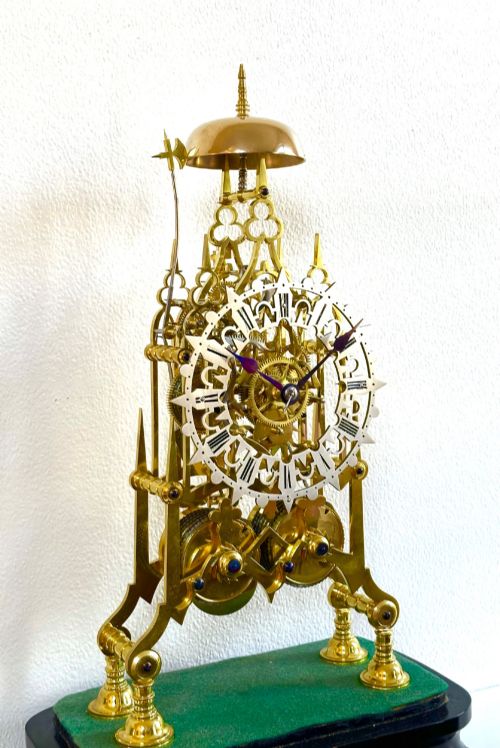


Victorian Double Fusee
When you want a Victorian double fusee, you are looking at precise 19th-century English timekeeping driven by chains or cords and spring barrels.
Victorian Double Fusee
A victorian double fusee timekeeper is a clock driven by a chain or cord wound around a cone-shaped pulley, which ensures even tension as the mainspring unwinds. This mechanism appears across several nineteenth-century forms, including bracket clocks, skeleton clocks, and wall dials.
The pieces listed on this page span the nineteenth century and into the early twentieth century, taking the form of heavy mahogany bracket clocks, wall dials in oak or mahogany cases, and open skeleton clocks often protected by glass domes. These clocks originate from both London makers and regional English workshops.
Bracket clocks and mantel clocks dominate the selection, alongside wall-hanging dial clocks and striking regulators. Cabinets utilise dense timbers such as mahogany, oak, burr walnut, and bronze for Gothic revival cases.
Judging quality and execution
Quality rests upon the crispness of the movement engraving, the finish of the brass work, and the structural integrity of the timber case. Maker signatures from known London firms or regional workshops elevate a piece, particularly when movements feature elaborate skeletonised plates or engraved backplates.
Case materials and proportions dictate the visual appeal, ranging from plain oak wall dials to figured mahogany and burr walnut bracket clocks with bronze mounts. The presence of original components, such as glass domes and matching brackets, distinguishes standard production from finer examples.
Victorian Double Fusee Retail Price Guide 2026
Typical asking prices for victorian double fusee among the pieces listed under this phrase on Sellingantiques today, from the lower quarter to the upper quarter. They describe what is for sale here now, not the wider market.
Several skeleton clocks preserve their original glass domes, keeping dust away from the spinning brass wheels for over a century.
Geo Carter Hackney·Budgen Croydon·Goldsmiths Silversmiths London·Osborn of Bognor Regis·Edwards Of London
The Victorian Double Fusee Glossary
- Fusee
- A conical pulley connected to the mainspring barrel by a chain or cord. This device equalises the diminishing torque of the spring as it runs down.
- Double fusee
- A movement incorporating two separate fusee mechanisms, typically dividing timekeeping from striking or chiming trains.
- Bracket clock
- A portable clock originally designed to sit on a wall bracket or table. These pieces often feature arched wooden cases and carrying handles.
- Skeleton clock
- A clock with open metal plates that expose the gear train and escapement to view. They are frequently housed beneath glass domes.
- Dial clock
- A wall-mounted clock featuring a prominent circular face. The case often includes a short wooden trunk or drop dial below.
Victorian Double Fusee: Frequently Asked Questions
What is a double fusee movement?
A double fusee movement uses two separate conical pulleys and chains to power two distinct trains within the clock, usually for timekeeping and striking.
This setup maintains constant force on the gear train to deliver accurate time over the full duration of the wind.
How do I wind a double fusee clock?
Winding requires a dedicated key inserted into the dial holes to tension the chains or cords around the fusee cones.
Care must be taken not to overwind the mechanism, following the specific directions indicated by the movement layout.
Where were these clocks placed?
Bracket and mantel clocks sat upon wooden tables, shelves, or dedicated wall brackets within main rooms. Wall dial versions hung in hallways, offices, and domestic interiors for clear public viewing.
Enclosed skeleton clocks rested on surface tables beneath glass domes to protect the exposed gears from dust.
How do I tell a wall clock from a bracket clock?
Wall clocks hang directly from vertical surfaces by means of back cases and wall fixings, often featuring drop dials or round wooden rims. Bracket clocks are heavier, free-standing box structures designed for horizontal surfaces.
Bracket clocks frequently incorporate carrying handles on top and glazed side panels to reveal the movement.