





Victorian Cylindrical Nightstands
Victorian cylindrical nightstands are remarkably practical nineteenth-century bedside cabinets prized for their curved timber bodies and compact footprints.
Victorian Cylindrical Nightstands
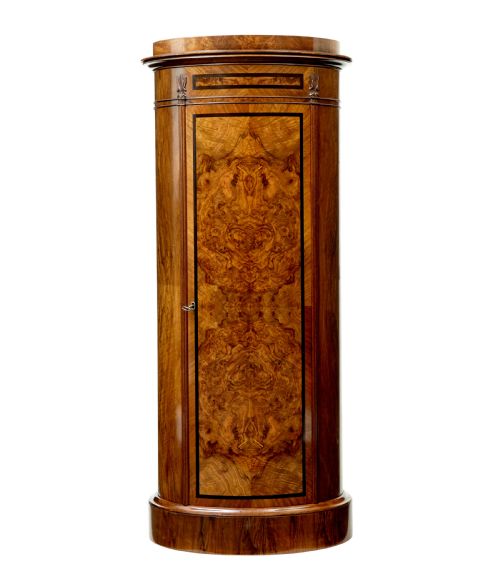
Victorian cylindrical nightstands take the form of circular bedside cabinets and pedestal cupboards designed to fit snugly beside nineteenth-century beds. These pieces provide concealed storage within a distinct round footprint that saves valuable floor space in smaller bedchambers.
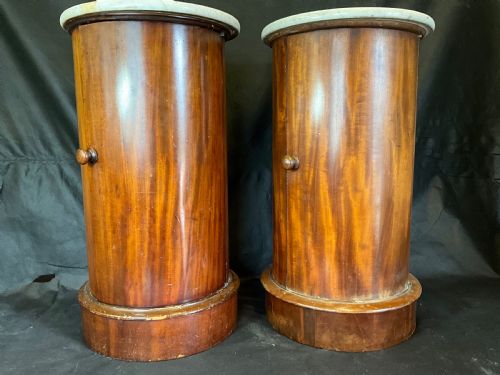
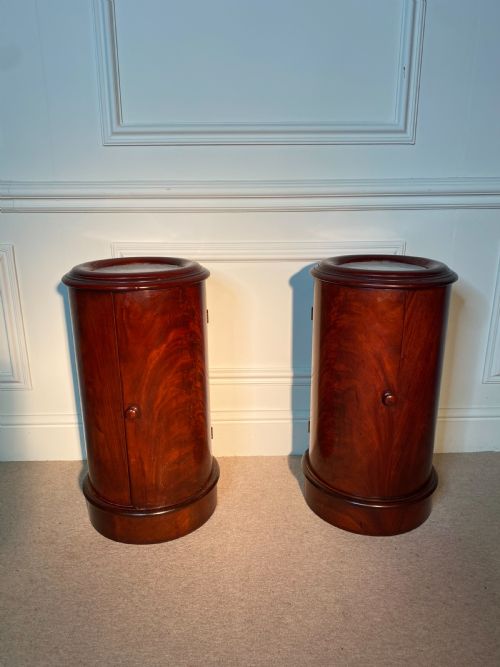
The versions most commonly met on this page date from the nineteenth century, including specific pieces from 1850, 1860, and 1880. They appear as single cabinets and matched pairs, utilising classic Victorian proportions and enclosed internal shelving.
Makers of the period shaped these stands as enclosed cupboards or pot cupboards, often topping the cylindrical wooden bodies with fitted white or grey marble slabs. This combination of timber and stone offered a durable, wipe-clean surface for bedside water jugs and chamber items.
Materials and construction methods
Cabinet makers constructed the curved walls of these nightstands using solid and veneered timbers, bending or segmenting wood to achieve the true circular cylinder shape. The primary woods recorded in these listings are mahogany, flame mahogany, burr walnut, ebony, and plain walnut.
Many examples incorporate inset marble tops, adding substantial weight and a cool, impervious surface to the top of the wooden pedestal. Some alternative pieces utilise faux marble finishes painted onto the surface to mimic solid stone at a lighter weight.
Listings feature 19th century pieces spanning 1840 to 1880, predominantly constructed from mahogany, walnut, and marble.
Distinctions in quality
The grade of the timber veneer dictates much of the visual appeal, with highly figured flame mahogany and burr walnut commanding greater presence than plain or unfigured wood. Expert matching of the grain around the curved door and cylindrical body demonstrates superior cabinet work.
The integration of the marble top also separates standard examples from finer ones, particularly where the stone is heavy, well-veined, and neatly recessed into the timber rim. Furthermore, the presence of matching pairs rather than single cabinets changes the utility and balance of the pieces.
The Victorian Cylindrical Nightstands Glossary
- Pot cupboard
- A nineteenth-century bedside cabinet designed specifically to enclose a chamber pot. These practical units usually feature a single curved door and an internal shelf.
- Flame mahogany
- A decorative timber veneer showing a distinctive flickering, flame-like grain pattern. Cabinet makers reserved this highly figured wood for the most prominent exterior surfaces.
- Pedestal cupboard
- A tall, freestanding storage unit built on a circular or square base. These single-door pieces provide deep interior space beneath a flat or marble top.
Victorian Cylindrical Nightstands: Frequently Asked Questions
What are Victorian cylindrical nightstands?
These are nineteenth-century bedside cabinets featuring round wooden bodies and enclosed doors for bedroom storage.
They were built during the Victorian era, frequently topped with marble and finished in mahogany or walnut.
How were these nightstands used originally?
Bedchambers utilised them to hold water jugs, candlesticks, and personal items within arm's reach of the bed.
The enclosed interior cupboards also served to house chamber pots discreetly out of sight.
How do I fit one into a modern bedroom?
The compact circular footprint allows these cabinets to sit comfortably beside contemporary bed heights without dominating the room.
Their enclosed shelves provide hidden storage for books and modern bedside accessories while keeping surfaces clear.
How can I tell the different woods apart?
Mahogany offers a rich reddish-brown tone with straight or flame-figured grain patterns, whereas walnut displays deeper brown hues with complex swirling growth marks.
Burr walnut shows dense, speckled knot formations, and ebony provides a very dark, dense appearance.
Are pairs common for these nightstands?
Matched pairs appear periodically alongside single cabinets, having originally flanked larger Victorian double beds.
Finding a true pair requires matching timber grain and dimensions across both cylindrical bodies.