




Victorian Cranberry Glass Pitcher
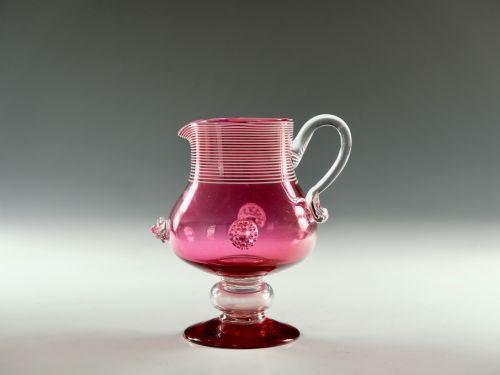
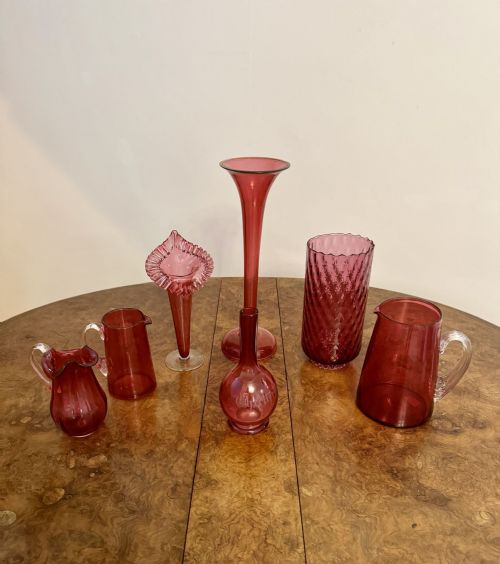
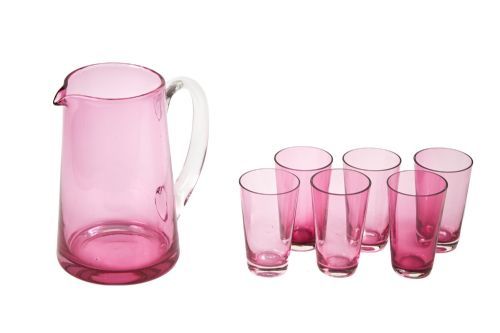
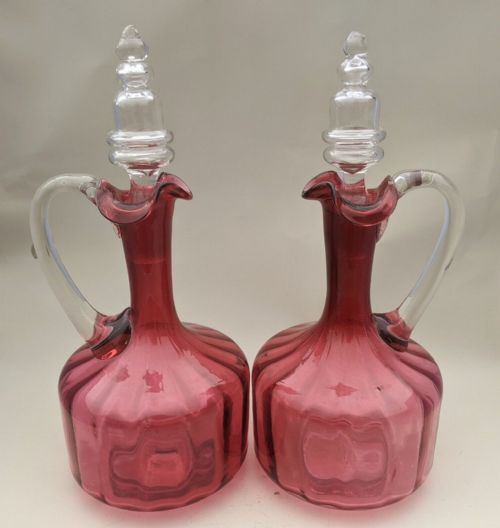
These Victorian cranberry glass pitchers bring rich crimson warmth to a table, combining intense glass colour with practical pouring forms.
Victorian Cranberry Glass Pitcher
A Victorian cranberry glass pitcher is a table vessel created in deep red or pink tones, appearing across the nineteenth century and into the Edwardian era. You will find these pieces taking forms such as cream jugs, wine decanters, and larger pouring pitchers.
The items listed on this page span from the middle of the Victorian period through to the early twentieth century. Most examples date from the later decades, particularly around eighteen-eighty, and range from single cream jugs to complete drinkware sets.
How they were made
These vessels are formed from glass enriched with gold salt additives to achieve their characteristic red colouration. Makers often combined the cranberry glass body with clear glass handles, stoppers, or rims.
Decoration includes applied white piping and engraved details such as fruiting vines. Some pieces also integrate metal elements like silver plate mounts.
The site listings feature items spanning from eighteen-sixty through the Victorian era and into the Edwardian period.
What varies in quality
Quality rests in the depth and evenness of the cranberry colour achieved through the gold salt mixture. Richer, more vibrant red tones indicate careful temperature control during the glass-making process.
Finishing details also separate standard examples from finer ones, such as the crispness of engraved fruiting vines or the precise application of contrasting white piping.
The Victorian Cranberry Glass Pitcher Glossary
- Cranberry Glass
- A transparent red glass produced by adding gold salts to the molten batch. The resulting hue ranges from pale pink to deep ruby red.
- Gold Salt Additive
- The metallic compound mixed into the glass formula to create the distinct pink and red shades. It is essential for the characteristic colour.
- White Piping
- Raised threads of opaque white glass applied hot to the surface of the vessel for decoration. This technique creates linear contrast against the red body.
- Silver Plate
- A thin layer of silver bonded to a base metal, commonly used for mounts, collars, and handles on decanters and jugs. It provides a bright metallic contrast to the glass.
Victorian Cranberry Glass Pitcher: Frequently Asked Questions
What were cranberry glass pitchers used for?
These vessels served functional roles on the dining table for pouring cream, wine, or water. They also functioned as decorative glassware collections within Victorian homes.
Over time, their primary use shifted from active service to display pieces admired for their striking colour.
How do I date a cranberry glass pitcher?
Dating relies on observing the form, decorative style, and associated metalwork mounts. Pieces range from mid-nineteenth-century examples up to Edwardian productions.
Stylistic markers like engraved fruiting vines or applied white piping help place items within specific decades of the period.
Are these pitchers made of real gold?
Gold is not present as solid metal or plating on these pieces. Instead, minute quantities of gold salt additives are melted into the glass mixture to produce the red colour.
This chemical process is what gives the material its distinctive cranberry tint.
How should I clean my glass pitcher?
Cleaning requires warm water and mild soap applied with a soft cloth to protect the surface. Harsh abrasives must be avoided to prevent scratching the glass or any applied enamel.
Metal components like silver plate need appropriate polishing creams kept strictly away from the surrounding glass.