

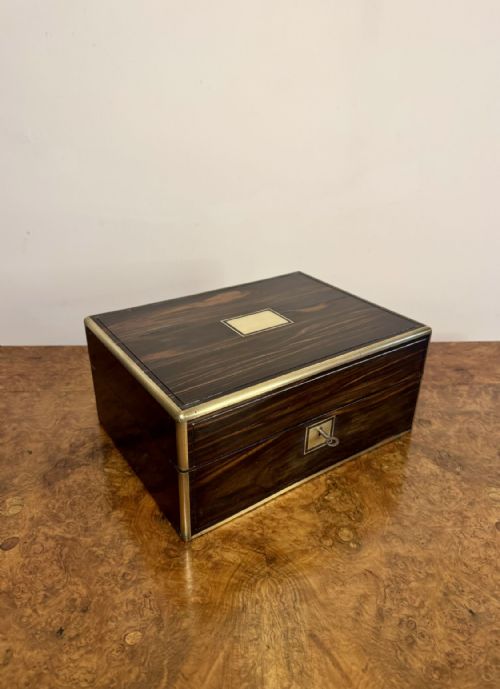


Victorian Coromandel Case
A victorian coromandel case brings dense grain and brass mounts together into a travelling box designed to hold jewellery, decanters, or writing supplies.
Victorian Coromandel Case
When you search for a victorian coromandel case, you encounter sturdy wooden boxes built during the nineteenth century to serve travellers and domestic households alike. These pieces take various functional forms, appearing most frequently as fully fitted jewellery boxes, gentleman's and lady's vanity cases, and decanter boxes.
The materials span exotic timber, polished glass, and metal fittings, reflecting the height of Victorian craftsmanship. Alongside standard domestic boxes, variations include Anglo-Indian styles and Gothic Revival designs that adapt the dense timber to different aesthetic tastes.
Materials and Construction
Maker workshops utilised coromandel wood for its heavy weight and intricate, dark grain patterns, often pairing the timber with sturdy brass mounting for structural reinforcement. Interiors were lined with velvet to protect fragile contents such as cut crystal bottles and silver items.
Detailing often incorporated mother-of-pearl inlay or reeded decoration carved directly into the wooden surfaces. Master craftsmen constructed these caskets to house complex internal mechanisms, secret drawers, and fitted trays that secured specific objects during transit.
Victorian Coromandel Case Retail Price Guide 2026
Typical asking prices for victorian coromandel case among the pieces listed under this phrase on Sellingantiques today, from the lower quarter to the upper quarter. They describe what is for sale here now, not the wider market.
Many vanity cases still hold their original glass scent bottles, waiting quietly for a fragrance they have not smelt in a century.
Distinctions in Quality
Quality rests in the density and figuring of the coromandel grain, alongside the precision of the brass corners and escutcheons. Superior examples retain their original working keys and complex internal lifting mechanisms that reveal concealed compartments smoothly.
The standard of internal fittings also separates ordinary boxes from masterworks, with top-tier pieces featuring matching cut crystal bottles, trays, and intact velvet linings. Maker signatures stamped onto locks or leather inner edges elevate the standing of a piece significantly.
H Mitchell·Asprey·Edwards·Mappin Brothers
The Victorian Coromandel Case Glossary
- Coromandel
- A dense, heavily grained exotic hardwood used primarily for high-end nineteenth-century furniture and decorative boxes. Its dark brown colour and striking black stripes distinguish it from common veneers.
- Escutcheon
- A flat plate of brass surrounding a keyhole that protects the surrounding wood from wear and adds a decorative accent. On these boxes, brass mounts frequently match the material of the keyhole plate.
- Tantalus
- A locking wooden frame holding decanters or scent bottles that prevents access to the contents without a key. This form appears across nineteenth-century drinks and scent bottle caskets.
- Reeded decoration
- Parallel convex mouldings carved into the surface of wooden boxes. This technique creates a textured linear effect across the exterior panels.
- Vanity case
- A portable container outfitted with glass bottles, trays, and compartments for personal grooming items. These travelled with owners during the Victorian period.
Victorian Coromandel Case: Frequently Asked Questions
What is a coromandel case used for?
These boxes served multiple domestic and travelling purposes during the nineteenth century, holding personal valuables securely.
Owners utilised them for jewellery, writing equipment, decanters, and travelling grooming kits.
How do I date a Victorian box?
Dating relies on stylistic clues, materials, and maker signatures stamped into the locks or leather fittings.
Most examples date between the eighteen-sixties and eighteen-eighties, aligning with the height of Victorian manufacture.
Are keys usually included?
Many surviving pieces retain their working keys, though original locks often operated complex internal mechanisms.
Working keys add practical value for collectors who wish to secure the fitted compartments.
How should I clean the wood?
Coromandel wood benefits from gentle dusting and occasional waxing with a traditional furniture polish.
Avoid excessive moisture, which can damage the delicate velvet interiors and brass mounts.