



Victorian Coloured Glass Goblet
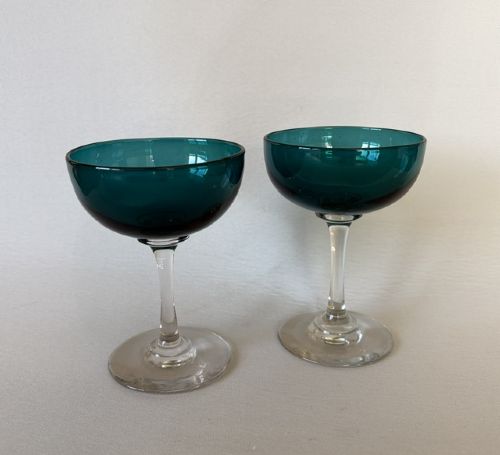
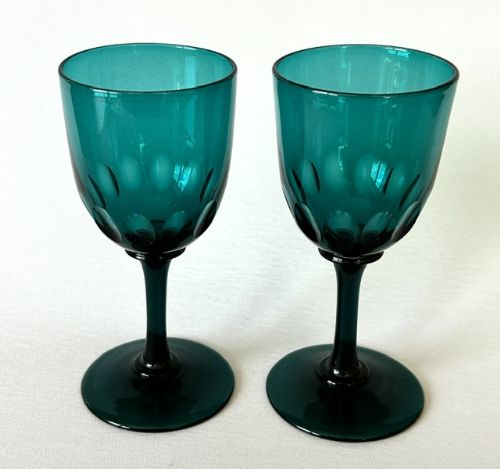
These Victorian coloured glass goblets and wine glasses bring brilliant tones and hand-blown forms to the table.
Victorian Coloured Glass Goblet
When you search for a Victorian coloured glass goblet, you are looking at drinking vessels that span the nineteenth century, with Cranberry glass forming a large portion of the selection alongside rich green, blue, amethyst, and aqua pieces. These items appear primarily as sets of wine glasses and liquor glasses, often shaped with tulip bowls or bobbin stems.
The objects range from English and Venetian Revival workshops to Italian Murano production, capturing the vibrant palette favoured during the Victorian era. Sets vary from pairs to larger groupings of fifteen, reflecting the dining customs of the period.
Materials and manufacture
These pieces are made from hand-blown glass and lead glass, shaped into wine glasses and stemware with distinct colour infusions. Artisans utilised techniques that produced Cranberry glass, green glass, amethyst glass, and clear glass combinations.
Makers shaped the molten material into specific forms such as tulip bowls and bobbin stems, achieving the distinctive hues seen in the aqua green and blue Venetian Revival examples.
Victorian Coloured Glass Goblet Retail Price Guide 2026
Typical asking prices for victorian coloured glass goblet among the pieces listed under this phrase on Sellingantiques today, from the lower quarter to the upper quarter. They describe what is for sale here now, not the wider market.
Listings feature periods spanning from Georgian and Victorian eras up to nineteen hundred, using Cranberry glass and lead glass.
Judging quality in coloured glass
Quality in these vessels rests on the depth and consistency of the coloured glass, whether cranberry, emerald green, or deep amethyst. Uniformity across a set of wine glasses elevates the standing of the pieces.
The finesse of the hand-blown stemware and the crispness of form, such as in tulip-shaped bowls and bobbin stems, distinguish standard production from finer examples.
Salviati
The Victorian Coloured Glass Goblet Glossary
- Cranberry glass
- A type of transparent red-pink glass created by adding gold chloride to the molten batch. It is a defining material of the Victorian period.
- Lead glass
- Glass containing lead oxide, which increases brilliance and weight. This material allows for finer manipulation during hand-blowing.
- Bobbin stem
- A stem formed with spherical or disc-like nodes resembling wooden bobbins. This decorative shape appears on English wine glasses from the period.
- Venetian Revival
- A nineteenth-century style drawing inspiration from historic Murano glassmaking traditions. It often incorporates vibrant colours and intricate forms.
- Tulip shaped
- A bowl contour that curves outward at the rim, resembling a closed tulip flower. This profile is common among nineteenth-century wine glasses.
Victorian Coloured Glass Goblet: Frequently Asked Questions
What are Victorian coloured glass goblets?
They are hand-blown drinking vessels produced during the nineteenth century in shades such as cranberry, green, and amethyst.
These pieces were typically made as wine glasses or liquor glasses for formal dining.
How do I care for antique coloured glass?
Wash these delicate items by hand in warm water using a mild detergent. Avoid sudden temperature changes to protect the historic material.
Store them securely on stems rather than rims to prevent chipping.
Are these glasses safe for drinking?
Most collectors use these historic wine glasses for display or occasional celebratory toasts. The glass composition is generally stable for beverages.
Hand-washing is essential to preserve the finish of the hand-blown surfaces.
How are different periods identified?
Dating relies on stylistic markers such as bobbin stems, tulip bowl shapes, and specific colour formulas like Cranberry glass. English and Murano pieces often exhibit distinct regional traits.
Comparing form and manufacturing technique helps place pieces across the nineteenth-century timeline.