

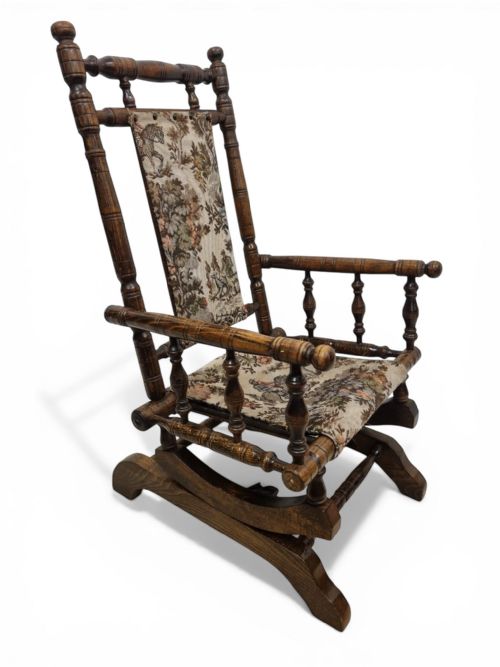


Victorian Child Rocking Chair
A Victorian child rocking chair brings miniature scale and domestic history together, offering a functional seat made smaller for a nursery or parlour.
Victorian Child Rocking Chair
A Victorian child rocking chair is a scaled-down seat designed for children, found frequently in nineteenth-century domestic settings across the evidence. Buyers seeking this phrase encounter a range of forms, from simple rustic country models to more formal upholstered or carved examples.
The material evidence shows pieces spanning the nineteenth century alongside occasional earlier and later examples, including rustic windsors and bentwood designs. These seats served practical daily use in homes, resulting in varied patination and wear across surviving specimens.
Materials and construction
Makers utilised solid timbers such as ash, elm, beech, oak, fruitwood, and mahogany to construct these small frames. Windsor designs incorporated turned spindles and bent components, while others relied on joined or carved framework.
Seating surfaces varied by style, incorporating solid wooden boards, woven cane, rush, horse-hair covering, or tapestry upholstery. Thonet examples demonstrate bentwood techniques typical of late nineteenth-century production.
Materials recorded across the inventory range from common utilitarian pine and beech to high-status mahogany and fruitwood.
Assessing quality and character
Quality in a Victorian child rocking chair rests in the integrity of the timber, the balance of the proportions, and the originality of the materials. Pieces retaining their original rush, cane, horse-hair, or tapestry coverings hold distinct interest for collectors.
Simpler vernacular examples demonstrate honest country craftsmanship, whilst more ornate carved or upholstered versions reflect formal parlour aesthetics. The distinction lies in the deliberate choice of finer woods like mahogany or fruitwood versus everyday utilitarian timbers like pine.
Thonet
The Victorian Child Rocking Chair Glossary
- Windsor
- A chair built with a solid wooden seat into which the legs and back spindles are tenoned directly. This traditional construction method provides sturdy support for country seating.
- Bentwood
- Wood softened by steam and bent into curved shapes under pressure. Thonet utilised this technique to create lightweight and resilient frames.
- Bergere
- A type of upholstered armchair featuring cane panelling set into the wooden frame. This method creates a light, breathable backrest or seat.
- Rush
- Woven marsh plants used to create traditional seating surfaces. The material offers a durable and textured finish for vernacular chairs.
Victorian Child Rocking Chair: Frequently Asked Questions
Were these made for children?
Many examples served actual children in Victorian nurseries and parlours, providing a comfortable seat scaled to their size. The evidence notes several pieces intended for daily use in domestic spaces.
At the same time, contemporary listings and past sales show that some smaller models functioned as doll chairs. Scale often distinguishes pieces meant for infants from those intended for display dolls.
What woods were used?
Makers selected timber based on availability and the intended style of the chair. Everyday items utilised local woods such as ash, elm, beech, and pine.
More formal or decorative pieces employed denser hardwoods like mahogany and fruitwood. Solid wood construction ensured the small frames could withstand active use.
Are original coverings common?
Surviving upholstery is uncommon due to the heavy wear nursery furniture naturally experienced. Most original surfaces have been replaced over the decades.
When horse-hair covering or tapestry upholstery does survive, it provides valuable evidence of the original aesthetic. Cane and rush seats also show varying degrees of historical repair.
How do I date a piece?
Dating relies on stylistic markers, construction methods, and recorded historical details. Nineteenth-century examples often display vernacular turning or simple rustic forms.
Later pieces from the close of the century incorporate industrial innovations such as bentwood. Comparing the timber and joinery helps place the chair within its broader period.