


Victorian Charcoal Sketch
A victorian charcoal sketch delivers direct, unvarnished draughtsmanship that captures nineteenth-century sitters and landscapes with immediate graphic power.
Victorian Charcoal Sketch
When you search for a victorian charcoal sketch, you encounter original works on paper spanning portraits, academic life studies, and atmospheric landscapes. These works capture subjects ranging from English gentlemen to dramatic seascapes through direct hand-drawn media.
The versions most commonly met on this page include nineteenth-century portrait drawings and academic life studies framed in wood or gilt wood frames. Many pieces date from the Victorian and Edwardian periods, reflecting academic realism and tonalism.
Subjects frequently encompass formal portraiture of historical figures alongside anonymous studies of male nudes and topographical views. The materials consistently centre on paper supported by wood frames and protective glass.
How they were made
These works rely primarily on charcoal, chalk, and graphite applied directly to paper supports. Artists utilised the friable nature of charcoal to build deep shadows and broad tonal gradients alongside sharper graphite lines.
Finished pieces were secured within wood or gilt wood frames, often protected beneath glass. The combination of charcoal and chalk on paper allowed draughtsmen to achieve distinct contrasts between light and dark across academic studies and portraits.
The documented periods span the nineteenth century, Victorian era, and Edwardian period through academic and realist styles.
What varies in quality
Quality rests upon the sureness of the draughtsmanship and the expressive depth achieved within the medium. Academic life studies and signed portraits by identified artists demonstrate superior anatomical precision and tonal control.
Condition of the paper support and the originality of the associated wood or gilt wood frame contribute significantly to the standing of an individual drawing. Works retaining contemporary framing and clear provenance distinguish themselves within the range.
Sir Edwin Landseer RA·John Macallan Swan·Theobald Chartran·George Richmond RA
The Victorian Charcoal Sketch Glossary
- Academic Realism
- A style of painting and drawing produced under the influence of European academies of art. It emphasises precise anatomical accuracy and detailed observation of the human figure.
- Life Study
- A drawing executed directly from a live model, often an unclothed human figure. These works formed a core component of nineteenth-century artistic training.
- Gilt Wood Frame
- A wooden picture frame coated with a thin layer of gold leaf or metallic gilt paint. These frames frequently accompany nineteenth-century works on paper.
- Tonalism
- An artistic style that prioritises atmospheric effects and shadow over sharp outlines. Edwardian examples often employ this approach to create moody landscapes.
Victorian Charcoal Sketch: Frequently Asked Questions
How should I hang a charcoal drawing?
Charcoal drawings on paper require protection from direct sunlight to prevent fading of the delicate carbon medium. Position the framed artwork away from heat sources and damp environments.
Ensure the piece remains sealed behind glass with adequate spacing between the drawing surface and the glazing. Professional framing safeguards the paper from environmental degradation over time.
What subjects appear in these sketches?
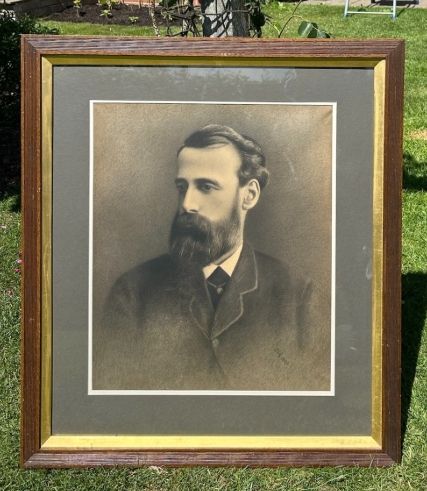
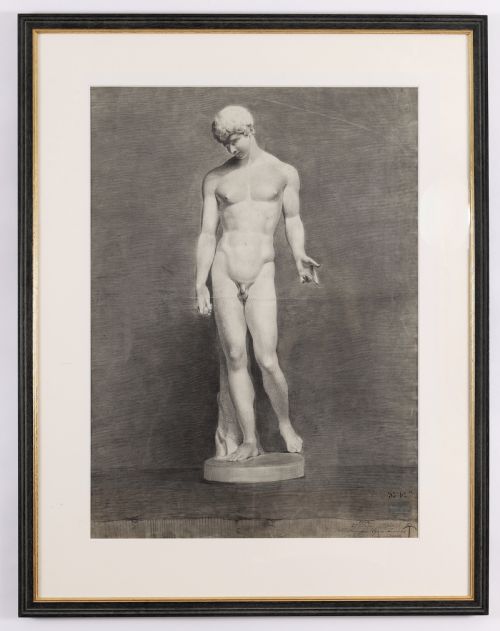
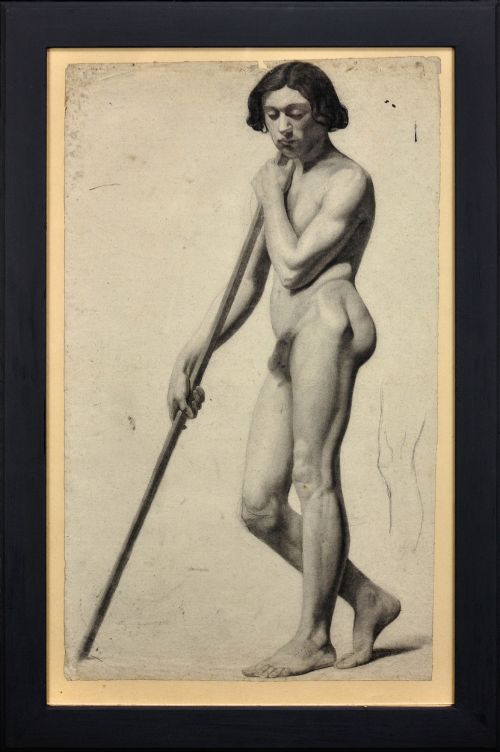
The subjects include formal portraits of gentlemen, literary figures, and historical personages. Academic life studies of male nudes carrying staves or standing are also common.
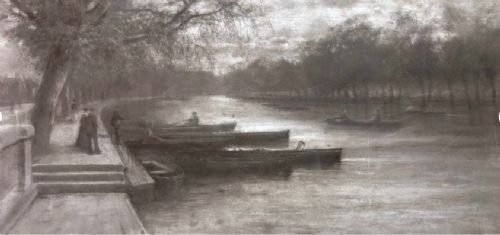
Landscapes, cityscapes such as the Bedford Embankment, and dramatic Victorian shipwreck seascapes complete the thematic range. Many works reflect academic realism or Edwardian tonalism.
How do I identify a Victorian drawing?
Nineteenth-century drawings typically employ paper supports characteristic of the period, often housed in original wood or gilt wood frames. Signatures, dates, and inscriptions provide direct documentation of the era.
Stylistic markers such as academic realism and academic life study conventions point to nineteenth-century training methods. Examining the backing boards and framing materials offers additional clues to age.
Are these works original art?
The listings comprise original hand-drawn works executed directly in charcoal, chalk, and graphite on paper. Each piece represents a unique historical graphic creation rather than a mechanical reproduction.
Artists drew these studies by hand during the nineteenth and early twentieth centuries. Signatures, monograms, and preparatory markings confirm their status as original art.