



Victorian Champleve Clock
These Victorian champleve clock pieces bring vibrant coloured enamel and polished metalwork together in substantial mantel and carriage forms.

Victorian Champleve Clock
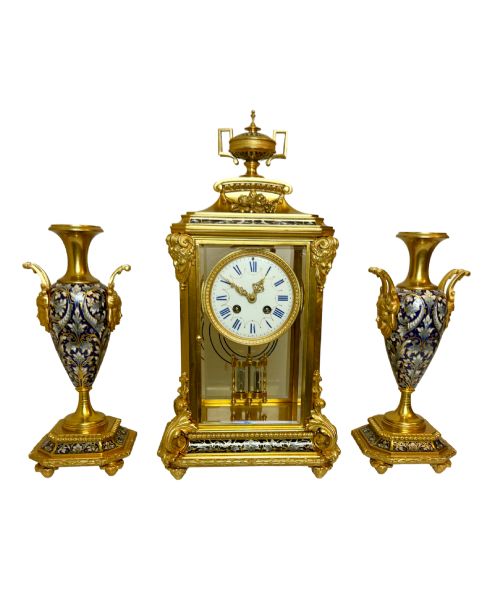
When you search for a victorian champleve clock, you encounter pieces that sit firmly within nineteenth-century French and British decorative arts. The selections span mantel clocks, carriage clocks, and larger clock garniture sets that combine timekeeping with sculptural display.
You meet variations ranging from compact bedside timepieces to elaborate crystal regulators and onyx mantel clocks. Many incorporate repeating mechanisms or hand-painted dials alongside their characteristic enamel work.
The aesthetic leans heavily on nineteenth-century French revival styles, including Second Empire and Rococo influences. These objects served as functional centrepieces for drawing rooms and studies during the period.
Materials and Construction
The construction relies heavily on cast brass, gilt bronze, and ormolu frames that provide structural integrity and a gleaming surface. Champleve enamel technique involves recessing troughs into the metal base, filling them with coloured vitreous paste, and firing the piece before grinding it flush.
Glass panels feature in crystal regulators and four-glass models to expose the intricate mechanical movements within. Additional decorative elements include hand-painted ceramic dials, onyx plinths, and inset enamel bandings.
Listings feature brass, gilt bronze, and ormolu paired with vibrant champleve enamel across various French and British nineteenth-century styles.
Judging Quality
Quality reveals itself in the crispness of the cast bronze or ormolu mounts and the depth of the champleve enamel work. Superior examples display smooth colour transitions and securely set vitreous pastes within the metal channels.
The complexity of the mechanism also dictates value, particularly in repeating carriage clocks and striking movements. Cases featuring matching garniture sets or unusual forms like novelty desk watches command stronger interest from collectors.
Le Roy and Fils·Barwise London
The Victorian Champleve Clock Glossary
- Champleve enamel
- A technique where troughs or cells are sunk into a metal surface and filled with enamel powder before firing. This creates colourful decorative patterns flush with the surrounding metal.
- Ormolu
- Gilded bronze used extensively for decorative mounts on nineteenth-century clock cases. The finish provides a rich golden appearance.
- Clock garniture
- A set comprising a central clock accompanied by matching decorative side pieces such as urns or vases. These arrangements decorated nineteenth-century mantelpieces.
- Crystal regulator
- A mantel clock featuring glass panels on all four sides to showcase the internal gear train and pendulum. Brass frames hold the glass panes in place.
- Repeating carriage clock
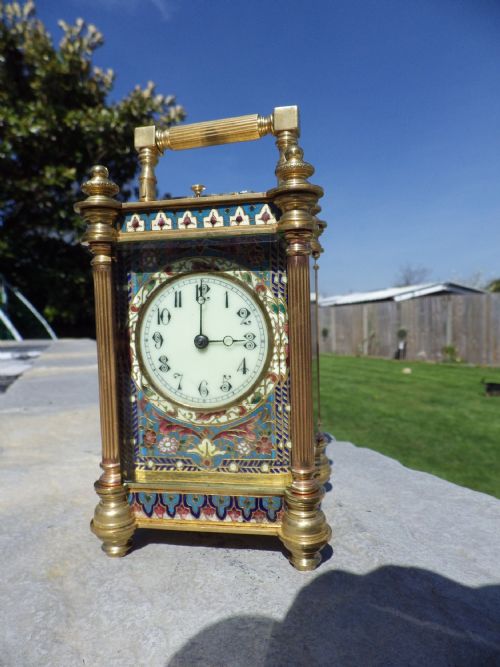
- A portable timekeeper equipped with a mechanism that chimes the hours and quarters upon pressing a button. These originated for travellers during the nineteenth century.
Victorian Champleve Clock: Frequently Asked Questions
How do I wind a carriage clock?
Use the dedicated winding key on the backplate, turning it gently until resistance indicates the mainspring is fully tensioned. Take care not to overwind.
Ensure you handle the heavy brass case securely by its fixed handle rather than movable top components when moving the clock.
What is a clock garniture set?
A garniture set pairs a central timepiece with matching ornamental side pieces, such as urns or candelabra, designed for symmetrical mantelpiece display.
These coordinated ensembles were popular in nineteenth-century drawing rooms to create a balanced decorative arrangement.
How do I clean enamel clock faces?
Dust the surface gently with a dry, soft-bristled brush to remove loose particles without scratching the glass or metal mounts.
Avoid liquid cleaners entirely, as moisture can seep into delicate nineteenth-century enamelwork and damage the underlying brass or bronze.
Why does my clock stop ticking?
Mechanical clocks often stop if they are standing on an uneven surface, which disrupts the balance wheel or pendulum beat.
Adjust the position slightly until the ticking sounds even, or consult a professional restorer if the movement requires a service.