
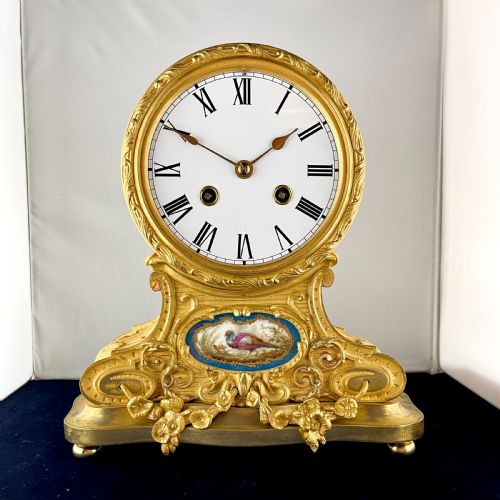


Floral Enamel Mantel Clock
A floral enamel mantel clock brings vibrant botanical decoration and dependable timekeeping to a room, combining painted petals with precious metal mounts.
Floral Enamel Mantel Clock
When you search for a floral enamel mantel clock, you are looking at domestic timepieces adorned with delicate painted or champlevé flowers upon enamel dials and panels. These pieces span the nineteenth and early twentieth centuries, drawing on French Rococo, Louis XVI, and Victorian design traditions.
The versions most commonly met on this page include French carriage clocks, gilt bronze drumhead clocks, and boudoir timepieces featuring enamel flower designs. Makers such as Leroy and Marti feature alongside unsigned Swiss and French works housed in ormolu, gilt brass, and painted wood.
Forms vary from compact repeating carriage clocks to larger bracket clocks and lyre clocks resting on matched stands. Each item merges mechanical movement with botanical artistry, reflecting the period taste for naturalistic ornamentation.
Materials and construction
These clocks rely on metal alloys such as gilt bronze, ormolu, and gilded brass to form the structural cases and decorative mounts. Craftsmen cast and chased these metals to support delicate glass panels and enamel dials.
Enamelwork forms the visual centrepiece, applied in champlevé techniques or hand-painted floral motifs directly onto metal or porcelain surfaces. Movements incorporate mechanical brass gear trains, ranging from simple timepieces to repeating and quarter-striking mechanisms.
One tiny boudoir timepiece manages to pack an entire floral garden and a silver case into a fraction of a mantel's footprint.
Assessing quality and craftsmanship
Quality reveals itself in the crispness of the gilt bronze or ormolu casting and the fineness of the hand-painted enamel flowers. Superior examples display depth and shading in the botanical artwork rather than flat, uniform application.
The sophistication of the internal movement dictates the tier of the piece, moving from standard timepieces to repeating carriage clocks and quarter-striking mechanisms. Signed works by established makers demonstrate superior mechanical precision and case finishing.
Leroy & Fils·Marti
The Floral Enamel Mantel Clock Glossary
- Ormolu
- Gilded bronze produced by applying a mercury-gilding mixture to a cast bronze base. This technique creates a rich, lasting golden surface frequently found on nineteenth-century French clock cases.
- Champlevé
- An enamelling technique where troughs are dug into a metal plate and filled with enamel powder before firing. The resulting design shows vibrant colours bounded by thin metal walls.
- Carriage clock
- A small, portable spring-driven timepiece designed for travel during the nineteenth century. They usually feature glass panels that reveal the escapement and movement inside.
- Drumhead clock
- A mantel clock featuring a circular dial housing shaped like a drum, mounted upon a pedestal or base. This distinct silhouette became popular during the nineteenth century.
- Repeating clock
- A mechanical timepiece equipped with a mechanism that chimes the last hour or quarter-hour on demand when a lever or button is pressed.
Floral Enamel Mantel Clock: Frequently Asked Questions
What is a floral enamel mantel clock?
A floral enamel mantel clock is a domestic timepiece decorated with hand-painted or champleve enamel flowers upon the dial or case. These pieces typically date from the nineteenth and early twentieth centuries.
They combine mechanical clockwork with decorative arts, often housed in gilt bronze, ormolu, or brass frames designed to sit upon a mantelpiece or desk.
Where were these clocks made?
The pieces seen here originate predominantly from French workshops and Swiss makers active during the nineteenth century. France and Switzerland dominated the production of decorative mantel and carriage clocks during this era.
Regional styles range from Parisian gilt bronze drumhead clocks to Swiss Neuchatel pieces and boudoir timepieces.
How do I care for enamel dials?
Enamel surfaces require gentle dusting with a soft, dry cloth to prevent the accumulation of dirt. Avoid chemical cleaners and excessive moisture, which can damage painted details.
Keep the clock away from direct sunlight and dramatic temperature fluctuations to protect the enamel from stress and discolouration.