


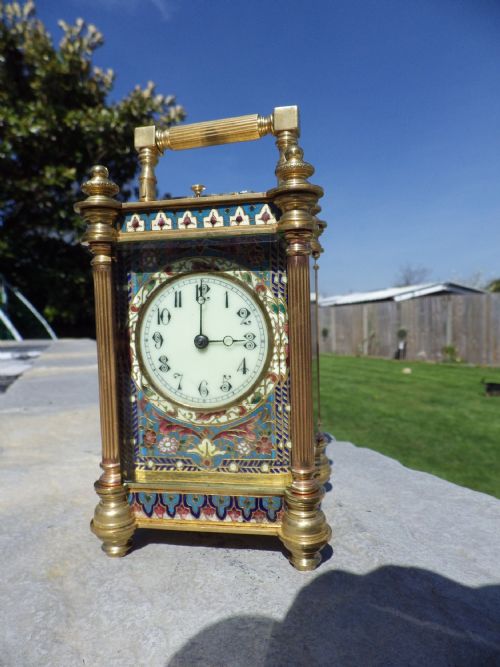


Champleve Desk Clock
A champleve desk clock brings vibrant enamelled colour and gilt metalwork to a mantelpiece, offering a striking centrepiece for a traditional interior.

Champleve Desk Clock
A champleve desk clock is primarily a nineteenth-century French or Victorian timepiece designed for a desk, mantel, or bedside table. These pieces range from small strut easel clocks and carriage clocks to larger mantel clocks and clock garniture sets.
The selections span distinct periods from the 1870s through the Edwardian era, encompassing Napoleon III, French Rococo Revival, and Belle Epoque styles. Buyers will encounter various formats including crystal regulators, novelty watch desk clocks, and repeating carriage pieces.
Originating largely from French workshops, these timepieces combine functional horology with decorative enamel work. The forms vary from simple oval four-glass designs to elaborate architectural cases mounted on bronze plinths.
Materials and construction
The construction relies heavily on cast gilt bronze, brass, or ormolu forming the structural chassis and decorative case. Glass panels feature frequently in crystal regulators and four-glass models to expose the movement.
Champleve enamel work defines the aesthetic, where troughs are gouged into the metal base, filled with vitreous enamel paste, and fired. Hand-painted dials and occasional diamontes complement the enamelled surfaces.
Some nineteenth-century makers packed complex timekeeping into novelty watch desk cases small enough to slip into a pocket.
Factors of quality
Quality rests in the crispness of the gilt bronze or ormolu casting and the depth and complexity of the champleve enamel patterns. Finer pieces demonstrate meticulous hand-painting on the dial and integration of repeating mechanisms or striking trains.
The structural integrity of the case, from heavy bronze plinths to multi-glass enclosures, separates standard production from superior examples. Maker attribution also influences standing, with signed works by known houses marking the upper tier.
Le Roy and Fils·Barwise London
The Champleve Desk Clock Glossary
- Champleve Enamel
- An enamelling technique where sunken channels are carved into a metal surface and filled with coloured vitreous paste before firing. This creates raised metal outlines around the vibrant enamel fields.
- Ormolu
- Finely ground high-purity gold applied to a bronze base using mercury amalgamation. It provides a durable, rich golden surface finish typical of fine French decorative objects.
- Crystal Regulator
- A mantel clock housed within glass panels on all four sides, allowing a clear view of the mechanical movement and pendulum. These typically feature brass or gilt bronze framing.
- Carriage Clock
- A small, portable spring-driven timepiece originally designed for travel by horse-drawn carriage. They generally feature a rectangular brass or gilt case with a handle on top and a glass top panel to view the escapement.
- Garniture Set
- A decorative grouping consisting of a central clock flanked by matching ornamental side pieces such as urns or vases. They are designed to sit together on a mantelpiece or sideboard.
Champleve Desk Clock: Frequently Asked Questions
What is a champleve desk clock?
A champleve desk clock is a nineteenth-century or Edwardian timepiece featuring metalwork decorated with fused glass enamel. These clocks were produced predominantly in France and Switzerland.
They serve as decorative timepieces for desks, bedside tables, and mantelpieces, combining mechanical movements with ornate metal and enamel cases.
How do I identify a Victorian champleve clock?
Victorian examples often display French influence through gilt bronze, ormolu, or brass construction paired with vibrant champleve enamel panels. Look for stylistic cues such as Rococo Revival curves or Belle Epoque detailing.
Many of these pieces date from the 1870s to the 1900s, encompassing various formats from carriage clocks to larger mantel timepieces.
Where should I place a desk clock?
These clocks suit stable, flat surfaces such as mantels, bureaus, or bedside tables where their decorative cases can be appreciated. Enamelled and gilt surfaces benefit from being kept away from direct sunlight and excessive moisture.
Smaller strut easel clocks work well on flat desk surfaces, while heavier crystal regulators require sturdy mantel support.
What is a crystal regulator clock?
A crystal regulator is a style of clock featuring heavy glass panels on the front, back, and sides. This design exposes the movement and mercury or gridiron pendulum to view from multiple angles.
These pieces usually incorporate gilt brass or ormolu framing and frequently feature enamel accents on the dial or bezel.