
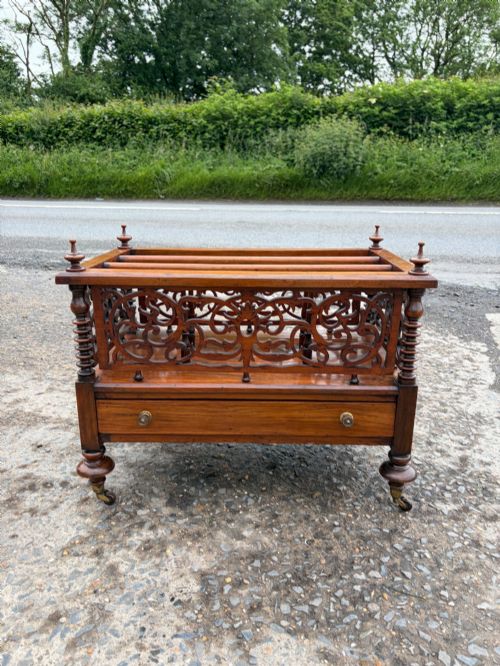


Victorian Carved Canterbury Stand
A victorian carved canterbury stand combines partitioned storage for periodicals or sheet music with a sturdy lower drawer or table base, offering practical elegance for a traditional sitting room.
Victorian Carved Canterbury Stand
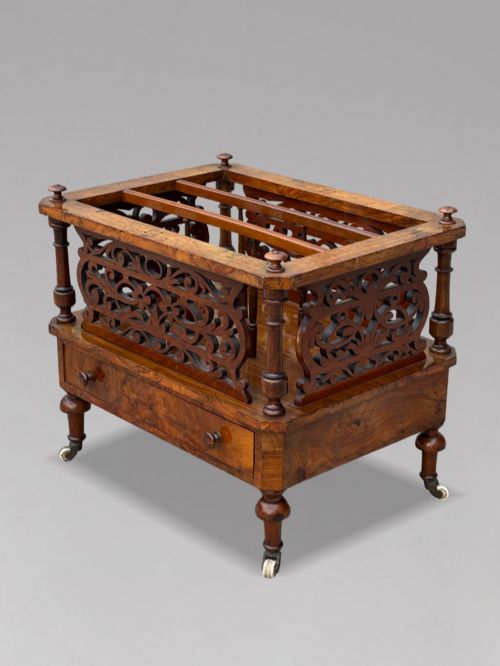
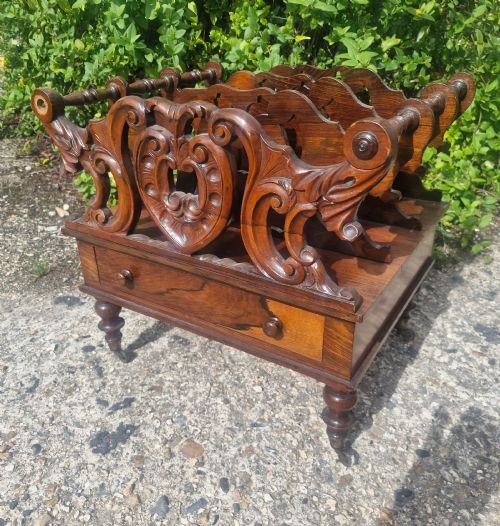
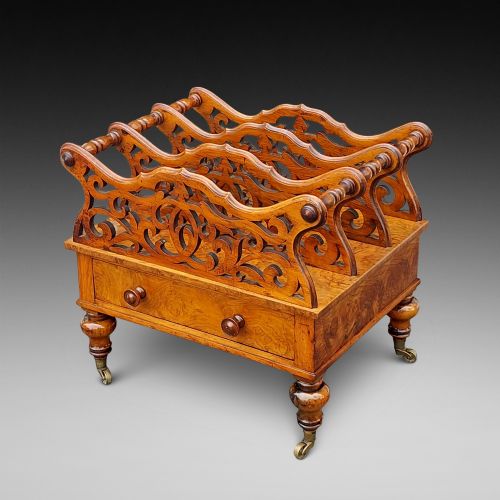
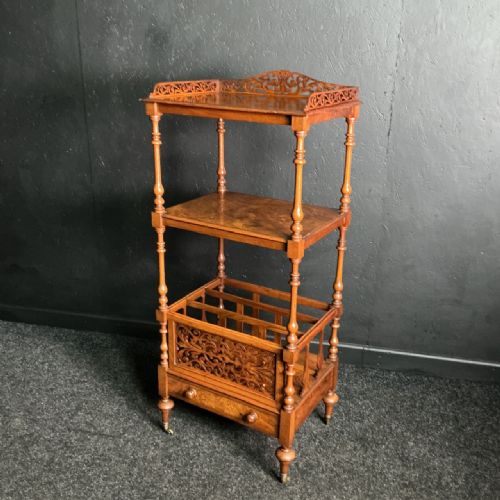
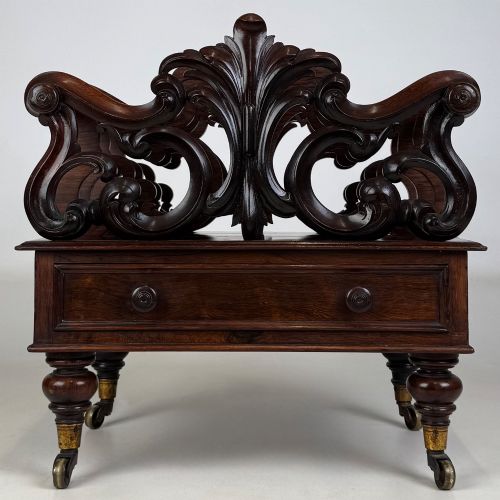
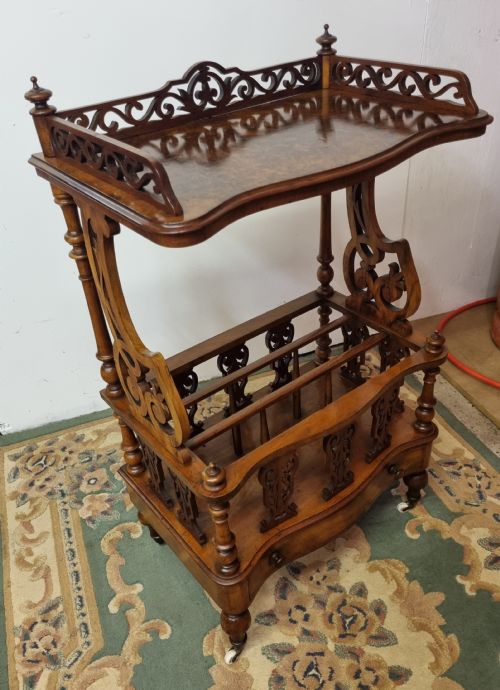
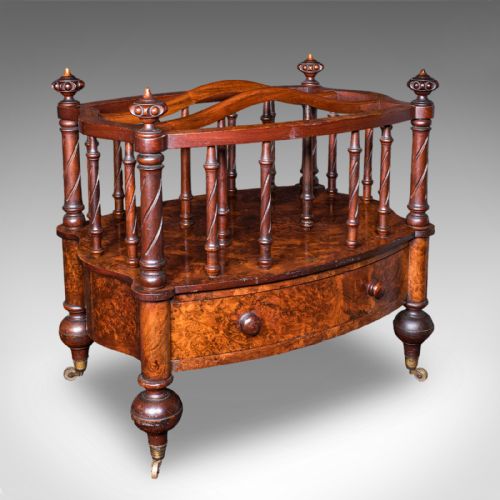
A victorian carved canterbury stand is a versatile piece of nineteenth-century furniture designed originally to hold sheet music, folios, newspapers or magazines. On this page, buyers will most frequently encounter walnut, burr walnut and rosewood variations shaped with pierced partitions and occasionally combined with a lower drawer or occasional table top.
The form bridges the gap between a display surface and a practical rack, often incorporating slender turned supports, ceramic castors or serpentine profiles. While many date securely to the Victorian era and the broader nineteenth century, examples also span Regency, William IV and Aesthetic Movement styling.
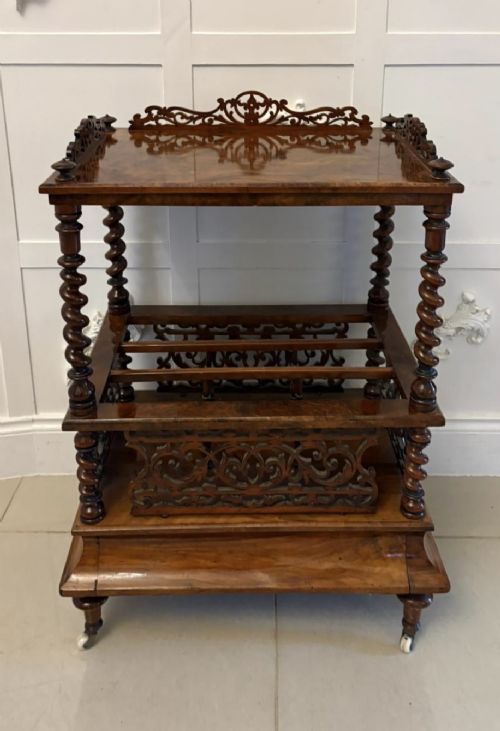
Makers adapted the form for music rooms and drawing rooms alike, producing dedicated music cabinets, drop-front holders and multi-tiered whatnots alongside traditional freestanding newspaper racks.
Materials and construction
Cabinetmakers utilised rich timber veneers such as burr walnut and rosewood over solid secondary woods, applying intricate wood inlay and carved details to the upright supports and division rails. Turned brass castors and ceramic mounts frequently finished the base.
Partition slats were typically fretted or pierced from solid boards, then joined carefully to the base plinth to handle the weight of heavy bound volumes without compromising the delicate scrollwork.
Early musicians trusted these stands to keep their heaviest opera scores from sliding onto the drawing room rug.
Distinguishing quality across examples
Superior pieces display deep, natural figuring in the burr walnut or rosewood veneer alongside crisp, hand-carved mouldings rather than shallow machine stamping. The joinery of the pierced divisions and the integrity of the lower drawer show the maker's underlying skill.
Proportion and stability separate standard utility pieces from exceptional salon furniture. A well-balanced frame retains its original castors and displays harmonious curves without heavy timber distortion or mismatched grain patterns.
Henry Ogden & Son
The Victorian Carved Canterbury Stand Glossary
- Canterbury
- A low stand with partitioned sections designed for holding music sheets, books or newspapers. It typically includes a small drawer beneath the rack.
- Burr Walnut
- A highly prized timber veneer derived from the growth warts of walnut trees. It yields swirling, organic patterns across table tops and panels.
- Whatnot
- A piece of open shelving furniture with multiple tiers used for displaying ornaments or holding books. It often integrates directly with a canterbury base.
- Serpentine
- A curved line that undulates inwards and outwards, commonly seen along the front edge or top shelf of finer nineteenth-century cabinets.
- Aesthetic Movement
- A late nineteenth-century design style emphasising visual beauty over narrative meaning. It drew inspiration from Japanese art and simplified geometric forms.
Victorian Carved Canterbury Stand: Frequently Asked Questions
What were canterbury stands originally used for?
These stands were built to hold sheet music, folios and heavy books near a piano or seating area. The partitioned upper sections kept scores organised and upright for musicians.
Over time, owners also used them for newspapers and weekly periodicals in the drawing room. The addition of a drawer provided extra storage for smaller accessories.
How do I identify a Victorian canterbury?
Look for characteristic nineteenth-century timber choices such as burr walnut, rosewood and mahogany, often complemented by intricate wood inlay or turned uprights. Pierced scroll partitions and ceramic castors are also typical markers of the period.
Details like serpentine shaping and applied mouldings help distinguish mid-century salon pieces from earlier Regency designs.
Where should I place a canterbury in my home?
A canterbury sits naturally beside a sofa, armchair or piano where its open rack can hold current reading material or sheet music. Freestanding models with table tops also function well as occasional lamp tables.
Keep the timber away from direct heat sources and strong sunlight to protect the delicate veneers and polished finishes.
What is the difference between a canterbury and a whatnot?
A canterbury focuses primarily on partitioned storage for books or paper with a low profile, sometimes adding a small drawer or surface. A whatnot consists of multiple open display shelves rising upwards for ornaments.
Many refined nineteenth-century examples combine both forms by mounting shelving tiers directly above the music rack base.