



Victorian Canterbury Cabinet
A victorian canterbury cabinet brings refined partitioning and open display to sheet music and periodicals.
Victorian Canterbury Cabinet
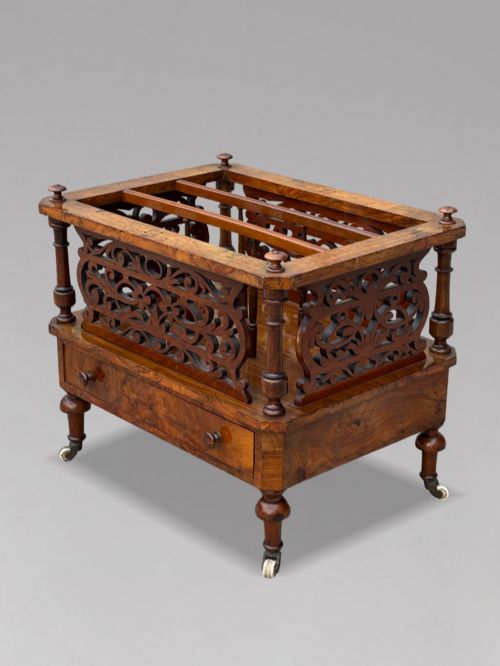
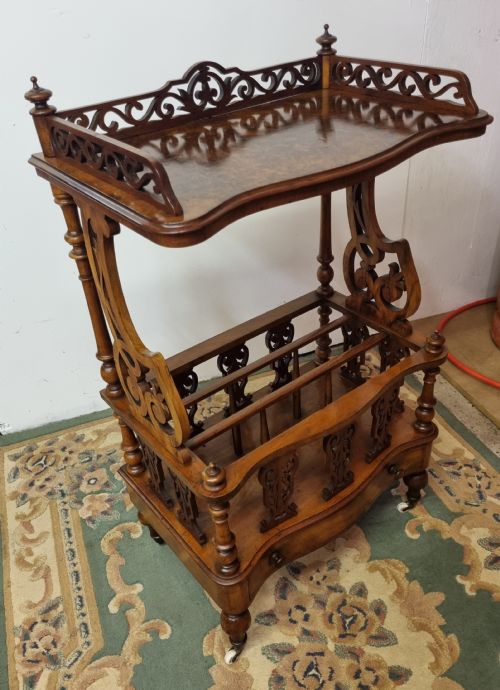
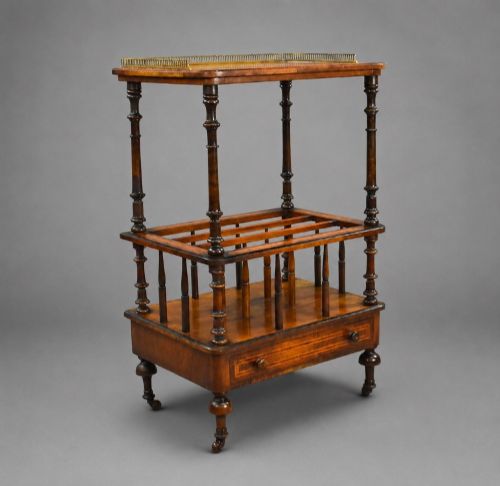
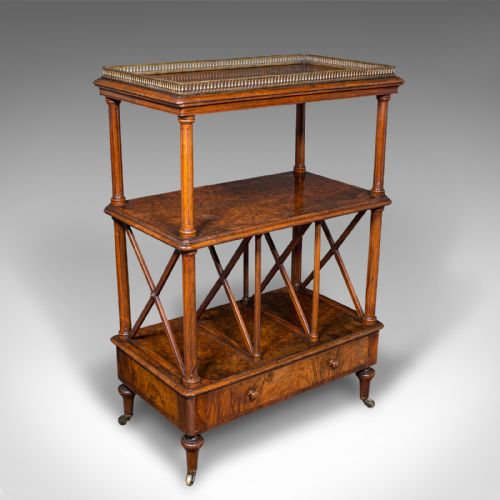
A victorian canterbury cabinet combines traditional slatted dividers designed for holding folios and sheet music with enclosed cupboard space, drawers or open shelves. These pieces frequently appear in rich timbers such as burr walnut, rosewood and mahogany.
The form evolved during the nineteenth century from simple open racks into multifunctional side cabinets, music stands and tiered what-nots. Buyers encounter variants ranging from serpentine-shaped tables to tall fall-front cabinets.
Origins span English workshops alongside French and American examples from periods including the Regency, William IV and Aesthetic Movement. Many incorporate marquetry inlay, brass accents or ceramic castors to aid movement across the floor.
Materials and Construction
Cabinetmakers utilised dense hardwoods like mahogany and rosewood, alongside decorative veneers such as burr walnut and satinwood applied over solid pine or oak carcases. Marquetry and contrasting stringing provide geometric or floral ornamentation across flat surfaces.
Structural elements frequently feature brass handles, hinges and castors, while internal partitions rely on shaped wooden slats and vertical dividers to organise paper. Fall-front mechanisms and locking doors required precise joinery to ensure smooth operation of compartments.
Listings feature walnut, rosewood, mahogany and satinwood across Victorian, Regency and Aesthetic Movement styles.
Distinctions in Quality
The calibre of a piece rests upon the selection of timber veneers, particularly the richness of figured burr walnut and the precision of inlaid marquetry details. Master craftsmen matched wood grain symmetrically across serpentine fronts and tabletops.
Construction depth separates standard production from exceptional work, seen in dovetailed drawer linings, substantial brass hardware and integrated side columns or carved galleries. Pieces bearing specific maker attribution or complex multi-functional forms represent higher tiers of craftsmanship.
Henry Ogden And Son
The Victorian Canterbury Cabinet Glossary
- Canterbury
- A low stand or cabinet originally designed for holding sheet music, folios or periodicals, featuring vertical partitions.
- Burr walnut
- A prized timber veneer obtained from the gnarled growths of walnut trees, noted for its swirling, highly decorative grain patterns.
- Marquetry
- The art of applying thin pieces of wood veneer to a structure to form decorative patterns or pictures.
- Whatnot
- A piece of furniture consisting of a set of open shelves for displaying small objects, often combined with a cabinet base.
- Fall-front
- A hinged door or panel that drops down to form a writing surface or to provide access to internal compartments and slots.
Victorian Canterbury Cabinet: Frequently Asked Questions
What was a canturbury cabinet used for?
These cabinets served primarily to store sheet music, unbound books and periodicals near parlour pianos or sitting room seating areas.
Over the nineteenth century, the design adapted to incorporate drawers for small accessories and shelves for displaying decorative objects.
How do I identify a Victorian piece?
Look for characteristic timber choices such as burr walnut and rosewood, alongside stylistic indicators like Aesthetic Movement or Gothic Revival influences.
Construction methods including hand-cut dovetails and the presence of brass castors help distinguish nineteenth-century examples from later reproductions.
Where should I place it?
A freestanding cabinet suits living rooms, studies or hallways, functioning effectively as an occasional table or bedside unit.
Position the piece away from direct heat sources to protect delicate veneers and polished wooden surfaces from drying out.
What styles are available?
The selection includes formal Regency and William IV designs, decorative Aesthetic Movement cabinets, and later Art Nouveau variations.
Forms range from open lattice racks to multi-functional side cabinets featuring drawers, drop-front compartments and tiered etagere tops.