
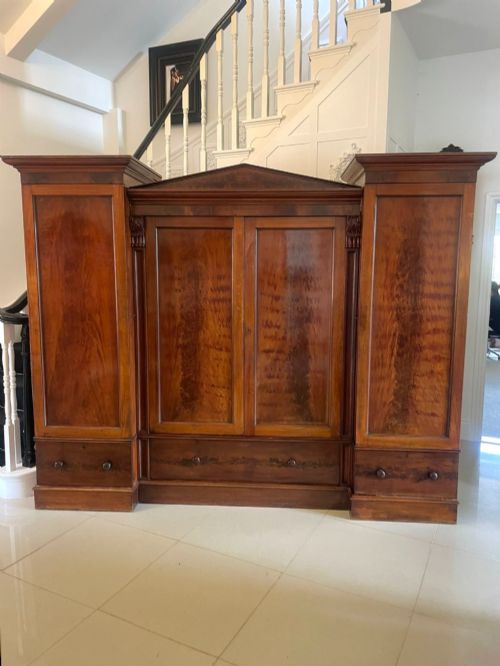
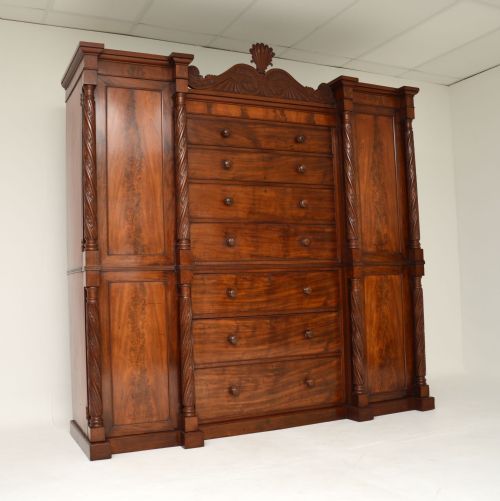
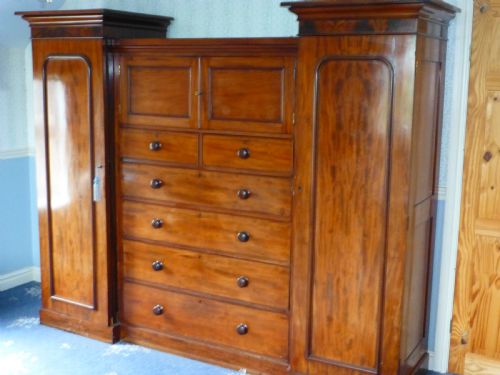
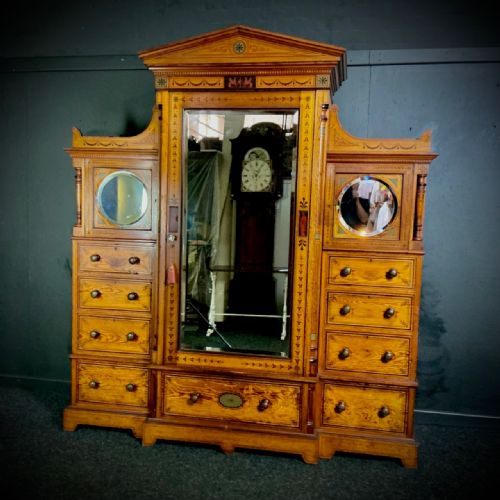
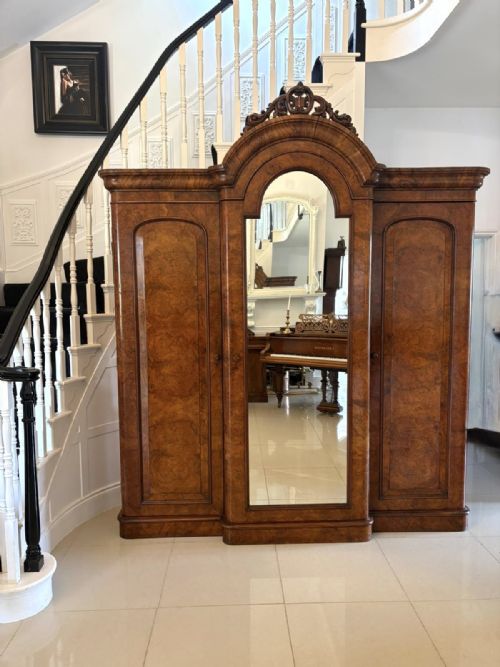


Victorian Breakfront Wardrobe
A victorian breakfront wardrobe organises a grand bedroom with architectural presence and generous compartmentalised storage.
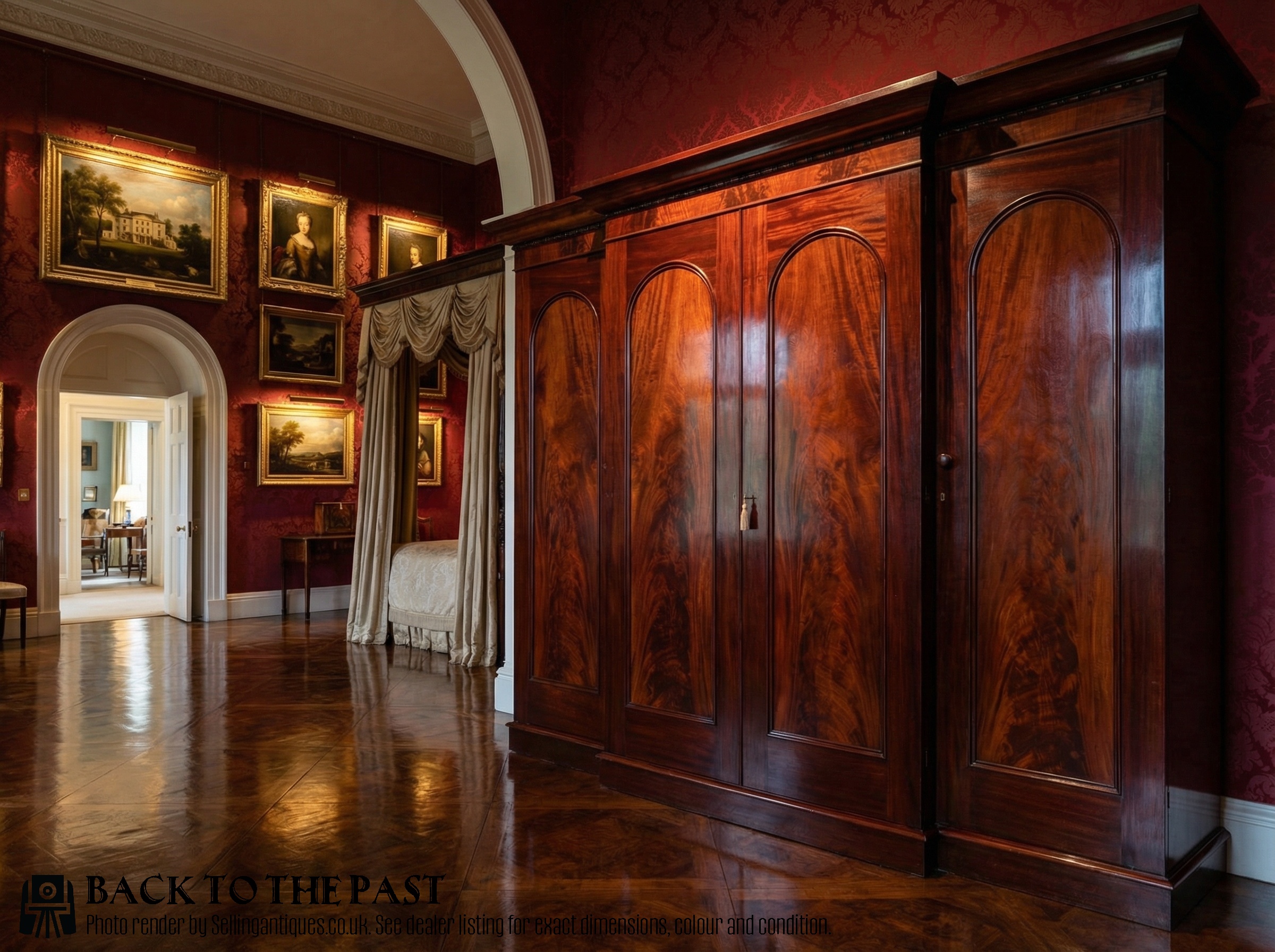
Victorian Breakfront Wardrobes
A victorian breakfront wardrobe presents a commanding facade where the central section projects forward from the flanking wings, creating a strong architectural rhythm in the bedroom. These substantial pieces typically span three or four doors, offering vast internal capacity for hanging garments and linen.
Mahogany and burr walnut dominate the selection, appearing in both solid construction and rich veneer work. Many examples incorporate interior drawers and sliding trays, functioning as complete compactum units designed for comprehensive wardrobe organisation.
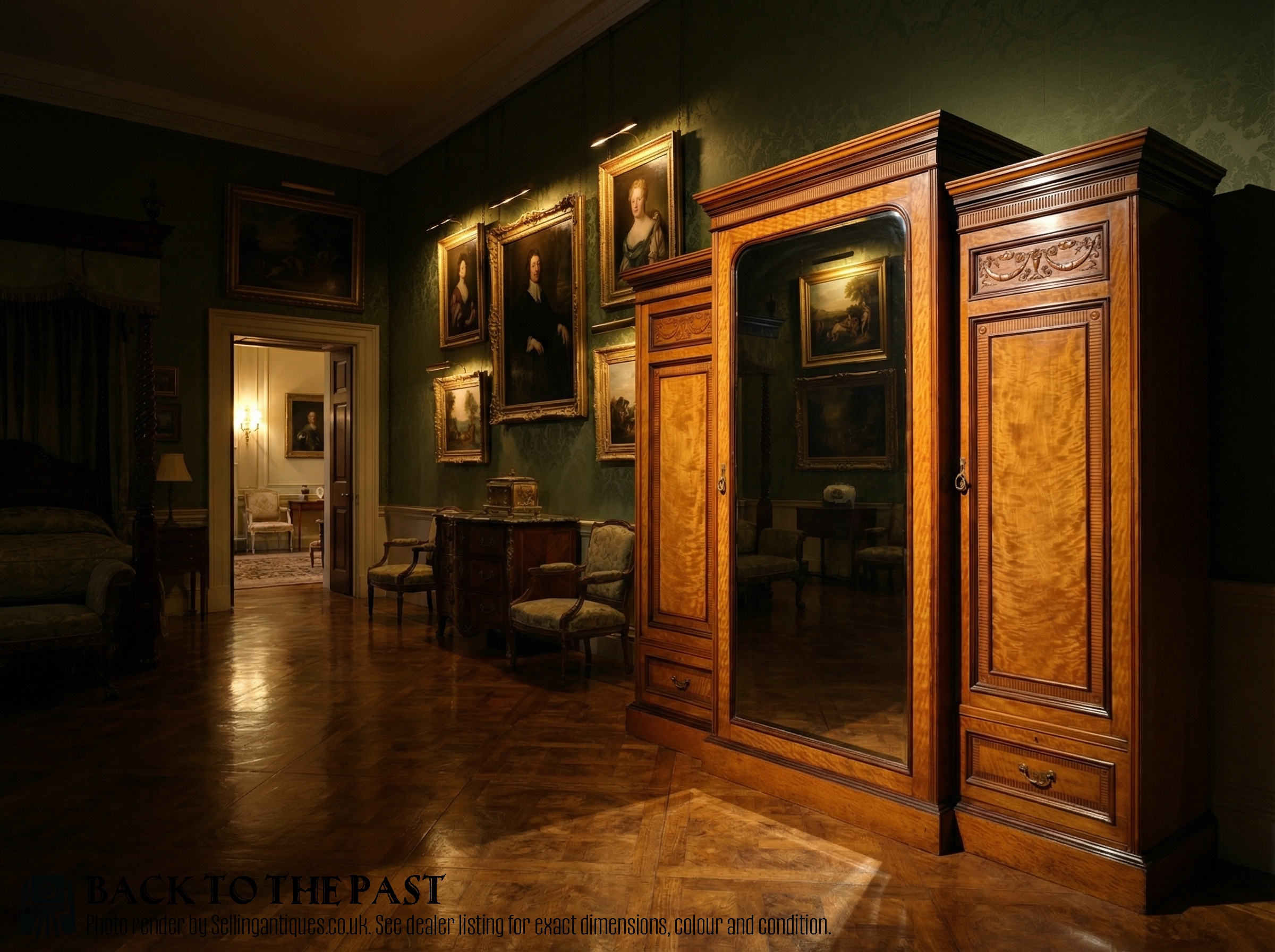
Construction and Materials
The architectural form relies on precise joinery to manage the heavy timber doors without warping over decades of use. Carved details and moulded cornices crown the upper sections, uniting the projecting central bays with the recessed wings.
Retail Price Guide 2026
Typical UK retail prices for victorian breakfront wardrobe, calculated from the Sellingantiques database of over a million retail prices indexed since 2003. This retail price guide relies exclusively on Sellingantiques data; no external sources or auction records are used, so the figures do not describe the wider market.
The Spectrum of Quality
Quality rests upon the selection of timber veneers and the architectural ambition of the breakfront configuration. Highly figured grains, symmetrical flame mahogany, and rich burr walnut elevate the visual impact far beyond plain timber surfaces.
Internal sophistication also defines the upper tier, where fitted compactums feature precise drawer dividers, sliding linen trays, and integrated dressing spaces rather than simple empty hanging cavities.
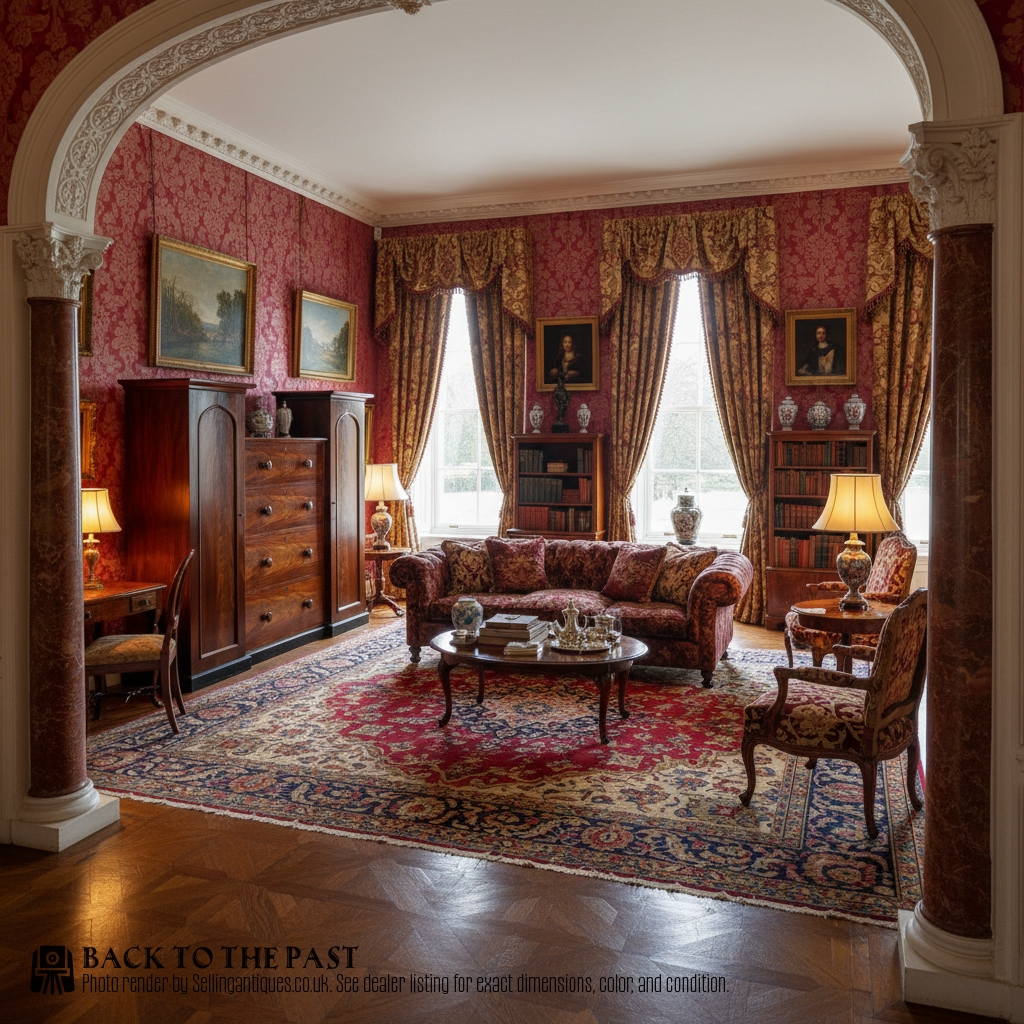
Gillows·Robert Strahan of Dublin·Maple and Co.
The Victorian Breakfront Wardrobe Glossary
- Breakfront
- An architectural cabinet design where the central section projects forward from the flanking side sections. This arrangement creates depth and shadow across large furniture facades.
- Compactum
- A multi-functional wardrobe combining hanging space with drawers, shelves, and sliding trays. It provides comprehensive storage within a single large piece of furniture.
- Flame Mahogany
- A veneer cut from timber where the grain resembles flickering flames. Cabinet makers matched these dramatic patterns symmetrically across large wardrobe doors.
- Burr Walnut
- Timber taken from walnut tree growths, producing swirling, intricate grain patterns. It forms a luxurious surface on high-status Victorian wardrobes.
Frequently Asked Questions
How do I dismantle a breakfront wardrobe?
These large wardrobes typically separate into distinct modular components, including a heavy cornice, a base plinth, central and side carcases, and individual heavy doors.
Careful dismantling requires noting the position of each screw and panel to ensure proper realignment during reassembly in a new room.
What is a compactum wardrobe?
A compactum is a specialised fitted wardrobe that integrates multiple storage functions, such as linen slides, drawers, and hanging space, into one unified piece.
This internal arrangement reflects Victorian desires for organised domestic management and specialised clothing care.
How do I care for mahogany veneers?
Polished timber surfaces require stable room humidity and protection from direct sunlight to prevent the underlying veneers from drying and lifting.
Regular dusting with a soft, dry cloth preserves the natural lustre of the polished wood without building up heavy wax residues.
How do I distinguish walnut from mahogany?
Mahogany displays a warm reddish-brown colour with straight or figured grain patterns, while walnut presents deeper chocolate and golden brown tones with swirling burr formations.
Examining the grain under natural light reveals the distinct cellular structures and natural pigments characteristic of each timber species.