
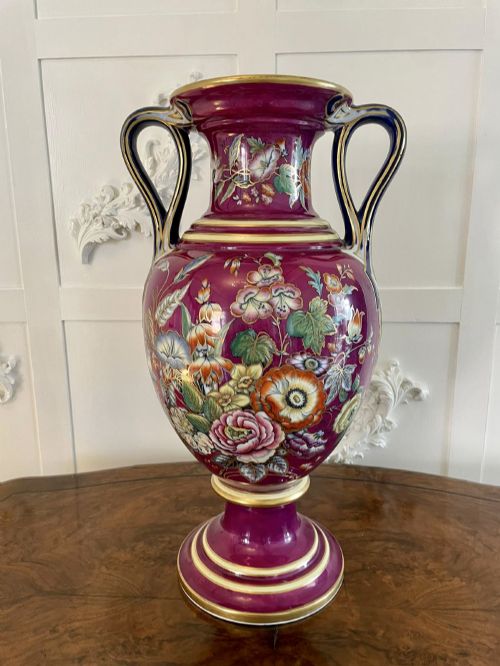


Victorian Botanical Pottery
Victorian botanical pottery brings nineteenth-century flora into the home through painted earthenware, ironstone and porcelain.
Victorian Botanical Pottery
Victorian botanical pottery encompasses tableware, vases and wash basin sets decorated with flowers, foliage and garden wildlife. Pieces from this search phrase range from mid-nineteenth-century transfer-printed plates to later hand-painted studio pottery.
The most common forms encountered here are jugs, vases and plates, often featuring specific floral motifs like roses, sunflowers or poppies. Makers across Staffordshire and beyond utilised various earthenwares and porcelains to capture natural detail.
Examples stretch across the nineteenth century, touching upon Aesthetic Movement and Art Nouveau styles. Buyers select these items for their rich plant ornamentation and domestic utility.
Materials and production methods
Potters employed earthenware, ironstone and porcelain as bases for botanical decoration. These bodies received glazes, enamels and sometimes gold leaf highlights to enhance the plant motifs.
Techniques included transfer printing for precise outlines, alongside hand-painted application for individual floral studies. Firing processes fixed the colours beneath or above the glaze depending on the workshop method.
The listings show nineteenth-century periods including eighteen eighty, eighteen ninety, and eighteen fifty, utilising earthenware, porcelain, and enamel.
Assessing quality in the collection
Quality rests upon the crispness of the botanical painting and the refinement of the ceramic body. Hand-painted examples demonstrate individual artist skill, whereas transfer prints vary in alignment and clarity.
The sophistication of the glaze and the weight of the ironstone or porcelain indicate the ambition of the piece. Matching sets and signed works by notable designers elevate the standing of an item within the range.
Doulton Lambeth·Livesley Powell And Co·Ernst Wahliss·Elkin And Newbon·George Jones·William De Morgan
The Victorian Botanical Pottery Glossary
- Earthenware
- A porous pottery body fired at lower temperatures, requiring a glaze to become impermeable. It forms the base for many nineteenth-century plates and jugs.
- Ironstone China
- A durable, heavy earthenware developed in the nineteenth century to imitate porcelain. It provides a sturdy surface for botanical transfer prints.
- Porcelain
- A fine, vitrified ceramic made from kaolin, fired at high temperatures until translucent. It allows for delicate vases and dessert services.
- Transfer Printing
- A method of applying engraved designs to ceramics via paper from a copper plate. This technique enabled uniform production of floral patterns.
- Majolica
- A colourful, lead-glazed earthenware popular in the Victorian period. It suits naturalistic plant forms like bullrushes and leaves.
Victorian Botanical Pottery: Frequently Asked Questions
What is Victorian botanical pottery?
It is nineteenth-century ceramics decorated with flowers, leaves and garden birds. Items range from everyday plates to decorative exhibition vases.
The category spans various ceramic bodies including ironstone and porcelain. Each piece reflects the period interest in natural history and garden flora.
How were these botanical jugs used?
Jugs served practical roles in nineteenth-century households for water, wash basin sets or milk. Larger vessels functioned as display pieces in parlours.
Their botanical decoration turned functional domestic objects into decorative displays. Many survived within matched wash sets or dessert services.
How do I identify Art Nouveau pieces?
Art Nouveau ceramics display flowing, stylized plant lines rather than strict botanical realism. Look for sinuous stems and organic forms typical of the late nineteenth century.
Makers applied these fluid motifs to vases and tableware around eighteen ninety. This style follows earlier Victorian naturalism.
What ceramic bodies are common?
Listings feature earthenware, ironstone and porcelain. Earthenware and ironstone provide durable surfaces for transfer-printed and hand-painted floral designs.
Porcelain appears in finer vases and dessert services. Each material influences the weight and translucency of the finished object.