


Victorian Barograph
A victorian barograph is a mechanical weather-recording instrument housed in a glazed timber case, prized for tracking atmospheric pressure with inked precision.
Victorian Barograph
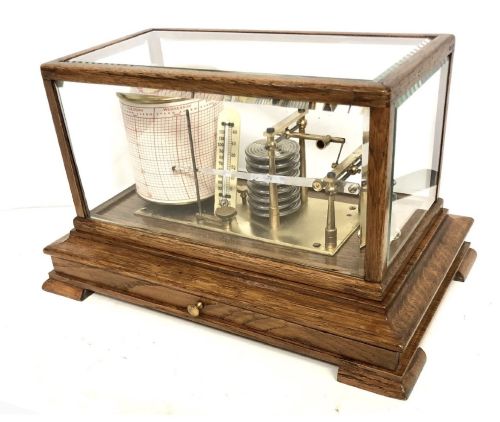
A victorian barograph is a self-recording meteorological instrument designed to trace atmospheric pressure onto a rotating paper chart over the course of a week. These scientific instruments combine mechanical engineering with fine cabinet-making, housed beneath glazed protective covers to allow continuous observation.
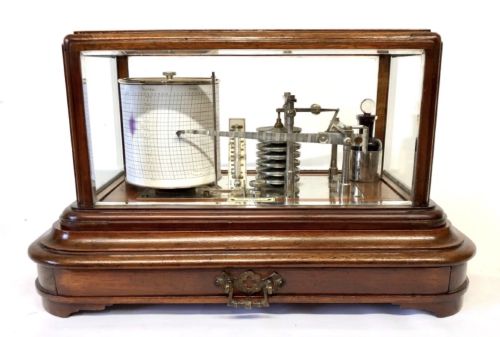
The most common examples on this page are housed in mahogany, oak, or walnut cases, frequently featuring bevelled glass panels and a lower drawer for spare paper charts. Many incorporate a mercury thermometer mounted beside the recording drum, whilst some combine the mechanism directly with an aneroid barometer dial.
Materials and Construction
The casing relies heavily on dense hardwoods such as mahogany, oak, and walnut, joined with tight cabinetry to protect the delicate interior mechanism from dust and draughts. Bevelled glass panels are set into brass or timber frames to provide clear views of the working parts from every angle.
The internal recording apparatus utilises brass and steel linkages connected to a stack of vacuum-sealed metal bellows that expand and contract with atmospheric changes. An inked arm attached to this movement traces the pressure variations onto a clockwork-driven brass drum holding a paper chart.
The archive records pieces originating from regional British makers as well as international establishments in Hong Kong and Singapore.
Distinctions in Quality
The standard of the timber case and the crispness of the maker's signature engraved on the brass bedplate define the upper tier of these instruments. Finer examples display superior cabinet work, such as figured walnut or polished mahogany with integrated thermometer scales and heavy bevelled glass.
The precision of the mechanical linkages and the quality of the clockwork drum movement further separate standard workshop pieces from those produced by premier scientific instrument makers. The inclusion of a chart drawer and robust brass fittings indicates a higher grade of production intended for professional or affluent domestic use.
GAUPP & CO HONGKONG & SINGAPORE·NEGRETTI & ZAMBRA LONDON·SHORT & MASON LONDON·BAINES HARROGATE·Antoine Redier·RICHARD FRERES·Beck·Dolland of London·Adie
The Victorian Barograph Glossary
- Aneroid barometer
- An instrument that measures atmospheric pressure using expanding and contracting metal bellows rather than liquid mercury. It forms the primary sensing element inside a barograph.
- Chart drawer
- A small storage compartment built into the base of the wooden case beneath the recording mechanism. It holds spare weekly paper charts and spare bottles of special recording ink.
- Clockwork drum
- A cylindrical brass drum rotated by an internal spring-driven movement once every seven days. The paper chart is wrapped around this cylinder to receive the ink trace.
- Bevelled glass
- Heavy plate glass panes with angled, polished edges fitted into the sides and top of the wooden case. This allows an unobstructed view of the working mechanism while protecting it from air currents.
Victorian Barograph: Frequently Asked Questions
How does a barograph work?
A stack of sealed metal vacuum chambers expands or contracts as atmospheric pressure rises and falls. This physical movement transfers through brass levers to an arm holding an ink nib, which records the pressure onto a revolving paper chart.
The rotating drum contains a clockwork mechanism that turns the cylinder once every seven days. This continuous mechanical tracing provides a complete visual history of local weather patterns throughout the week.
Where should I place a barograph?
These instruments require a stable, level surface away from direct sunlight, central heating radiators, and damp areas. Placing the timber case on a sturdy sideboard or table prevents vibrations from interfering with the delicate recording arm.
Because the mechanism relies on precise mechanical balance, avoiding high-traffic locations where the furniture might be bumped ensures the recording trace remains accurate and unbroken.
How do I change the chart?
Weekly charts are replaced by lifting the hinged pen arm away from the brass drum and sliding the old paper slip off the cylinder. A fresh chart is wrapped securely around the drum, aligning the time markings with the start position.
After securing the new paper, the ink nib is gently lowered back onto the surface, and the clockwork drum is wound using its dedicated key if the movement requires manual power.
What is the difference between a barometer and a barograph?
A standard barometer uses a dial and a single needle to show the current atmospheric pressure at the exact moment you look at it. It provides an instantaneous reading of the weather conditions.
A barograph records that pressure continuously over time by drawing a permanent ink line on a rotating chart. This allows you to study pressure trends and see whether the weather has been steadily rising or falling over days.