


Victorian Ale Pitcher
These Victorian ale pitchers are stout, honest vessels of copper, pewter, brass and stoneware built for serving hearty pours in taverns and homes.
Victorian Ale Pitcher
A victorian ale pitcher serves as a sturdy container for pouring and measuring beer, cider, and spirits in nineteenth-century settings. The selection on this page centres primarily on substantial metal and ceramic vessels, taking the form of jugs, flagons, harvest jugs, and haystack measures.
Most examples hail from the nineteenth century, encompassing styles from rustic country taverns to more finished Victorian provincial designs. Buyers frequently encounter copper and brass measures alongside salt-glazed stoneware harvest jugs and traditional pewter flagons.
Forms range from intimate spirit measures up to large four-gallon measuring jugs bearing official VR marks. These pieces reflect the robust drinking customs of the era, combining utilitarian capacity with straightforward decorative appeal.
How they were made
Metal vessels such as copper and brass measures rely on skilled sheet metalwork, featuring seamed construction and applied brass bands or copper riveting. Coopered wooden oak jugs utilise tight stave construction reinforced with heavy brass hoops.
Pewter pieces typically employ casting methods to shape the heavy metal into characteristic haystack forms or traditional tavern jugs. Ceramic harvest jugs are formed from clay and stoneware, finished with salt glazes and occasionally fitted with silver rims.
Some measures arrived in matched nests so tight they stacked like nesting dolls, saving precious tavern shelf space.
What varies in quality
The standard of a Victorian ale pitcher rests upon the heaviness of its gauge and the crispness of its construction. Thicker metal walls, clean seaming, and well-balanced handles distinguish finer workshop output from simpler utilitarian ware.
Originality of surface and marks defines the upper tier of pieces, where maker stamps, capacity verification VR marks, and genuine patination remain intact. Graduated sets and matched pairs also demonstrate higher intentionality than single scattered vessels.
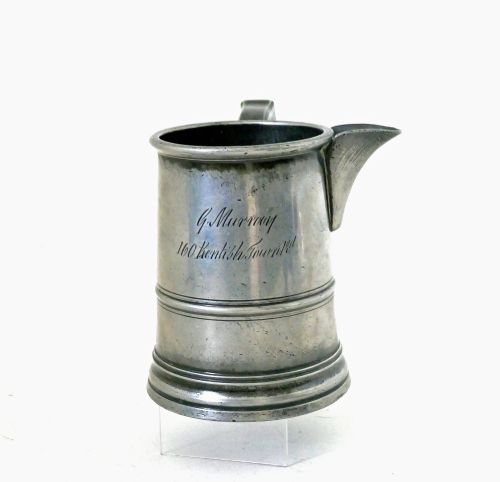
Doulton Lambeth·J. Bower·G. Murrouy
The Victorian Ale Pitcher Glossary
- Haystack measure
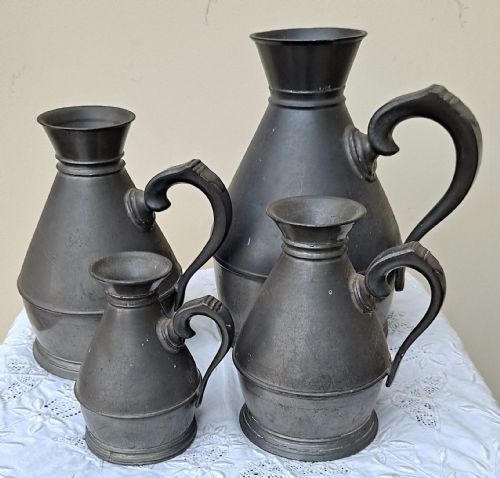
- A traditional Irish or British pewter measuring jug with a distinctive bulbous body tapering toward the top, resembling a stacked heap of hay. These measures were produced in graduated sets for fluid capacity.
- Harvest jug
- A large stoneware or earthenware container, often salt-glazed and decorated with relief hunting scenes, used during agricultural harvest celebrations. They frequently feature detailed Doulton Lambeth designs or applied silver rims.
- Coopered
- A method of construction where narrow wooden staves are fitted together and bound with metal hoops, much like a barrel. This technique is used for large wooden jugs reinforced with brass.
- VR mark
- The official royal cypher standing for Victoria Regina, stamped onto official measuring jugs to verify their legal accuracy for trade use. Such marks indicate the vessel served in public houses.
- Old Sheffield Plated
- An early method of fusing a thin sheet of silver onto a thicker copper base, creating tableware with rich metallic depth. This technique appears on nineteenth-century beer jugs and tankards.
Victorian Ale Pitcher: Frequently Asked Questions
What were Victorian ale pitchers used for?
These vessels served primarily for measuring, holding, and pouring ale, beer, and cider in domestic households and bustling nineteenth-century taverns. Larger multi-gallon jugs functioned as bulk storage or measuring standards.
Smaller individual measures allowed hosts and barmen to serve exact quantities of spirits and fermented drinks to patrons. Their robust construction ensured they could withstand daily use in busy drinking environments.
How do I display an ale pitcher at home?
Metal pitchers in copper, brass, and pewter look striking placed on open kitchen shelving, dressers, or beside a fireplace where their metallic surfaces catch the light. Grouping graduated sets together creates a strong visual focal point.
Stoneware harvest jugs integrate well into rustic or traditional dining spaces, often displayed on sideboards or tables. Their earthy glazes and textured reliefs provide natural warmth and historical texture to a room.
Are these pitchers waterproof for everyday use?
Most metal and glazed stoneware pitchers remain structurally sound and capable of holding liquids without issue. However, antique seams and historic repairs should be considered before putting delicate pieces to daily service.
Many collectors prefer to keep these vessels as decorative display items rather than risking moisture damage to aged interiors. A gentle wipe with a soft cloth suffices for routine care.
How can I tell the difference between copper and brass measures?
Copper exhibits a warm, reddish-pink metallic hue that develops a deep brown or green patination over time. Brass contains an alloy of copper and zinc, resulting in a brighter yellow or golden tone.
Many nineteenth-century pieces combine both materials, utilising copper bodies with contrasting brass bands, handles, or rims. Examining the metal under natural light reveals these distinct tonal differences.
What do official markings on these jugs mean?
Official marks, such as the VR crown stamp, indicate that the vessel passed government standards for commercial measuring accuracy. These inspection stamps confirm the piece worked in a licensed tavern or public house.
Maker stamps and capacity inscriptions provide further provenance, linking the vessel to specific potters, metalworkers, or geographic regions. Such details help date the piece within the Victorian era.