
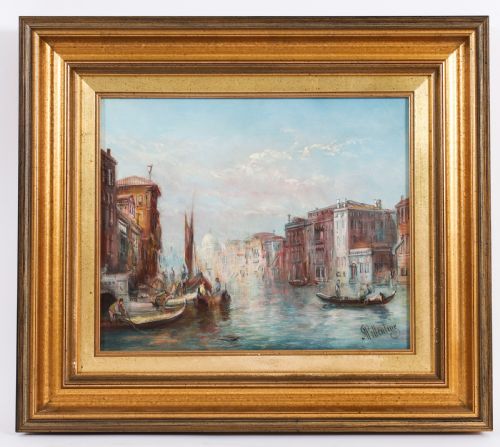
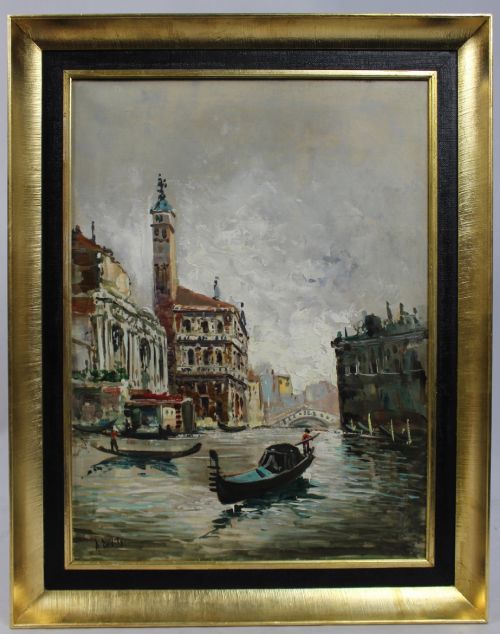
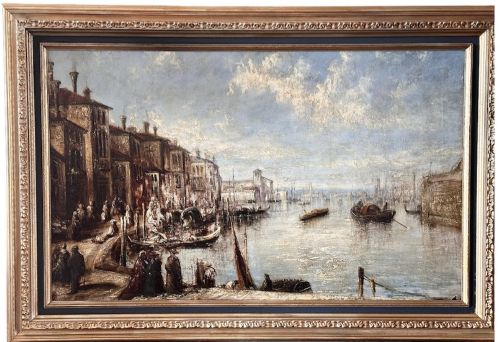
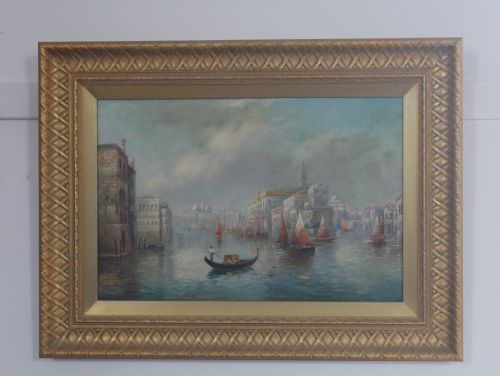
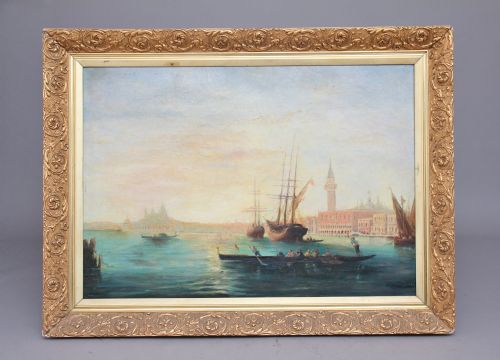

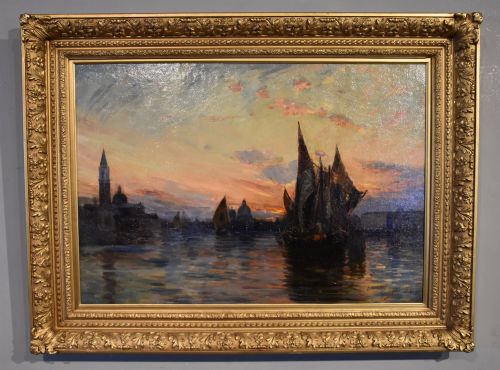


Venice Landscape Oil Painting
A venice landscape oil painting captures the historic architecture and shimmering light of the lagoon through traditional pigment and canvas.
Venice Landscape Oil Painting
When searching for a venice landscape oil painting, collectors encounter townscapes and lagoon views created across the nineteenth and twentieth centuries. These artworks depict iconic landmarks such as the Grand Canal, the Doge's Palace, and Santa Maria della Salute.
The pieces on this page span from Victorian interpretations to mid-century impressionism, reflecting changing artistic approaches to Italian subjects. Canvas remains the primary medium, often housed within period giltwood frames.
Nineteenth-century Romanticism and British or Italian Impressionism dominate the available styles. Works range from intimate depictions of quiet canals to expansive architectural panoramas.
Materials and construction
Artists utilised oil paint applied to stretched canvas or wooden board to build up rich textures and luminous atmospheric effects. Gesso and gilded wood frames frequently complement the paintings, providing structural support and period presentation.
The handling of oil paint varies from tight, detailed architectural rendering to looser, impressionistic brushwork that captures water reflections. Canvases are typically secured within traditional wooden stretcher frames.
Listings span from the nineteenth century through the 1960s, featuring oil on canvas, wood, gesso, and gilded wood.
Distinctions in quality
Quality rests upon the artist's ability to render light, perspective, and architectural detail convincingly. Superior works demonstrate confident brushwork and accurate spatial depth, particularly in complex townscapes.
The integrity of the original canvas and the preservation of the pigment layer distinguish finer examples. The craftsmanship of the accompanying giltwood frame also contributes to the overall standing of the piece.
Alfred Pollentine·Antonio DeVity·Francis Moltino·Thomas Hodgson Liddell·Claude Jousset·Antonietta Brandeis·Antoine Bouvard Senior·Jane Vivian·William Raymond Dommersen·Charles Clement Calderon
The Venice Landscape Oil Painting Glossary
- Canvas
- A heavy woven fabric used as a surface for oil painting. It is typically stretched over a wooden frame before pigment is applied.
- Giltwood
- Wood that has been coated with a thin layer of gold leaf or gilt powder. This material is standard for ornate picture frames from the nineteenth century.
- Lagoon
- The enclosed body of water surrounding Venice. Many townscapes focus on this specific aquatic setting.
- Impressionism
- An art style focused on capturing light and its ephemeral qualities. It appears in several Italian and British works on this page.
Venice Landscape Oil Painting: Frequently Asked Questions
What subjects do these paintings show?
These works depict architectural landmarks, canals, and lagoon scenes across Venice. Popular views include the Grand Canal, the Doge's Palace, and Santa Maria della Salute.
Artists also recorded everyday scenes such as gondoliers operating beneath historic bridges. The compositions range from tight architectural studies to broad atmospheric townscapes.
How do I identify the period?
Dating relies on stylistic clues, artist signatures, and framing materials. Nineteenth-century pieces often lean towards Romanticism or detailed topographical realism.
Later works from the twentieth century frequently adopt looser impressionistic techniques. Frame styles also shift from heavy Victorian gesso to simpler profiles.
Are these works on canvas?
The majority of listings consist of oil paint applied to woven canvas supports. These canvases are typically stretched over wooden frames.
A small selection of works utilises wooden boards as the primary painting surface. Both formats were standard for artists working in Italy during this period.
How should I display a framed painting?
These artworks require placement away from direct sunlight and excessive moisture to protect the oil paint and canvas. Stable indoor humidity prevents warping in the wooden stretchers.
The heavy giltwood frames are designed for wall mounting using appropriate hardware that supports the combined weight of frame and canvas.