


Venice Canal Oil Painting
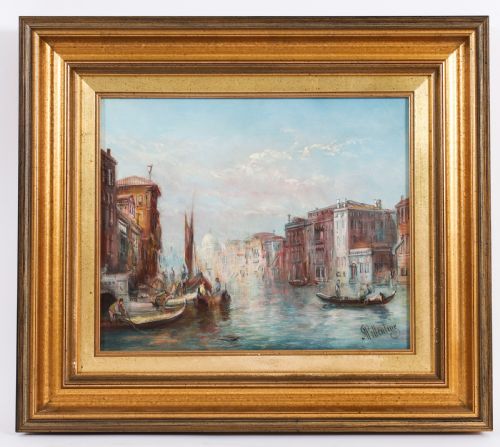
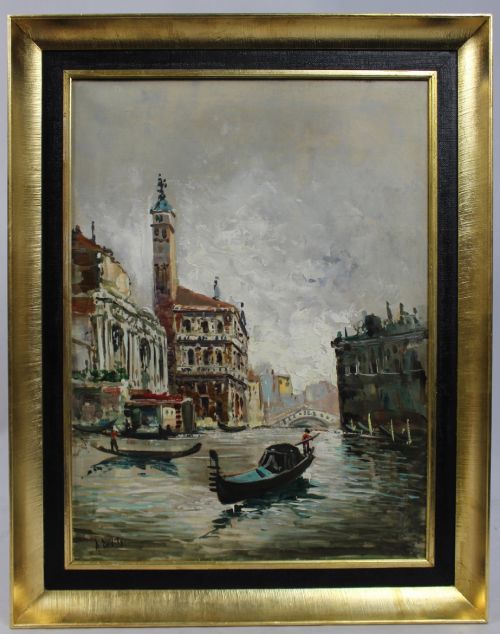
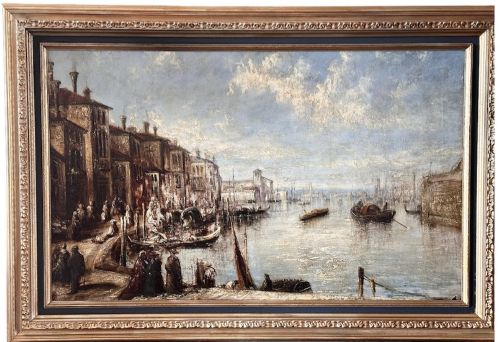
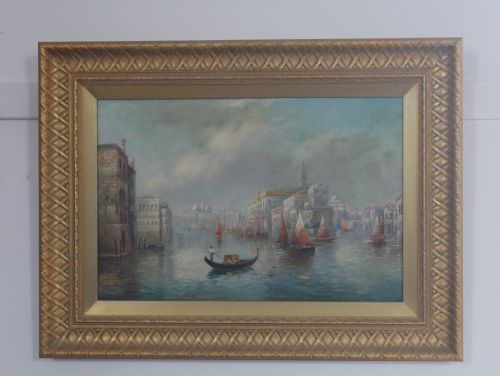
A venice canal oil painting captures the luminous light and historic architecture of the lagoon through pigment laid on canvas.
Venice Canal Oil Painting
When you search for a venice canal oil painting, you encounter townscapes and architectural views centered on the Grand Canal, the Doge's Palace, and the Santa Maria della Salute. These works record the distinctive waterborne city through nineteenth-century romanticism and mid-century impressionism.
You are most likely to meet nineteenth-century canvases framed in giltwood or gilded wood alongside twentieth-century interpretations. The compositions range from bustling regattas and gondolas beneath bridges to quiet lagoon perspectives.
The subjects focus on recognizable landmarks such as the Mocenigo Palace, La Dogana, and the Bridge of Sighs. Each piece reflects the enduring appeal of Italian topography to British and continental artists.
Materials and methods
The foundational support for these works is typically canvas stretched over a wooden frame, though occasional examples employ oil on board. Artists applied oil paint with brushes and palette knives to build up the luminous water effects and architectural stonework.
Many of these canvases sit within heavy giltwood or gilded wood frames that complement the ornate townscape subjects. The combination of oil paint and gilt frames defines the standard presentation for nineteenth-century and early twentieth-century fine art.
Recorded materials span oil paint, canvas, wood, and giltwood within Victorian and mid-century impressionist styles.
Distinctions in execution
The sophistication of brushwork and the handling of atmospheric light separate standard decorative scenes from works by established nineteenth-century painters. Stronger examples demonstrate confident perspective in complex architectural facades like the Ducal Palace.
The integrity of the original canvas support and the preservation of the oil paint layer influence the overall standing of an artwork. Period framing that matches the age of the canvas also contributes to the cohesion of the piece.
Alfred Pollentine·Antonio DeVity·Francis Moltino·Claude Jousset·Antonietta Brandeis·Marc Aldine·Antoine Bouvard Senior·E. Perez Senet·Jane Vivian·William Raymond Dommersen·Charles Clement Calderon·Alexander Edward Waite·Jean d'Alheim
The Venice Canal Oil Painting Glossary
- Giltwood
- Wood carved and coated with gold leaf or gold paint. This material is frequently found on nineteenth-century frames surrounding Venetian townscapes.
- Impressionism
- A style of painting emphasising loose brushstrokes and the depiction of light. This approach appears in mid-century interpretations of canal scenes.
- Townscape
- A painting representing a city or urban locality. These views focus on architectural monuments and waterways.
- Lagoon
- An area of shallow water separated from the open sea by sandbanks. This setting forms the background for many grand canal compositions.
Venice Canal Oil Painting: Frequently Asked Questions
What periods do these paintings span?
The works originate largely from the nineteenth century, including Victorian fine art and romanticism, extending into mid-century impressionism.
Dates across the records stretch from the 1870s through to the 1960s, reflecting changing artistic interpretations of the lagoon.
How should I hang a framed oil painting?
These works require secure wall fixings capable of supporting the combined weight of the canvas, wooden stretcher, and heavy giltwood frame.
Positioning the painting away from direct sunlight and excessive humidity protects both the oil paint and the gilded wood over time.
How do I identify a nineteenth-century Venetian view?
Look for traditional depictions of key landmarks such as the Grand Canal, the Doge's Palace, and the Bridge of Sighs executed in oil on canvas.
Signatures, period framing styles, and stretcher construction often provide further context regarding the age of the work.
What subjects appear most frequently?
The compositions commonly feature gondolas, sailboats, and architectural townscapes set along the Venetian waterways and lagoon.
Artists frequently recorded specific monuments including the Santa Maria della Salute and La Dogana under varying atmospheric conditions.