
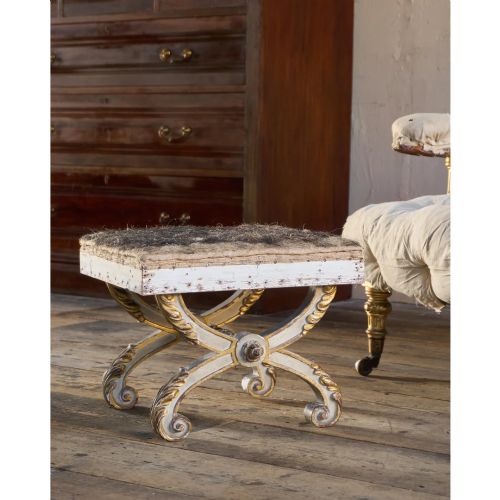
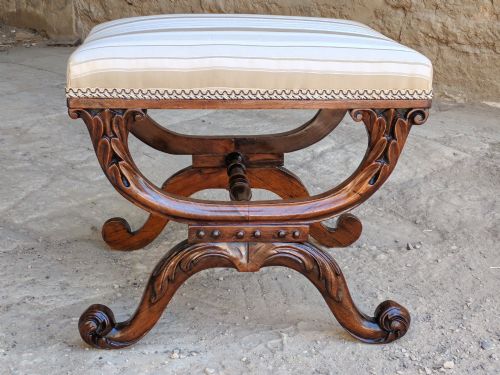
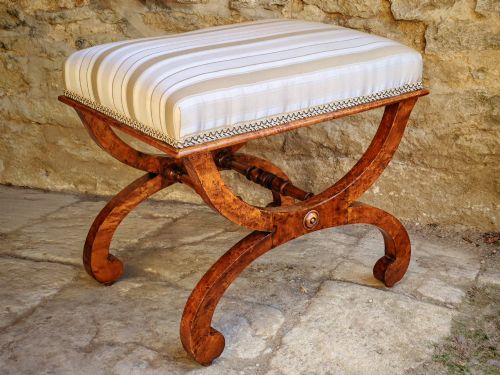


Upholstered Curule Seat
An upholstered curule seat offers classical cross-frame elegance, bringing historical form and comfortable seating into a modern interior.
Upholstered Curule Seat
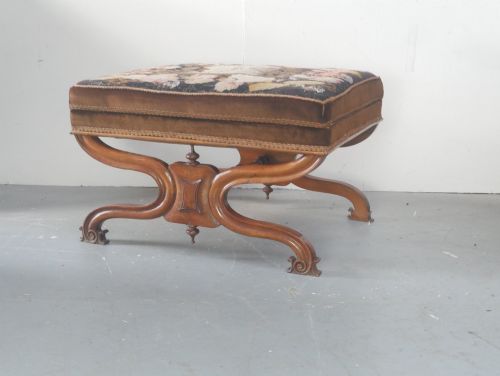
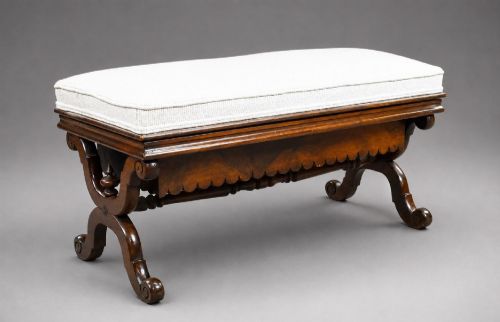
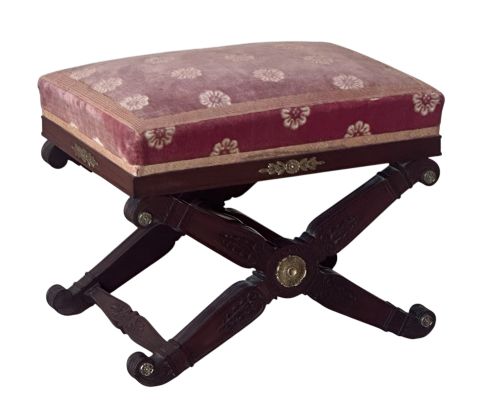
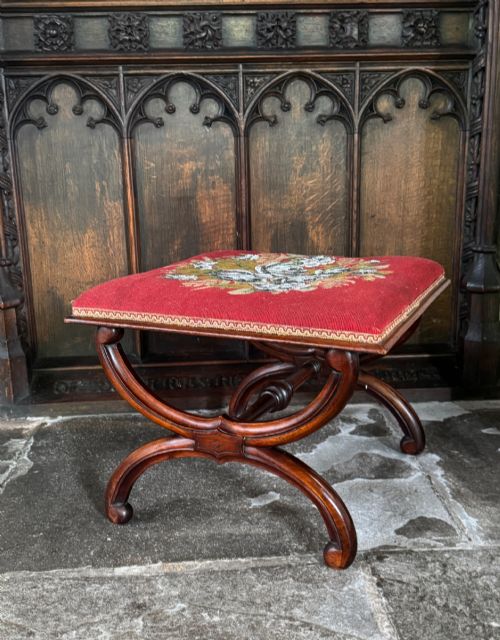
An upholstered curule seat draws on ancient Roman folding chair designs, translating classical architecture into domestic seating across multiple centuries. These pieces appear primarily as X-frame stools, footstools, and window seats, alongside occasional armchairs.
The selection ranges from Georgian and Regency examples to Victorian, Edwardian, and later revivals including French Empire and Renaissance styles. Makers and workshops constructed these forms in mahogany, rosewood, walnut, and oak, often pairing the wooden frames with rich textile seats.
Stools and dressing stools dominate the available forms, though window seats and occasional armchairs also emerge within the listings. Buyers encounter both simple wooden cross-frames and heavily carved frames featuring gilding or specialised upholstery like beadwork and red damask.
Materials and Construction
Craftsmen shaped these frames from dense hardwoods including mahogany, rosewood, walnut, oak, and burr maple, sometimes applying paint, ebonisation, or gilt finishes. Selected woods provided the structural integrity required for curved, intersecting X-frame legs and load-bearing cross-stretchers.
Upholstery methods utilised traditional textiles such as velvet, leather, damask, and tapestry, secured over padded foundations. Brass details occasionally reinforced joints or added decorative accents to the wooden frames.
Distinctions in Quality
Quality separates ordinary production pieces from those exhibiting refined cabinetmaking, visible in the precision of the intersecting frame joints and the fluidity of carved details. Superior examples display thoughtful timber selection, such as figured rosewood or burr maple, matched with harmonious upholstery.
The sophistication of the secondary ornament, whether carved hunting dog heads, gilt highlights, or intricate beadwork and tapestry seats, elevates certain pieces above standard utilitarian stools. Structural rigidity in the X-frame assembly remains paramount, distinguishing tightly executed joinery from loose or compromised frames.
Miles & Edwards·White, Allom & Co.
The Upholstered Curule Seat Glossary
- Curule
- An ancient Roman form of magistrate chair featuring opposing concave legs that cross to form an X-shape. This structural silhouette serves as the foundational design for the pieces in this category.
- X Frame
- A structural design utilising two intersecting diagonal members to support the seat. It provides both stability and a distinctive architectural profile.
- Savonarola chair
- A specific type of folding armchair constructed from multiple intersecting wooden slats forming a rich cusped lattice. Named after the 15th-century Florentine friar, it shares mechanical lineage with the curule seat.
- Gilt
- A thin layer of gold leaf or gold paint applied to the surface of wood or gesso. It accentuates carved details and imparts a luminous finish.
- Damask
- A reversible, figured fabric woven on a jacquard loom with patterns formed by contrasting warp and weft threads. It frequently appears as period upholstery on formal seating.
Upholstered Curule Seat: Frequently Asked Questions
Where were upholstered curule seats placed historically?
These seats traditionally occupied formal reception rooms, libraries, and grand hallways where their classical lines complemented architectural interiors. They also served in bedrooms and dressing rooms as specialised stools.
Their portable nature allowed them to be moved easily for additional seating during gatherings, functioning both as functional furniture and decorative accents.
How do I identify a Regency curule seat?
Regency examples typically exhibit dark dense timbers like rosewood or mahogany, often accompanied by brass inlay or classical mounts. The X-frame geometry reflects the neoclassical taste of the early nineteenth century.
Look for crisp, restrained carving and formal upholstery choices such as tapestry or silk velvet that align with the period aesthetic.
Can I use an antique footstool for everyday seating?
Most sturdy X-frame stools and footstools remain entirely suitable for daily use provided the internal frame and joints are secure. Solid hardwood construction generally ensures lasting structural integrity.
Evaluating the tightness of the central cross-joint guarantees the piece will safely support weight during routine use.
What defines a Scottish Baronial stool?
Scottish Baronial pieces incorporate robust vernacular carving, heavier proportions, and materials suited to grand Victorian country houses. They often feature prominent oak or walnut frames.
Such stools frequently display distinct regional decorative motifs that separate them from standard neoclassical English or French designs.