
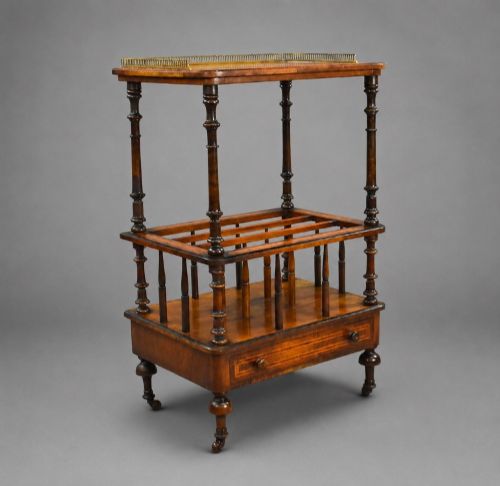


Turned Spindle Music Stand
These turned spindle music stand pieces are decorative book and sheet storage furnishings designed to hold folios and scores.
Turned Spindle Music Stand
A turned spindle music stand search brings up varied Victorian, Regency, and Georgian furnishings intended to hold folios, magazines, and scores. The listings show a heavy concentration of Victorian and 19th-century canuterburys, alongside related whatnots and magazine racks.
Most examples take the form of compartmentalised wooden racks, often featuring lower drawers or tiered shelving structures. These items served a practical function in domestic parlours and music rooms during the nineteenth century.
Buyers will encounter forms ranging from simple mahogany magazine stands to elaborate burr walnut and rosewood canterburys. The construction typically incorporates vertical partitions or turned spindle dividers to keep bound volumes upright.
Materials and construction methods
Cabinet makers utilised dense hardwoods including mahogany, walnut, burr walnut, and rosewood, occasionally applying ebonised finishes to the mahogany framework. Brass fittings, ceramic castors, and inlaid details frequently complement the timber bodies.
The upright divisions and structural supports are formed using turned spindle techniques, creating light yet rigid partitions for holding sheet material. Joinery relies on traditional framing methods, integrated drawers, and tier assemblies.
Several Victorian pieces have wheels, proving our ancestors liked rearranging their sheet music on a whim.
Assessing quality and workmanship
Superior examples display finely figured timber veneers such as burr walnut or carefully selected rosewood, contrasted with plain secondary woods on lesser pieces. The crispness of the turned spindles and the precision of any inlay work indicate the tier of craftsmanship.
Makers such as Gillows, Edwards & Roberts, and Shoolbred produced pieces with higher refinement in joinery and brass hardware detailing. The integration of smooth-running drawers and stable tiered frameworks separates standard production items from distinguished workshop outputs.
Edwards & Roberts·Gillows·Shoolbred
The Turned Spindle Music Stand Glossary
- Canterbury
- A low stand with divisions, originally designed for holding sheet music and folios. It frequently includes a drawer below the main rack.
- Whatnot
- An open set of tiered shelves used for displaying ornaments or books. These pieces often incorporate turned supports similar to music stands.
- Ebonised
- Wood finished with a dark stain or paint to imitate ebony. This treatment appears on several nineteenth-century mahogany pieces.
- Burr walnut
- Timber taken from the wart or growth on a walnut tree, yielding highly decorative grain patterns. It was favoured for high-status cabinet fronts.
Turned Spindle Music Stand: Frequently Asked Questions
How are these stands dated?
Dating relies on timber selection, construction methods, and stylistic cues associated with periods like the Regency, George IV, and Victorian eras. The presence of specific hardware, such as brass castors or ceramic wheels, also assists in narrowing the timeframe.
Cabinet makers of the nineteenth century frequently marked their work with stamps or paper labels, though many surviving pieces remain unmarked.
Where were these pieces used?
These furnishings were designed for domestic living spaces, specifically parlours, drawing rooms, and music rooms where instruments and reading materials were kept. Their portable size allowed them to be moved easily beside chairs or piano stools.
Today, they function well in modern interiors as magazine holders or decorative side tables.
What woods were used?
Cabinet makers predominantly employed dense hardwoods including mahogany, rosewood, walnut, and burr walnut. Some pieces feature ebonised mahogany finishes to achieve a dark, uniform appearance.
Secondary woods were often used for internal drawer construction and less visible structural framing.