

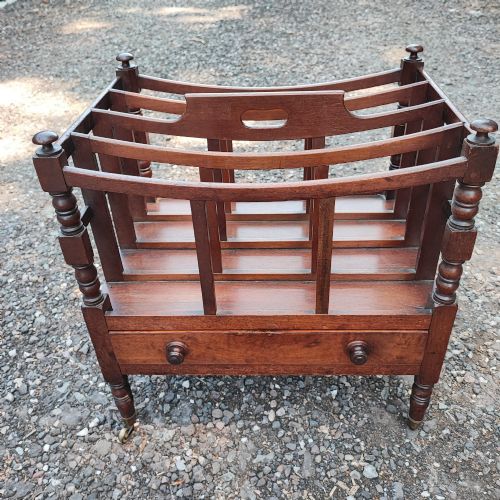


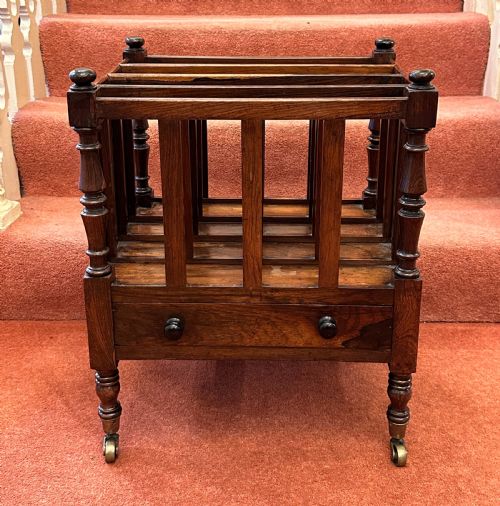


Turned Leg Canterbury
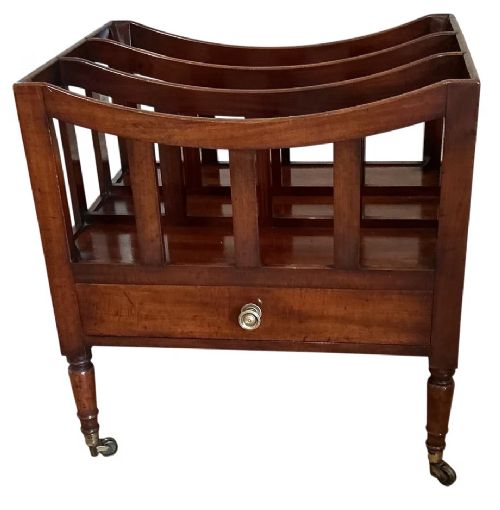
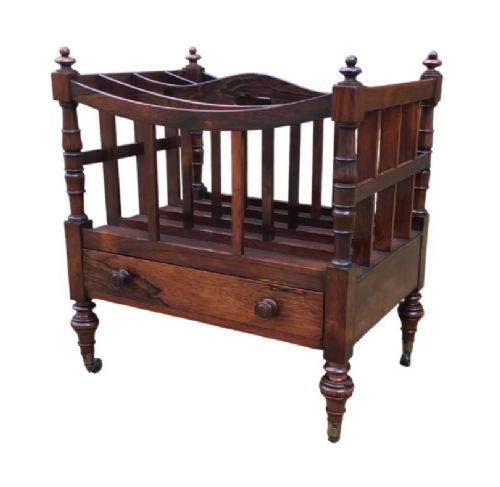
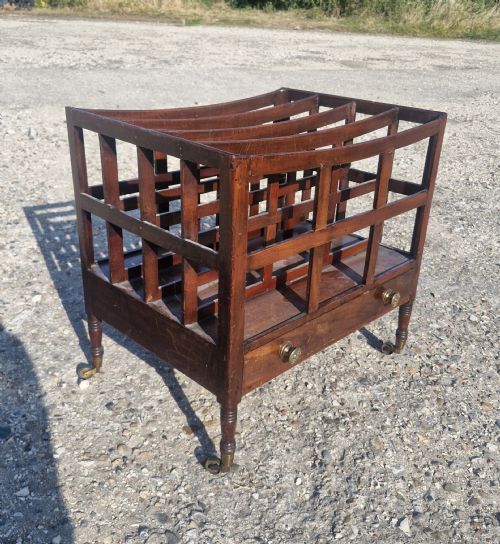
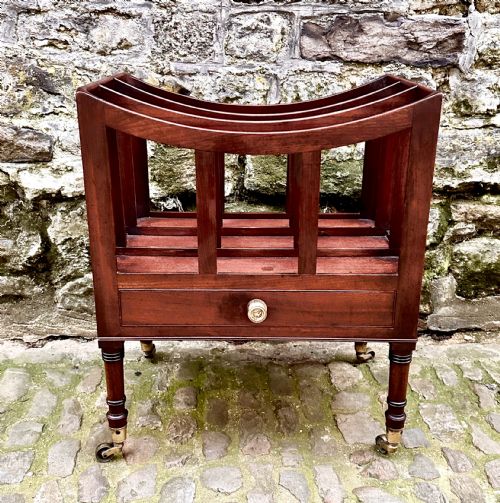
These turned leg canterbury pieces are elegant divided stands designed to hold folios and magazines, prized for their combination of mobility and fine timberwork.
Turned Leg Canterbury
A turned leg canterbury serves as a compact compartmentalised stand for sheet music, books, and periodicals. Most examples found here date from the Regency, Georgian, and Victorian periods, showcasing traditional craftsmanship in mahogany, rosewood, oak, and brass.
The form typically incorporates slatted or divided upper partitions atop low turned supports. Buyers frequently encounter single and double-tier variations, often fitted with small castors for easy movement across a room.
Materials and construction
Cabinetmakers utilised dense hardwoods such as mahogany and rosewood alongside oak, shaping the uprights and rails with traditional joinery. Turned legs provide the structural base, frequently incorporating brass castors to facilitate movement.
Metal accents appear in the form of brass handle mounts or delicate rods, complementing the rich grain of the timber. Every surface receives careful finishing to highlight the natural figures of the wood.
Turned Leg Canterbury Retail Price Guide 2026
Typical asking prices for turned leg canterbury among the pieces listed under this phrase on Sellingantiques today, from the lower quarter to the upper quarter. They describe what is for sale here now, not the wider market.
The listings span the Regency, Georgian, and Victorian periods, using mahogany, rosewood, oak, and brass.
Distinguishing quality in design
Superior examples display crisp turning on the legs and finely figured timber veneers that show deep grain patterns. The integration of dividers and the proportion of the undercarriage reveal the maker's attention to architectural balance.
Simpler pieces rely on plain oak or standard mahogany without elaborate turning or secondary details. The presence of original brass castors and unblemished wood framing separates standard domestic utility from finer parlour pieces.
The Turned Leg Canterbury Glossary
- Regency
- A style period spanning the early nineteenth century, characterised by classical revival motifs and refined proportions. Pieces from this era often employ mahogany and rosewood.
- Turned leg
- A cylindrical support shaped on a lathe to create decorative profiles and rings. This technique provides stability while adding visual interest to the base.
- Folio
- A large sheet of paper or musical score. Canterburys were specifically dimensioned to store these items upright.
Turned Leg Canterbury: Frequently Asked Questions
What was a canterbury originally used for?
These stands served as dedicated storage for sheet music and unbound folios near a piano or seating area. They kept musical scores organised and accessible in the principal rooms of a house.
Over time, owners also used them to hold newspapers and magazines, adapting the original musical function to general parlour storage.
How do I identify a Regency canterbury?
Regency pieces typically display classical restraint, featuring dark mahogany or rosewood and precise turned leg supports. The joinery is clean and reflects the architectural tastes of the early nineteenth century.
Check for original brass castors and well-defined slat partitions, which are characteristic of this specific period of design.
Are these stands suitable for modern magazines?
The vertical partitions easily accommodate standard periodicals, journals, and modern reading material. Their compact footprint allows them to sit neatly beside a sofa or armchair.
Because they often feature castors, you can reposition them effortlessly across different rooms depending on your daily reading habits.
Which woods are most common?
Mahogany and rosewood dominate the earlier Georgian and Regency examples, offering rich dark tones and smooth grain patterns. Oak appears more frequently in Victorian iterations.
Brass details frequently complement these primary timbers, appearing on castors or carrying handles.