


Tulipwood Writing Desk
A tulipwood writing desk brings sophisticated marquetry, rich crossbanding and refined brass or ormolu mounts straight into a traditional study.
Tulipwood Writing Desk
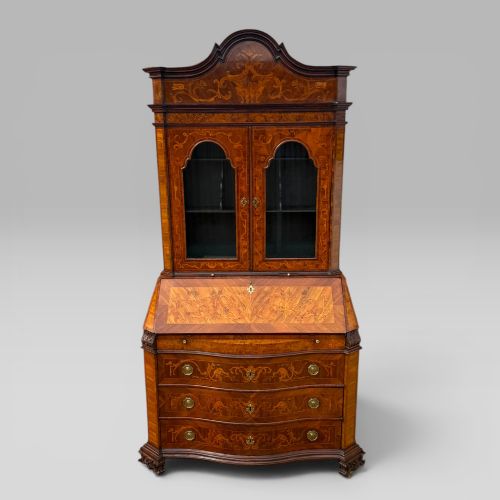
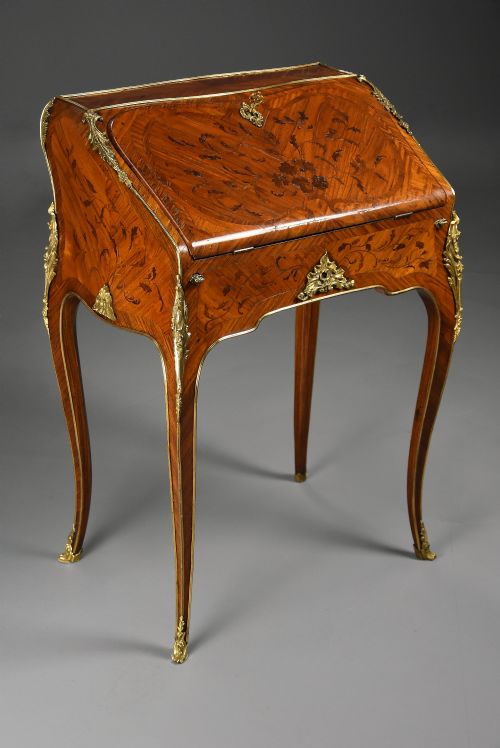
A tulipwood writing desk encompasses a variety of refined forms designed for correspondence and light administrative tasks, appearing across periods from the mid-18th century through the Victorian era. These pieces manifest primarily as bureau plat writing tables, bureau bookcases, secretaires, ladies writing desks, and poudreuse dressing tables.
The aesthetic leans heavily towards French taste, including Louis XV, Louis XVI, and Napoleon III revivals, alongside Venetian Rococo and Georgian interpretations. Bureau plats and petite secretaires en pente dominate the selection, often featuring sophisticated veneering and shaped silhouettes typical of continental cabinet making.
How they were made
Cabinet makers constructed these desks using foundational carcases of walnut, rosewood, or fruitwood, applied with delicate tulipwood and kingwood veneers. Parquetry and marquetry arrangements create complex geometric patterns or pictorial designs across the writing surfaces and facades.
Gilded bronze ormolu mounts, brass banding, and inset leather writing panels complete the construction. Bureau bookcases and secretaires incorporate fitted interior compartments, while dressing tables integrate porcelain plaques and specialised lifting mirrors.
The selection spans Georgian, Victorian, and 18th to 19th-century French revival periods.
What varies in quality
The standard of a tulipwood writing desk rests upon the precision of its veneer matching, the crispness of its parquetry layout, and the fluidity of its overall form. Finer examples display harmonious grain patterns across curved surfaces without awkward disruptions at the corners.
The quality of the cast ormolu mounts and the integration of secondary timbers such as walnut or kingwood elevate certain pieces significantly. Maker attribution and the complexity of internal fittings further distinguish standard production items from exceptional cabinet work.
Millet
The Tulipwood Writing Desk Glossary
- Tulipwood
- A decorative timber known for its distinctive cream and pinkish-brown striped grain, frequently utilised for contrasting veneers and banding. It provides a bright, warm visual quality on 18th and 19th-century cabinet work.
- Ormolu
- Gilded bronze mounts applied to furniture edges, corners, and legs for decorative accent. These cast metal details enhance the architectural lines of French revival pieces.
- Marquetry
- Inlaid wood veneers arranged to form pictorial or decorative patterns across a surface. Artisans combine different coloured timbers to achieve tonal depth.
- Bureau Plat
- A freestanding writing table fitted with drawers across the frieze, typically finished on all sides. This form became popular in 18th-century France for administrative use.
- Secretaire en pente
- A sloping-front desk that conceals an interior arrangement of small drawers and pigeonholes when opened. The slanted lid serves as the primary writing surface.
Tulipwood Writing Desk: Frequently Asked Questions
What is a bureau plat?
A bureau plat is a freestanding writing table featuring a flat top, often inset with leather, and drawers set into the frieze below.
Unlike traditional wall desks, these tables are finished on all sides so they can sit proudly in the centre of a room.
How do I care for tulipwood?
Tulipwood benefits from stable indoor humidity and protection from direct sunlight, which can alter the delicate pink tones of the timber over time.
Routine dusting with a dry cloth and occasional application of appropriate furniture wax help preserve the polished veneer surface.
Are these desks suitable for daily use?
Many of these pieces function well for contemporary laptop use or correspondence, provided the leather writing surfaces and internal drawers are treated with care.
Antique writing desks were built for handwritten letters and light administration rather than heavy modern office equipment.
How do I identify a Napoleon III piece?
Napoleon III furniture often reinterprets earlier Louis XV and Louis XVI styles with a lavish use of ormolu mounts, exotic veneers, and elaborate marquetry.
Cabinet makers working during this period embraced eclectic French revival designs using tulipwood, kingwood, and rosewood.