
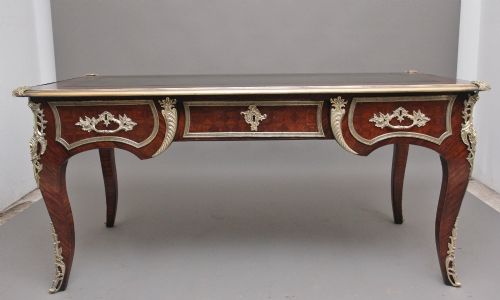
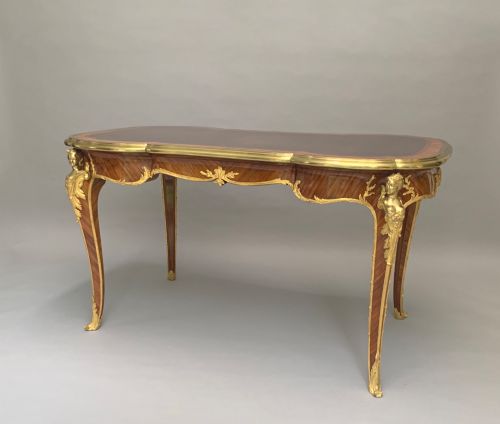
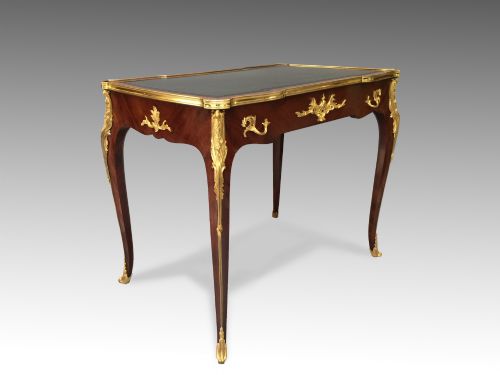
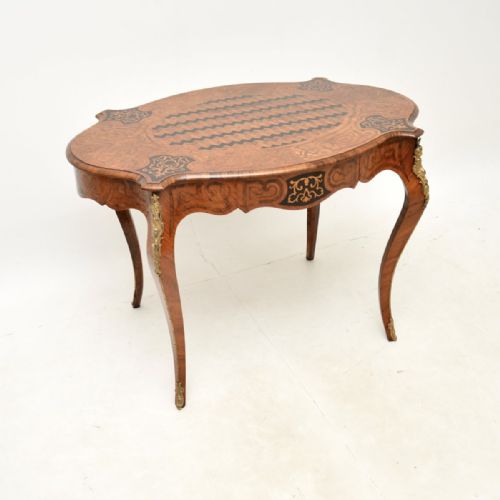

Gilt Bronze Bureau Plat
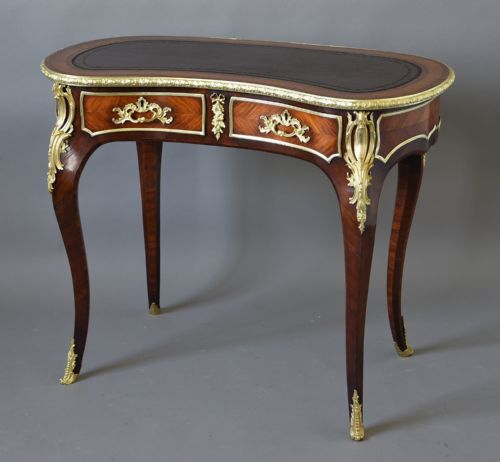
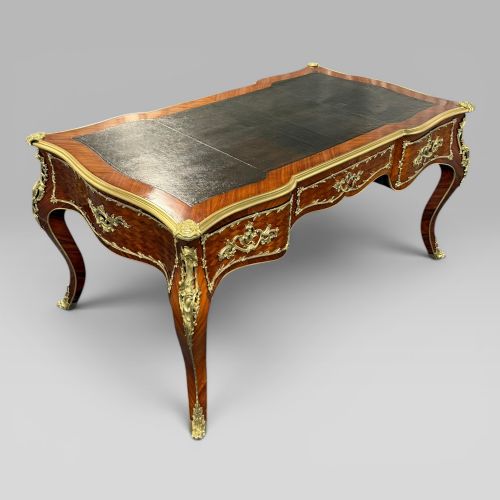
A gilt bronze bureau plat is a grand writing table built for display and work, offering polished leather and heavy cast mounts.
Gilt Bronze Bureau Plat
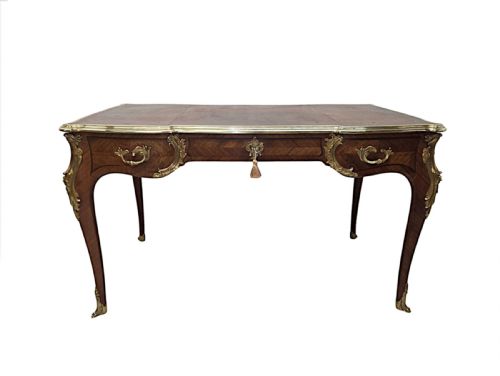
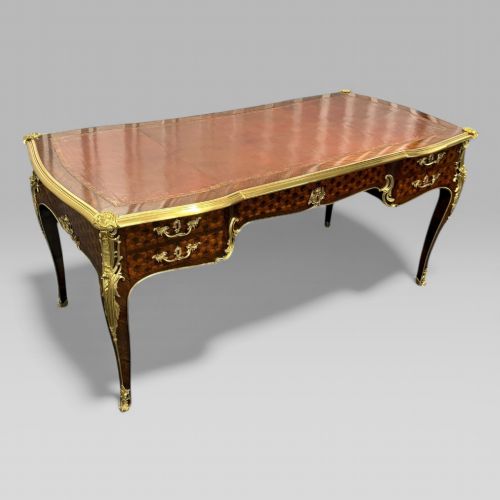
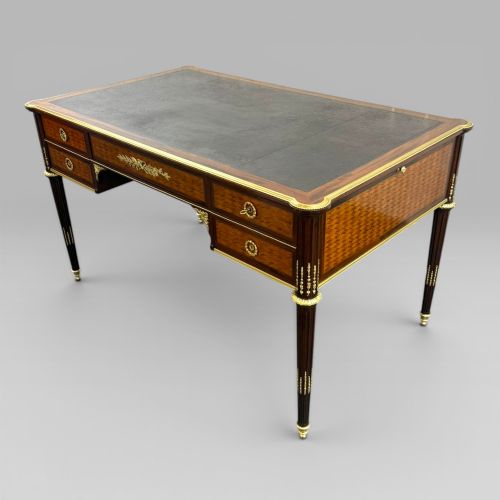
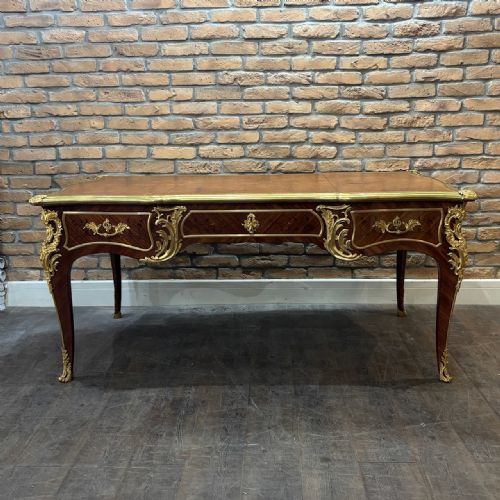
A gilt bronze bureau plat serves as a freestanding writing table designed to command the centre of a room rather than sit against a wall. The form combines a broad top inset with a leather writing surface above a frieze containing one or more drawers.
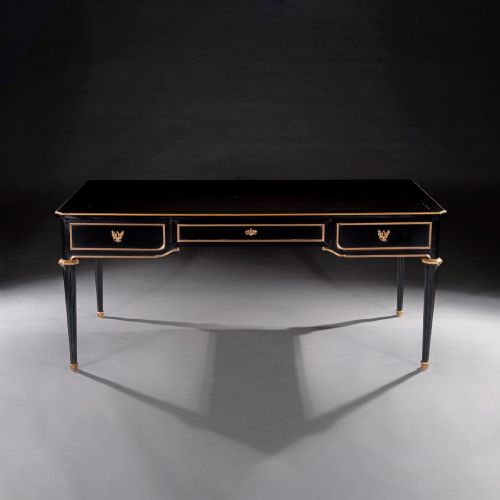
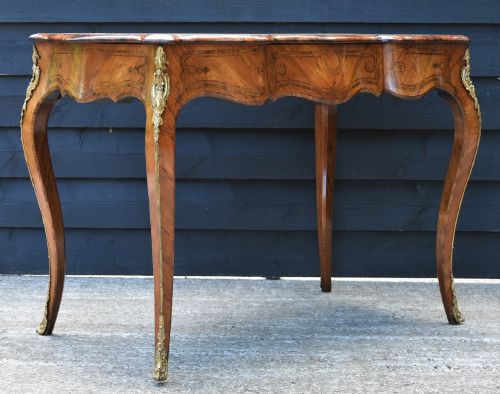
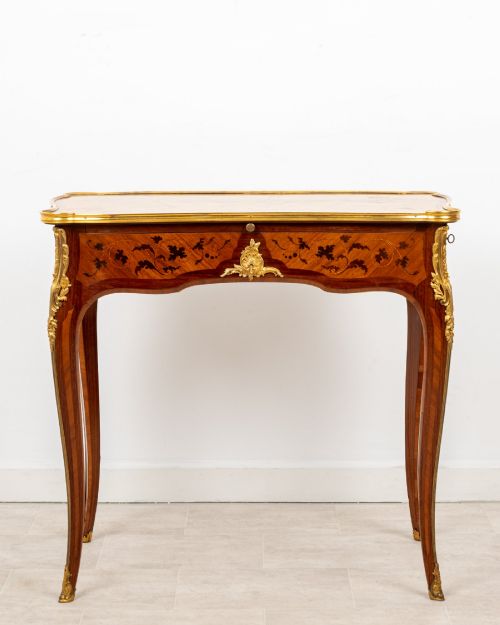
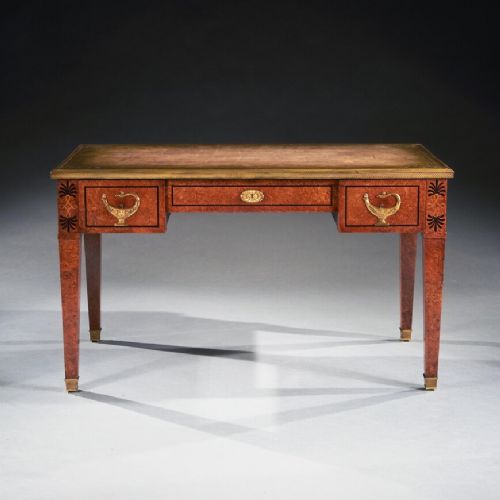
Most examples seen here date from the nineteenth century, drawing heavily on eighteenth-century French monarchical styles. Makers of this period favoured the sweeping asymmetrical curves of Louis XV revival designs or the geometric restraint of Louis XVI revival pieces.
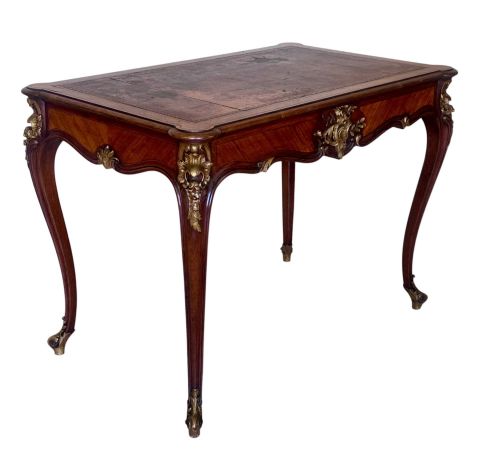
These writing tables range from compact ladies' desks to large centre tables scaled for libraries and salons. The underlying form remains consistent across sizes, defined by cabriole or tapered legs and elaborate metal enrichment.
How they were made
Carpenters constructed the carcase using dense hardwoods such as mahogany, walnut and ebonised timber, often overlaid with decorative veneers of kingwood, rosewood, tulipwood or satinwood. Marquetry and parquetry patterns created geometric or floral displays across the flat surfaces.
Casters shaped heavy gilt bronze and ormolu mounts to edge the desk top, encase the knees, and terminate the feet. These cast metal elements were chased by hand to sharpen the detail before being gilded and screwed to the wooden framework.
Gilt Bronze Bureau Plat Retail Price Guide 2026
Typical asking prices for gilt bronze bureau plat among the pieces listed under this phrase on Sellingantiques today, from the lower quarter to the upper quarter. They describe what is for sale here now, not the wider market.
The archive and active listings span the eighteenth, nineteenth and twentieth centuries.
What varies in quality
Quality rests primarily on the crispness of the gilt bronze casting and the depth of the hand-chasing. Top-tier pieces display finely articulated foliage and figures without the softening of detail found in secondary sand castings.
The choice of timber and the precision of the marquetry inlay also mark the tier of a desk. Master workshops employed dense exotic veneers with tight grain patterns, fitted into thick brass stringing and thick carcase walls that resist warping.
Francois Linke·Edwards and Roberts·CH Jeanselme and Co·Durand·Paul Sormani·Fournier
The Gilt Bronze Bureau Plat Glossary
- Bureau plat
- A freestanding writing table fitted with drawers in the frieze, typically finished with a leather writing surface on top. These tables lack the superstructure of a cabinet desk.
- Ormolu
- Gilded bronze used for decorative mounts on furniture. The metal is cast and then coated in gold leaf or an amalgam before finishing.
- Kingwood
- A dense, richly grained tropical timber native to Brazil, used extensively as a veneer in nineteenth-century French cabinet making. Its dark purple-brown stripes provide high visual contrast.
- Marquetry
- The art of applying pieces of veneer to a structure to form decorative patterns and pictures. Makers used various coloured woods to achieve tonal variation.
- Frieze
- The horizontal band running directly beneath the desk top, which commonly houses the drawer fronts. This area frequently carries the heaviest bronze mounts.
- Serpentine
- A shape characterised by a line of alternating convex and concave curves. Desk tops and drawer fronts often follow this contour.
Gilt Bronze Bureau Plat: Frequently Asked Questions
Where should a bureau plat go?
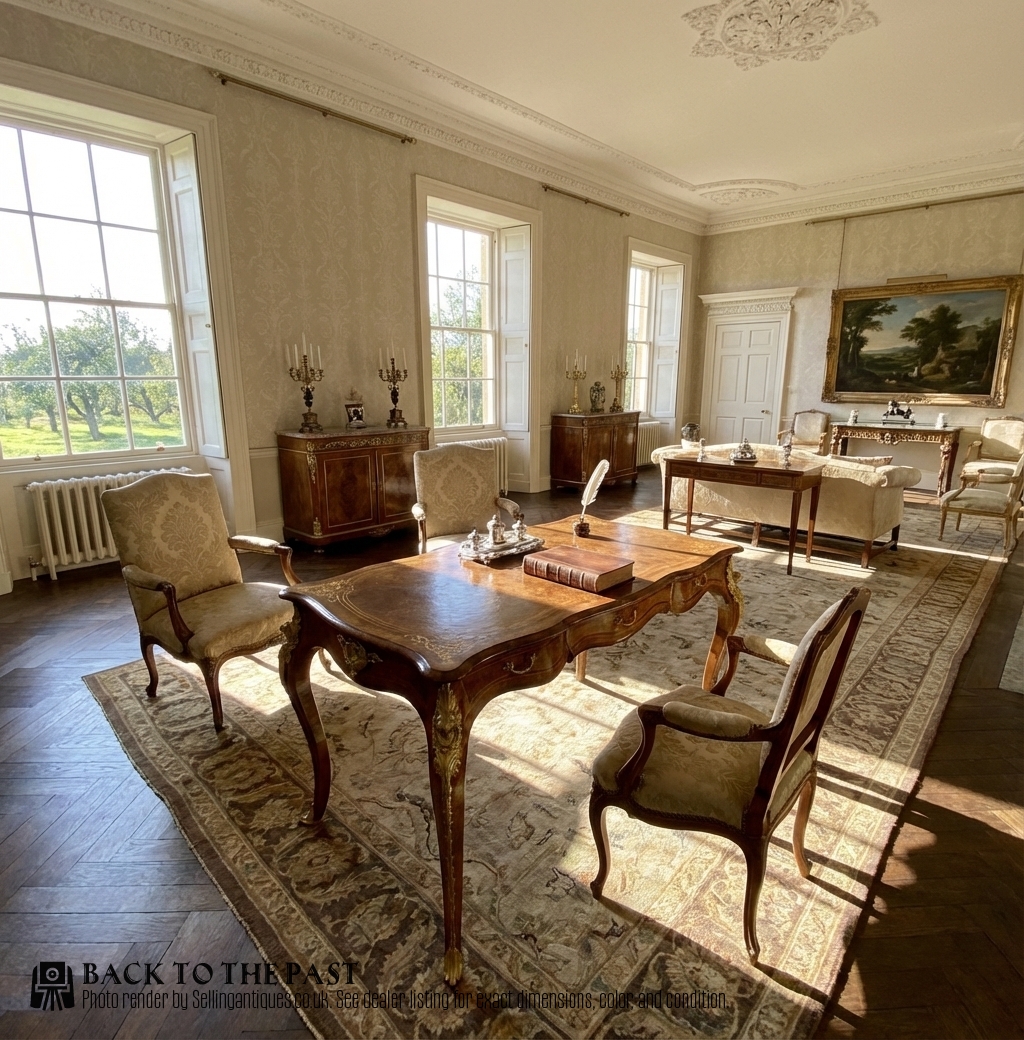
These writing tables are designed to sit away from walls, usually positioned in the middle of a study or drawing room. Because the back of the desk is finished with the same care as the front, it looks correct from any angle.
Ensure there is enough floor space around the table to pull out chairs and open drawers comfortably without crowding surrounding furniture.
How do I care for the leather top?
The leather writing surface benefits from occasional cleaning with a slightly damp cloth and treatment with appropriate leather dressings to prevent drying. Avoid placing hot cups or liquids directly onto the hide.
Keep the desk away from direct sunlight and heat sources, which can cause the leather to shrink and the underlying wood to split.
What is the difference between Louis XV and Louis XVI styles?
Louis XV style pieces are defined by asymmetrical curves, cabriole legs, and flowing rococo bronze mounts. The overall silhouette appears organic and rounded.
Louis XVI style pieces shift towards strict symmetry, straight tapered fluted legs, and neoclassical motifs like urns and acanthus leaves. The lines are much more architectural and restrained.
How do I clean gilt bronze mounts?
Gilt bronze mounts require only gentle dusting with a soft brush to remove dirt from the recessed chasing. Avoid abrasive metal polishes, which will strip away the historic gilding.
If the mounts need deeper cleaning, consult a professional conservator to prevent damage to the surrounding wood veneer and lacquer.