
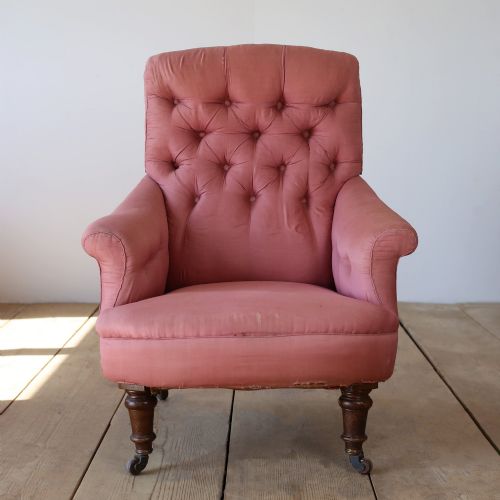
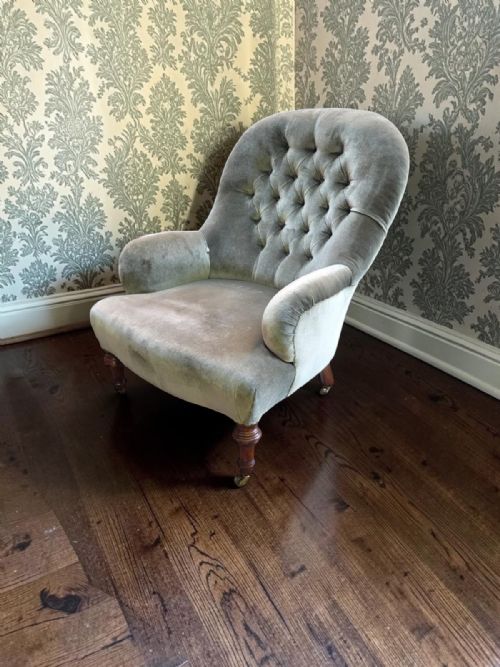
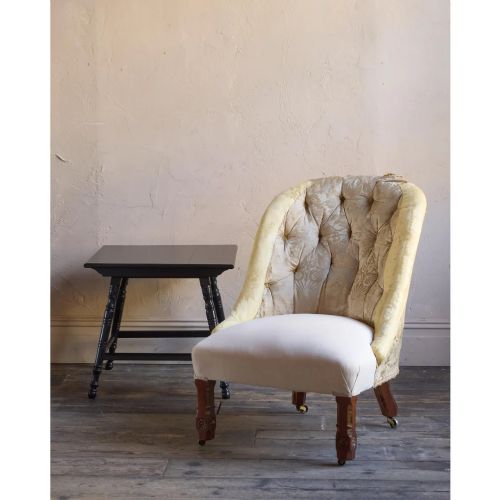
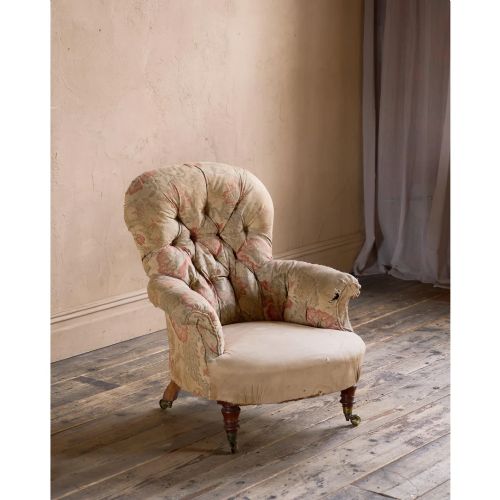
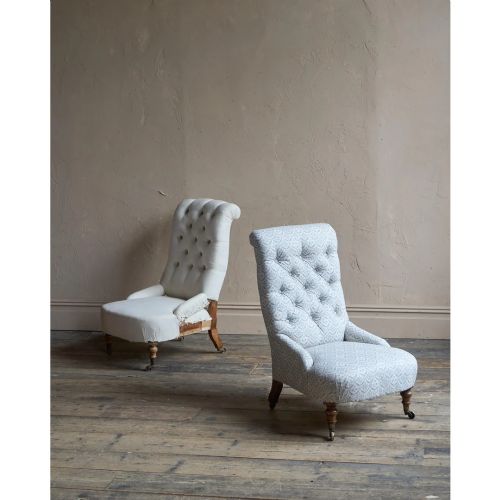
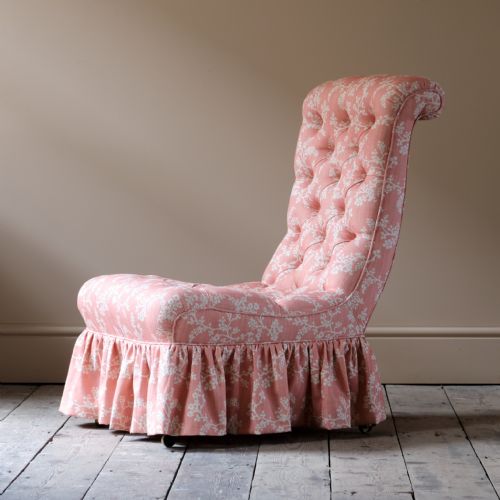
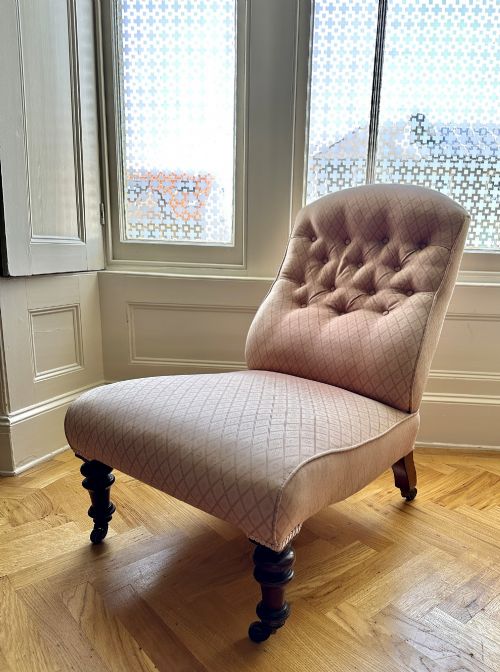
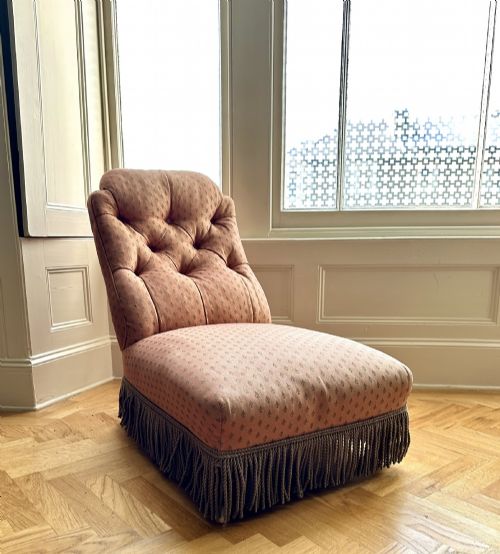


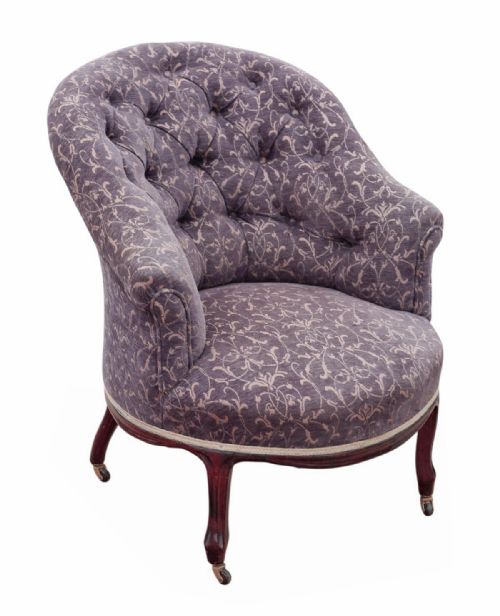


Tufted Back Nursing Chair
A tufted back nursing chair brings low-slung, buttoned comfort to a bedroom, prized for its supportive upright frame and compact proportions.
Materials and Construction
Frame construction relies on hardwoods such as mahogany and walnut, alongside iron frames and timber supports that provide sturdy foundations. Brass elements and ceramic castors frequently appear on the lower legs.
Upholstery techniques involve deep buttoning across fabric, velvet, linen, and orange velvet surfaces, secured with tight tension. Decoration includes carved walnut, gilt legs, fringe trims, and ebonised finishes.
Assessing Quality and Execution
Quality rests in the crispness of the wood carving, the stability of the mahogany or walnut frame, and the precision of the button tufting. Superior examples maintain firm internal support without sagging in the low seat.
Refined pieces display sophisticated leg forms such as cabriole designs or gilt enrichment, whereas simpler country house models rely on iron-backed frames and plain timber.
Listings demonstrate that walnut and mahogany remained the preferred timbers for nineteenth century frames, complemented by iron-backed variations.
Holland and Sons·Howard and Sons·Gillows
The Tufted Back Nursing Chair Glossary
- Button back
- A method of upholstery where deep buttons are pulled through the padding in a diamond pattern to create tufts. This technique secures the stuffing and adds textural depth.
- Slipper chair
- A low-set upholstered chair without arms, traditionally used in dressing rooms and bedrooms. The reduced height makes dressing and sitting exceptionally comfortable.
- Cabriole leg
- A furniture leg that curves outward and then tapers inward, finishing in a pad or scroll foot. This shape derives from ancient animal leg forms.
- Ebonised
- Wood treated with a chemical or stain to resemble ebony. This dark finish gives a sleek, formal appearance to Victorian bedroom furniture.
- Spoon back
- An upholstered chair back shaped like the bowl of a spoon, curved to fit the human spine. It is commonly found on mid nineteenth century parlour chairs.
Tufted Back Nursing Chair: Frequently Asked Questions
What is a tufted back nursing chair used for?
These low chairs were traditionally designed to give mothers a comfortable, low-slung seat for nursing infants. Their compact stature allowed users to sit close to the hearth or infant cradle.
Today, they serve primarily as bedroom chairs, accent seating, or fireside lounge chairs. Their diminutive proportions make them versatile for smaller reception spaces.
How do I date a Victorian nursing chair?
Dating relies on examining the frame timber, leg style, and internal construction methods. Mid nineteenth century examples often feature solid walnut or mahogany frames with hand-carved details.
Later Victorian and Edwardian pieces incorporate iron frames and machine-woven fabrics. Cabinetmaker stamps, when present, provide a direct link to specific workshops.
Are slipper chairs and nursing chairs the same?
While both share a low seat height, slipper chairs typically lack arms entirely to accommodate dressing. Nursing chairs frequently feature open arms or padded armrests to support holding an infant.
Both types belong to the broader category of nineteenth century bedroom and bedroom armchairs. Their primary distinction lies in the presence or absence of arm supports.
What fabrics were originally used on these chairs?
Original upholstery frequently featured rich textiles like velvet, linen, and heavy woven fabrics. Bold colours such as orange velvet and muted tones appeared depending on the exact decade.
Many surviving pieces retain later reupholstery while keeping their traditional buttoned back design. Frame materials underneath range from polished mahogany to painted ebonised wood.