


Floral Upholstered Nursing Chair
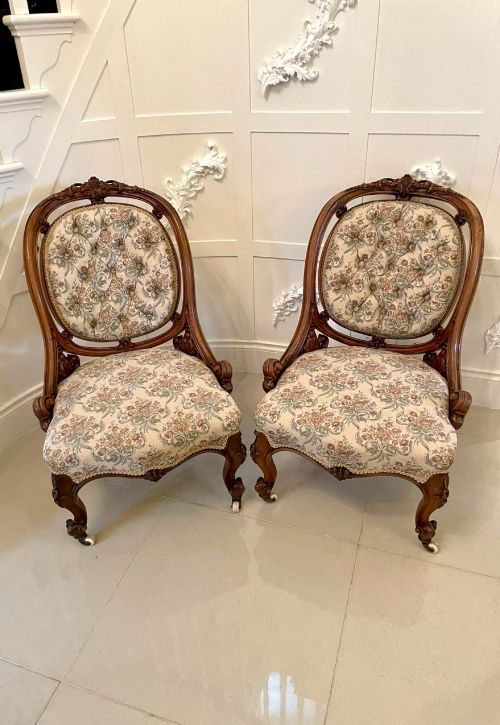
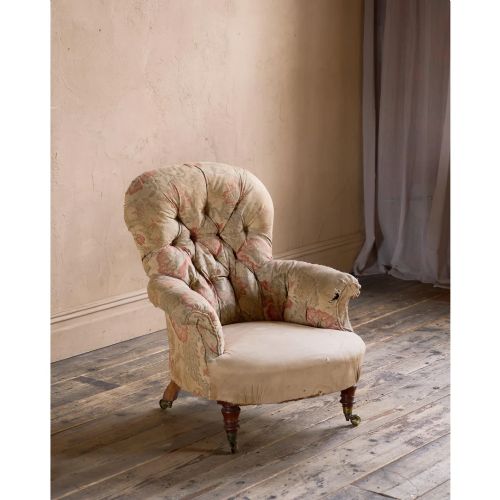
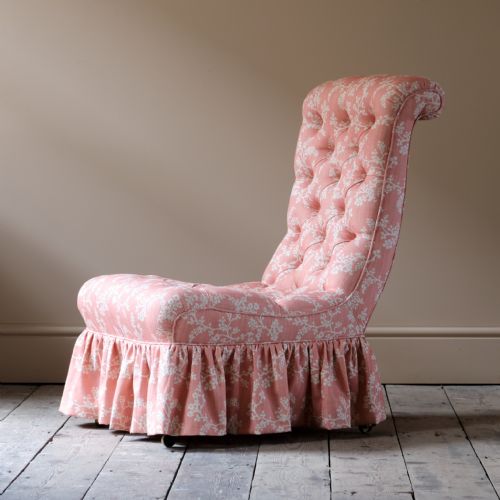
These floral upholstered nursing chairs offer low-slung seating and generous upholstery, pairing period woodwork with patterned textile covers for domestic comfort.
Floral Upholstered Nursing Chair
A floral upholstered nursing chair is a low Victorian seat designed originally for infant care, sewing, or fireside relaxation. The form prioritises a low seat and an upright, supportive back upholstered in patterned textiles.
Most examples encountered here date from the nineteenth century, spanning Regency, William IV, and Victorian periods. Woods such as mahogany and walnut frame the upholstered bodies, often featuring carved details.
Related forms on the page include slipper chairs, bedroom chairs, and prie-dieu chairs. These share the compact proportions and upholstered construction characteristic of nineteenth-century seating.
How they were made
Frames are constructed from hardwoods like mahogany and walnut, occasionally supported by internal iron structures or mounted on brass castors. Wood elements show hand-carved ornamentation, scroll backs, and gilt finishes on specific Victorian and French Napoleon III examples.
Upholstery relies on traditional techniques involving heavy textile covers, tapestry, and vintage linen. Button-backed styling and original floral tapestries appear frequently across the nineteenth-century inventory.
Several chairs include secret stamps hidden in the wood.
What varies in quality
The sophistication of the timber carving and the integrity of the wooden frame determine the foundational standard. Walnut and mahogany frames with refined spoon backs or crisp Victorian Rococo Revival detailing sit at the upper end of craftsmanship.
The grade and preservation of the upholstery material heavily influence the overall character. Pieces retaining original floral tapestry or high-grade vintage linen demonstrate superior period integrity compared to later recovered variants.
Holland and Sons·Gillows·Howard and Sons·Hindley and Sons
The Floral Upholstered Nursing Chair Glossary
- Spoon back
- A padded chair back shaped in the concave contour of a spoon to fit the human spine. This ergonomic curve became popular during the Victorian period.
- Prie Dieu
- A devotional chair featuring an elevated back designed for kneeling and prayer. These nineteenth-century variants share the low-slung upholstered build of standard nursing chairs.
- Napoleon III
- A French design style spanning the mid to late nineteenth century. It incorporates eclectic revivals, scroll backs, and decorative gilt woodwork.
- Tapestry
- A heavy hand-woven or machine-woven textile featuring pictorial or floral designs. It serves as a durable upholstery covering on nineteenth-century bedroom chairs.
- Button back
- An upholstery method where depressions are created by pulling tufting buttons deep into the padding. This secures the internal stuffing while forming a quilted geometric pattern.
Floral Upholstered Nursing Chair: Frequently Asked Questions
What is a nursing chair used for?
These low-slung seats were historically used by women for nursing infants and dressing in nineteenth-century bedrooms. The compact height allowed the sitter to hold a child comfortably while remaining close to the hearth.
Today, they function well as accent chairs in living rooms or bedrooms. Their small footprint makes them suitable for corners where standard armchairs prove too bulky.
How do I date a Victorian chair?
Dating relies on examining the timber frame, upholstery method, and stylistic markers such as spoon backs or carved walnut details. Mid-nineteenth-century examples often utilise solid mahogany or walnut with traditional button-backed padding.
Later Victorian and Edwardian pieces introduce alternative proportions and differing wood finishes. Comparing structural assembly and recorded maker attribution helps narrow the manufacturing decade.
Are these chairs comfortable for daily sitting?
The low seat height and upright padded back provide firm, supportive seating. Nineteenth-century construction focused on sprung or stuffed interiors designed for extended domestic use.
Comfort levels depend on the condition of the internal padding and webbing. Many buyers appreciate the ergonomic support offered by the curved spoon-back design.
What is the difference between a nursing chair and a slipper chair?
Slipper chairs traditionally sat low to the floor in bedrooms to allow ladies to put on shoes and hosiery easily. Nursing chairs share this low profile but typically feature a higher, more supportive back for holding infants.
In practice, nineteenth-century makers and modern sellers often overlap the terms. Both provide compact, low-level upholstered seating suited for smaller spaces.