

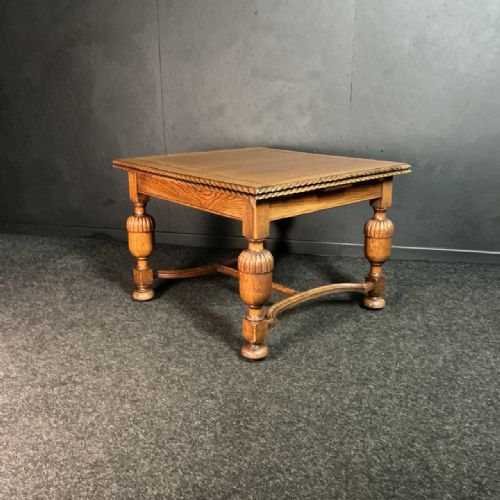


Tudor Revival Dining Table
A tudor revival dining table brings heavy timber presence and historical gravity into a modern dining room.
Tudor Revival Dining Table
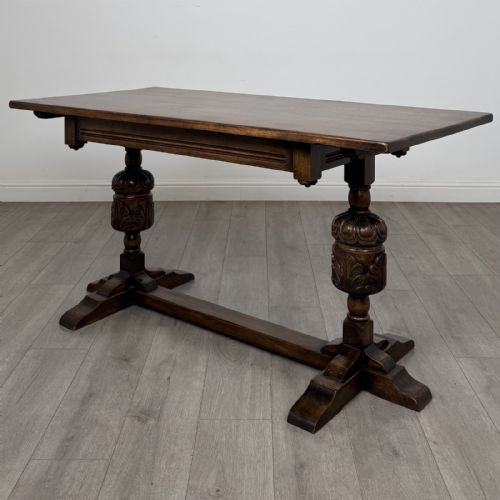
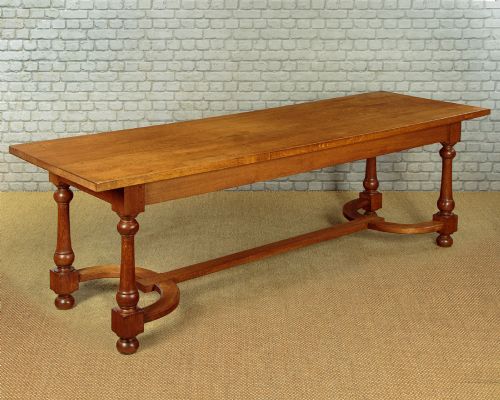
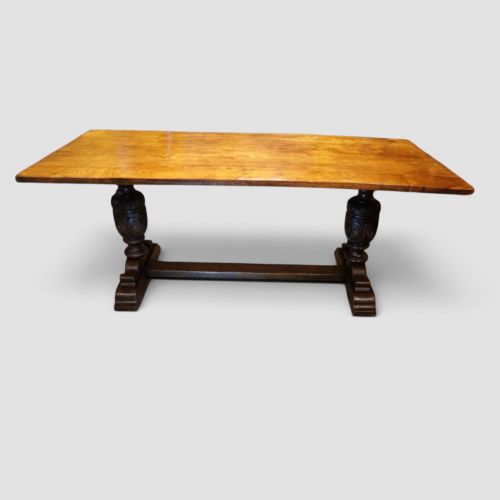
A tudor revival dining table is a solid timber board intended for communal dining, styled to evoke earlier centuries. The pieces seen here span the nineteenth century, the Edwardian era, and the decades up to nineteen thirty.
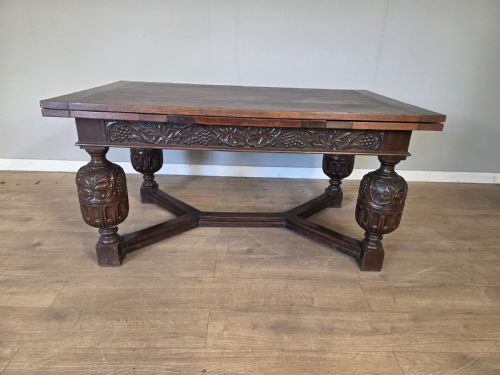
The dominant forms are refectory tables and extending draw leaf tables. These take inspiration from Jacobean, Elizabethan, and Tudor design vocabulary.
Makers of this period built furniture to anchor a room, relying on substantial proportions and architectural underframing. Buyers select these tables for their sturdy architecture and dark timber tones.
How they were made
Construction relies entirely upon solid oak, selected for its density and visible grain. Joinery techniques echo sixteenth and seventeenth-century methods, using pegged joints and thick timber tops.
Carving appears on friezes and supports, executed by hand or with early twentieth-century machinery to mimic historic handiwork. Draw leaf mechanisms allow the top to extend smoothly while preserving the heavy appearance of the main boards.
Tudor Revival Dining Table Retail Price Guide 2026
Typical asking prices for tudor revival dining table among the pieces listed under this phrase on Sellingantiques today, from the lower quarter to the upper quarter. They describe what is for sale here now, not the wider market.
Early twentieth-century dining tables were built so heavily that moving one usually requires removing all the internal doors on the ground floor.
What varies in quality
Quality rests in the weight of the timber and the honesty of the construction. Tables built from thick solid oak boards possess a structural integrity that lighter interpretations lack.
The distinction also lies in the depth of the carving and the proportion of the stretchers and legs. Finer examples balance bulk with careful attention to historical detail in the mouldings.
The Tudor Revival Dining Table Glossary
- Refectory table
- A long, narrow dining table historically used in monasteries and great halls. These revival examples adapt the long proportions for domestic interiors.
- Draw leaf table
- An extending table where two concealed leaves slide out from beneath the main top. This mechanism increases surface area without removing the end supports.
- Jacobean revival
- A decorative style popular in the nineteenth and early twentieth centuries that imitates the furniture of the early seventeenth century. It utilises dark oak, turned legs, and geometric panel carving.
- Stretcher
- A horizontal timber connecting the legs of a table to provide structural stability. On these tables, stretchers often run close to the floor to brace heavy oak frames.
Tudor Revival Dining Table: Frequently Asked Questions
How do I seat more people?
Many of these pieces utilise draw leaf mechanisms. You pull the hidden leaves out from beneath the main surface to extend the length.
Refectory styles remain fixed in length. For those, you rely on the open space between the structural legs to arrange chairs.
How do I care for solid oak?
Solid oak responds well to regular polishing with traditional beeswax. Avoid placing the timber in direct sunlight or near heat sources to prevent splitting.
Use coasters and mats to protect the surface from moisture and heat. Gentle cleaning with a damp cloth preserves the finish.
Will a refectory table fit my room?
Refectory tables are traditionally long and narrow. Measure your dining space carefully to ensure adequate clearance around the perimeter for chairs.
Consider the position of the structural legs and stretchers beneath the top. Ensure they will not obstruct the legs of anyone seated at the sides.