


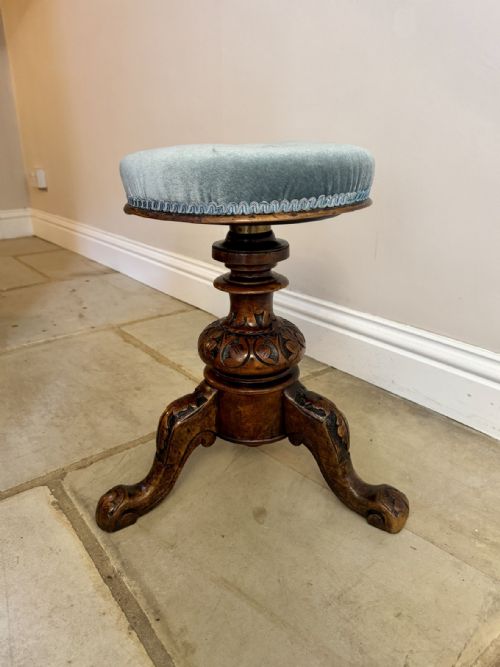


Tripod Piano Seat
A tripod piano seat gives you a steady, adjustable perch by the keyboard, shaped in walnut or mahogany across the Victorian and Georgian eras.
Tripod Piano Seat
When you search for a tripod piano seat, you encounter swivel and revolving music stools supported on central pedestals with three-legged bases. These seating forms span the Georgian, Victorian, and Edwardian periods, appearing alongside related country and industrial swivel stools.
You are most likely to meet Victorian walnut and rosewood examples on this page, often featuring carved wooden legs or cast iron mechanisms. Many variants offer adjustable height functions for the player at the keyboard, while others incorporate upholstered velvet, leather, or original fabric seats.
How they were made
Cabinet makers utilised dense hardwoods like walnut, mahogany, and rosewood for the carved pedestals and revolving tops, shaping them with twist or pedestal columns. Oak also appears in specific country and twist top variants.
Metal components, including iron and industrial mechanisms, were integrated into the design to allow height adjustment and smooth rotation. Seats were then finished with upholstery materials such as leather, velvet, and fabric.
Tripod Piano Seat Retail Price Guide 2026
Typical asking prices for tripod piano seat among the pieces listed under this phrase on Sellingantiques today, from the lower quarter to the upper quarter. They describe what is for sale here now, not the wider market.
The listings here span the Georgian, Victorian, and Edwardian eras, predominantly featuring walnut, rosewood, and mahogany woods.
What varies in quality
The sophistication of the wood carving on the pedestal and legs marks the difference between standard production and superior examples. Finer pieces display crisp detail in the carved walnut or rosewood components.
The engineering of the revolving and adjustable mechanism dictates the mechanical standard of the seat. Robust iron screws and smooth swivel action separate the better surviving pieces from simpler counterparts.
The Tripod Piano Seat Glossary
- Revolving
- Turning around a central axis to allow the seated person to pivot. This mechanism enables the player to adjust position easily while seated at the instrument.
- Pedestal
- A single central support column rising from a three-legged base. It carries the weight of the revolving seat above.
- Adjustable height
- A mechanism that allows the seat level to be raised or lowered. This function helps players achieve the correct posture relative to the keyboard.
- Grotto Revival
- A nineteenth-century decorative style inspired by natural shell and rockwork motifs. In seating, it manifests in organic, heavily carved wooden forms.
- Industrial
- A utilitarian style utilising raw metals and functional designs. These pieces often combine cast iron with simple wooden seats.
Tripod Piano Seat: Frequently Asked Questions
How do I adjust the height?
Many of these seats use a threaded wooden or metal screw mechanism hidden beneath the seat top. Turning the upper section clockwise or counter-clockwise raises or lowers the sitting surface.
Other variants rely on simple swivel actions or rising seat designs. You simply rotate the top until the desired playing height is reached.
Were these only used for pianos?
While primarily designed for keyboard practice, similar swivel and pedestal forms served other domestic purposes. Some examples functioned as dressing table stools or general music room seating.
The stable three-legged base and adjustable height made them versatile furniture pieces around the home beyond the music salon.
How do I date a tripod seat?
Dating relies on observing the combination of timber, carving style, and mechanical construction. Georgian and early nineteenth-century pieces often feature simpler mahogany or rosewood frames.
Later Victorian examples frequently incorporate walnut, heavy carving, or cast iron industrial mechanisms. Edwardian variants tend toward simplified adjustable bar stool formats.
How do I care for the upholstery?
Maintenance depends on whether the seat retains its original fabric, velvet, or leather covering. Gentle dusting and appropriate leather conditioners help preserve historical surfaces.
Avoid placing these seats in direct sunlight to prevent fading of the timber and textiles. Professional conservation is recommended for fragile antique fabrics.