
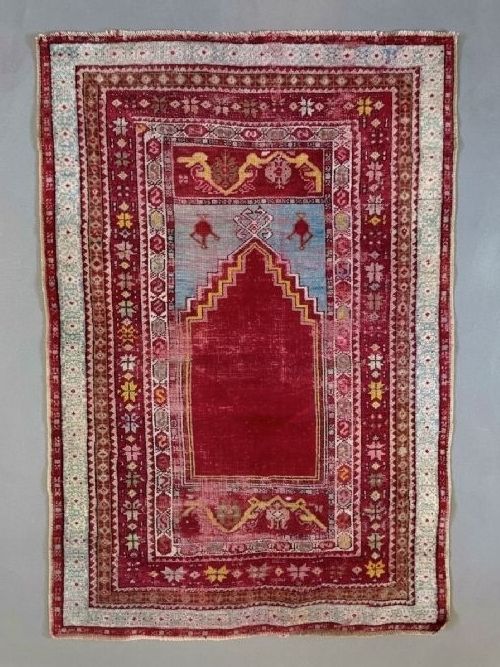


Traditional Ottoman Carpet
A traditional ottoman carpet brings centuries of Anatolian textile heritage into a room, offering rich colours and intricate geometric or floral designs.
Traditional Ottoman Carpet
A traditional ottoman carpet encompasses woven floor coverings and wall hangings originating from Turkey and the wider Ottoman Empire, spanning production from the eighteenth century through the early twentieth century. Buyers encounter various formats, ranging from large decorative room carpets to smaller specialised items such as village prayer rugs and flat-woven kilims.
How they were made
Weavers constructed these textiles using natural materials including wool, hand-spun wool, cotton, and silk, sometimes incorporating angora wool or floss silk for specific tactile effects. Foundation threads and pile yarns were manipulated by hand on vertical looms to create durable pile carpets and flat-woven structures.
Dyers utilised natural organic sources to colour the fibres, producing the soft palettes, pale blues, and pastel tones visible across nineteenth-century examples. The density of the weave varied by region, with certain Kayseri and Sivas productions exhibiting exceptionally fine knot counts.
Several prayer rugs carefully incorporate distinct star borders designed to guide the eye toward the central niche.
What varies in quality
Quality in a traditional ottoman carpet rests upon the integrity of the weave, the clarity of the classic medallion or prayer niche design, and the depth of the palette. Pieces featuring finely spun materials and balanced colour distributions stand apart from simpler village productions.
The preservation of the original borders and pile height influences the standing of each textile. Variations also arise from regional provenance, where master workshops in cities like Ushak or Kayseri achieved greater precision than smaller provincial looms.
The Traditional Ottoman Carpet Glossary
- Prayer rug
- A small carpet featuring a mihrab or niche design, historically used for individual daily prayers and defined by directional motifs pointing toward Mecca.
- Kilim
- A flat-woven textile produced without a pile, utilising slit-tapestry weaving techniques to create sharp geometric patterns.
- Mihrab
- The arched niche depicted on prayer rugs that represents the direction of prayer.
- Medallion
- A central ornamental motif dominating the field of a carpet, frequently circular, oval, or star-shaped in Anatolian weaving.
- Saf
- A multi-niche prayer rug containing several arches in a row, designed to accommodate multiple worshippers simultaneously.
Traditional Ottoman Carpet: Frequently Asked Questions
How do I style a traditional ottoman carpet?
These textiles anchor a room by introducing rich historical patterns and muted pastel or deep wool tones to hardwood or stone floors. They pair effectively with traditional timber furniture as well as contemporary neutral interiors.
Ensure you place an appropriate underlay beneath the rug to protect the vintage fibres and prevent slipping on smooth surfaces. Keep them out of direct, harsh sunlight to preserve the natural dyed colours over time.
What is the difference between a prayer rug and a carpet?
Prayer rugs are typically smaller formats designed for individual use, easily identified by the architectural arch or mihrab motif woven into one end. Carpets are larger floor coverings meant to anchor entire rooms with repeating medallion or all-over field designs.
While both share the same Anatolian material origins and knotting techniques, their distinct sizes dictate how they function within a domestic interior.
How do I identify an Ushak carpet?
Ushak carpets originate from western Anatolia and are recognised by large-scale floral motifs, star patterns, and restrained, soft colour palettes. They often feature generous proportions and a looser, supple weave compared to other regional Turkish carpets.
Examining the handling of the wool and the specific secondary colours helps distinguish an Ushak from Sivas or Kayseri productions.
Are these carpets made of silk or wool?
The materials vary depending on the specific weaving centre and period, with wool and hand-spun wool forming the majority of larger floor carpets. Silk and floss silk appear more frequently in finer prayer rugs from centres like Kayseri and Bursa.
Certain pieces also incorporate cotton foundations alongside wool piles to provide structural stability.