





Traditional Oak Banquet Table
A traditional oak banquet table anchors a room with solid presence, offering substantial timber surfaces designed for gathering family and guests.

Traditional Oak Banquet Table
When you search for a traditional oak banquet table, you seek a dining surface built for scale and daily communal use. These pieces span from the seventeenth century through to the Edwardian period, incorporating revivals such as Jacobean and Elizabethan styles alongside William and Mary and William IV influences.
You are most likely to encounter extending tables and refectory forms on this page. Makers utilised clever draw-leaf mechanisms and central leaves to expand the timber surface easily for large gatherings.
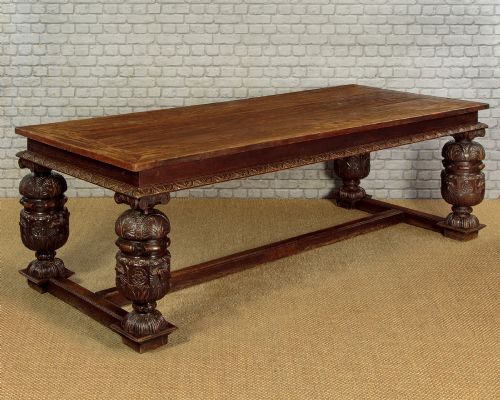
The architectural character of these tables emerges through robust construction, often featuring trestle bases or stout legs joined by stretchers. English country house aesthetics heavily influence the heavier proportions found across many of these dining tables.
Materials and construction methods
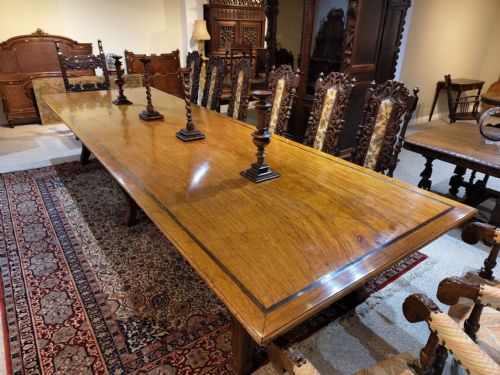
Makers relied primarily on solid oak and pollard oak, sometimes incorporating walnut and brass fixtures for mechanical extension systems. The timber displays natural grain patterns and medullary rays that highlight the quality of the wood.
Carpenters constructed these dining tables using traditional jointing methods to support expansive tops that often stretch over ten or fourteen feet. Draw-leaf mechanisms and drop-in leaves required precise engineering to ensure the timber surfaces remained level when fully extended.
Listings feature oak tables spanning the seventeenth century through to the Edwardian era, alongside pollard oak and walnut timbers.
Assessing quality in banquet tables
The distinction between average and exceptional pieces rests upon the choice of timber and the sophistication of the extension mechanism. Fine examples utilise figured pollard oak or dense English oak with well-matched grain across the primary leaves.
Construction integrity defines the upper tier, where heavy refectory bases and trestle supports remain entirely stable without wobble. Finer tables demonstrate superior cabinetmaking in the sliding tracks of extending frames and the crispness of revival carvings.
Maple and Co
The Traditional Oak Banquet Table Glossary
- Refectory table
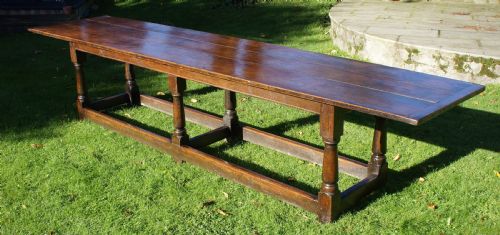
- A long dining table originally used in monasteries and great houses for communal meals. These forms feature substantial length supported by sturdy legs connected by longitudinal stretchers.
- Draw-leaf table
- An extending dining table with two sliding leaves stored beneath the main top. Pulling the main top slightly upward allows the hidden leaves to slide out and drop flush into place.
- Pollard oak
- Oak timber obtained from trees that were pollarded, a pruning method that produces burr or rich, clustered grain patterns. Cabinetmakers prized this wood for its decorative surface figure.
- Jacobean Revival
- A nineteenth-century style replicating the architecture and furniture design of the early seventeenth century. Pieces in this style typically feature geometric mouldings, turned legs, and dark oak finishes.
- Stretcher
- A horizontal wooden brace running between the legs of a table to provide structural rigidity. These elements often sit low near the floor on traditional English tables.
Traditional Oak Banquet Table: Frequently Asked Questions
How do I operate a draw leaf table?
To extend a draw-leaf table, you lift the main top slightly to clear the hidden end leaves. These leaves slide out from underneath and drop into place as the main top settles back down.
This clever mechanism allows a shorter everyday dining surface to double in length quickly without requiring separate storage leaves.
What is the difference between a refectory and extending table?
A refectory table maintains a fixed length defined by its sturdy timber top and stretcher base. These pieces rely on permanent proportions suited for large dining spaces.
Extending tables incorporate mechanical leaves that slide or drop in to expand the seating capacity on demand. Both forms appear frequently in traditional oak designs.
How do I care for an antique oak dining surface?
You should clean antique oak tables using a soft, dry cloth to remove dust without harming the polished finish. Avoid harsh chemical cleaners and keep the timber away from direct heat sources to prevent warping.
Applying a traditional beeswax polish periodically helps nourish the oak grain and maintains the rich lustre of the timber.
How can I tell an Edwardian oak table from an older one?
Edwardian oak tables often display machine-sawn components and standardised extension runners hidden beneath the top. Their revival styles emulate seventeenth-century or Elizabethan models but usually present lighter overall timber weights.
Older pieces from the seventeenth or early nineteenth centuries reveal hand-finished joinery marks, adze marks on the underside, and denser timber patination earned through decades of use.