
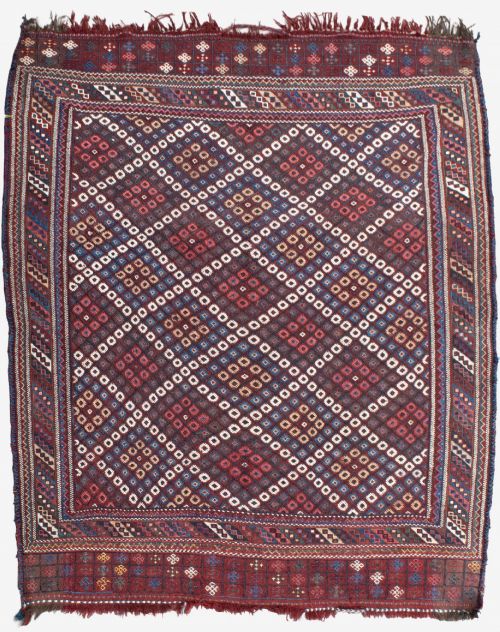


Traditional Nomadic Kilim
These traditional nomadic kilim textiles are flat-woven rugs and household pieces originating from tribal makers across Persia, Anatolia, and Central Asia.
Traditional Nomadic Kilim
A traditional nomadic kilim encompasses flat-woven rugs, runner rugs, cushions, and saddle bags produced by tribal groups. The selection on this page focuses heavily on Persian tribal, Central Asian, Baluch, and Anatolian tribal origins.
The objects span periods from the mid-nineteenth century through the early twentieth century. Common formats include single-panel rugs, multi-strip constructions, and embroidered panels intended for specific nomadic uses.
How they were made
These textiles utilise wool, hand-spun wool, and cotton foundations woven tightly without a pile. Natural dyes provide the colour palette across regional variations from Persia, Turkey, and Central Asia.
Many larger examples, such as Uzbek and Afghan pieces, are woven in multiple parts or strips and joined together. Specialised techniques like Soumak wrapping and embroidery appear alongside standard flat-weaving.
Several nomadic pieces arrive complete with their original long woven ends, perfectly preserved from a century ago.
What varies in quality
Quality rests upon the fineness of the weave and the complexity of the geometric or banded design. Tighter structures and precise execution of traditional motifs separate standard utility pieces from finer tribal work.
The integrity of the natural dyes and the preservation of original kilim ends also dictate the standing of a textile. Surviving structural details from regions like Yomut or Qashqai indicate superior initial manufacture.
The Traditional Nomadic Kilim Glossary
- Kilim
- A flat-woven carpet or rug produced without a pile by interlocking the coloured weft threads over the warp. This technique creates a lightweight textile with identical patterns visible on both sides.
- Sofreh
- A type of spread or cloth used traditionally for dining, kneading bread, or ritual purposes. These are frequently flat-woven by tribal groups.
- Soumak
- A brocade-like flat-weaving technique where coloured weft threads are wrapped around the warp threads for added strength and texture. It results in a ridged front surface and loose threads on the reverse.
- Cicim
- An embroidery-like technique where supplementary coloured threads are woven into the warp and weft during production. It creates raised patterns on the surface of the textile.
- Warp
- The stationary vertical threads stretched lengthwise on the loom that form the structural foundation of the textile. Weft threads are passed horizontally through them.
Traditional Nomadic Kilim: Frequently Asked Questions
What is a traditional nomadic kilim?
A traditional nomadic kilim is a flat-woven textile created by tribal communities for practical household and travel purposes.
Unlike piled carpets, these pieces rely entirely on interlocking weft threads to form geometric and banded patterns.
How were these rugs used originally?
Nomadic tribes utilised these flat-weaves as floor coverings, blankets, storage bags, and dining spreads.
Specialised forms like saddle bags and cushions served the daily functional needs of pastoral life.
How do I care for a vintage kilim?
Protect the wool and natural dyes by keeping the textile out of direct, prolonged sunlight. Gentle vacuuming without a rotating brush maintains the flat weave safely.
How can I tell regions apart?
Regional styles appear through distinct colour palettes, structural strip counts, and specific geometric motifs.
Anatolian pieces often show embroidery techniques, while Central Asian and Persian tribal works favour bold graphic alignments.