




Traditional Imari Porcelain Dish
A traditional imari porcelain dish brings together heavy cobalt blue underglaze and rich enamel work on crisp ceramic.
Traditional Imari Porcelain Dish
When you search for a traditional imari porcelain dish, you encounter decorative plates, bowls, chargers, and platters spanning the seventeenth century through to the Edwardian period and the early twentieth century. The selection leans heavily towards Japanese imari from the Meiji period and Victorian eras, alongside Chinese export pieces and late seventeenth-century Arita porcelain.
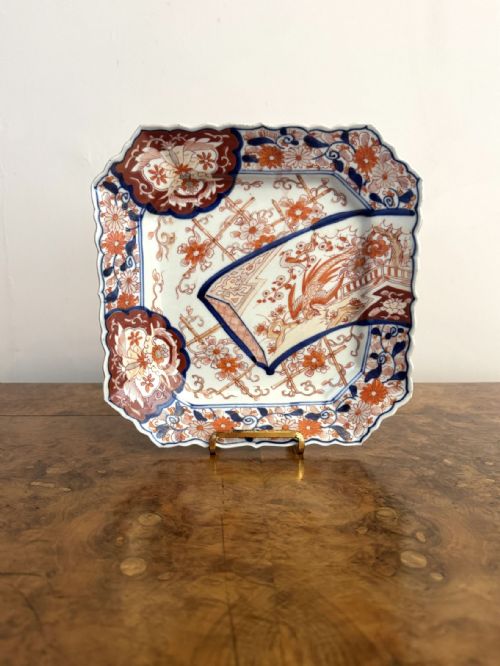
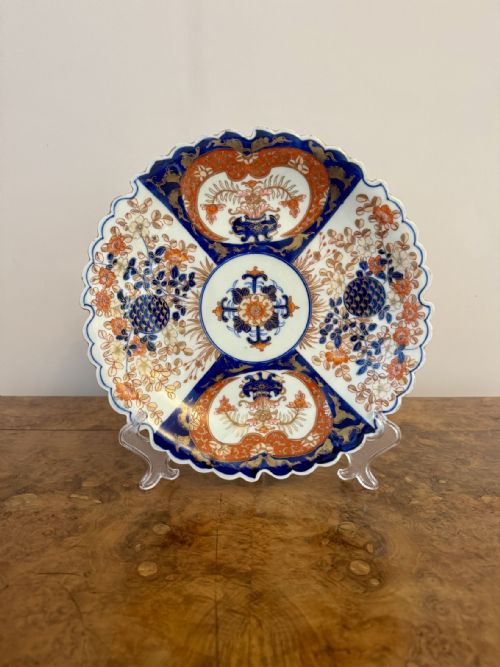
The forms vary from simple round plates to square shaped plates, scalloped shaped edge large plates, and large display chargers. Bowls and sugar bowls also appear among the selections, offering deep wells for fruit display or table service.
Most examples date from around nineteen hundred, reflecting a strong Victorian and Edwardian interest in imported Asian ceramics. You also find nineteenth-century output alongside earlier Edo period items.
How they were made
Makers shaped ceramic clay into plates, bowls, and chargers before applying cobalt underglaze to form the primary blue designs. Enamel colours and gold leaf, or gilding, were then added over the glaze to build the characteristic layered palette.
Hand painting ensured that each charger and plate received individual brushwork, combining iron red and cobalt pigments with gilt highlights. Firing in kilns set the underglaze patterns and fixed the subsequent enamel layers to the porcelain body.
Some plates feature scalloped edges so enthusiastic they resemble flower petals caught in a sudden breeze.
What varies in quality
The distinction between standard output and outstanding quality lies in the precision of the hand-painted brushwork and the richness of the enamel and gold leaf application. Finer pieces display crisp cobalt definition and balanced composition across the surface.
Condition and scale also differentiate the pieces, with large chargers and matched pairs or collections commanding attention for their visual impact. Unusual shapes, such as square profiles or scalloped edges, elevate the design beyond standard round plates.
Royal Crown Derby·Arita Hizen
The Traditional Imari Porcelain Dish Glossary
- Cobalt Underglaze
- A blue pigment applied to ceramic before glazing and firing. It survives high kiln temperatures without fading.
- Aka-e
- Japanese term for red-painted decoration, often combined with gold on porcelain. This style defines the characteristic warm tones of the ware.
- Charger
- A large decorative plate meant for display rather than routine dining. These wide vessels showcase complex pictorial arrangements.
- Meiji Period
- The era in Japanese history spanning from eighteen sixty-eight to nineteen twelve. Much of the decorative porcelain on the market originates from this time.
Traditional Imari Porcelain Dish: Frequently Asked Questions
How do I display a charger?
Large chargers work best on sturdy plate stands placed on sideboards or hung securely using specialist wall mountings.
Because of their substantial size and weight, ensure the support bears the load safely away from foot traffic.
Can I use these bowls for food?
Antique imari bowls and plates serve well for dry presentation, such as fruit displays on a dining table.
Frequent washing in modern dishwashers should be avoided to protect the delicate enamel and gold leaf decorations.
How do I identify Meiji period pieces?
Meiji period items typically date from the late nineteenth or early twentieth century, showing dense hand-painted patterns.
They often combine deep cobalt blue with vibrant iron red enamel and gilt highlights on dense porcelain.
What is the difference between a plate and a charger?
Chargers are significantly larger than standard dining plates and were traditionally designed as ornamental table centrepieces.
Plates measure smaller and were produced in larger quantities for both daily service and decorative display.