
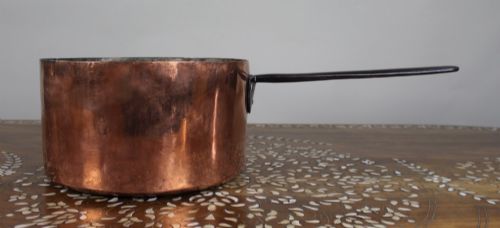


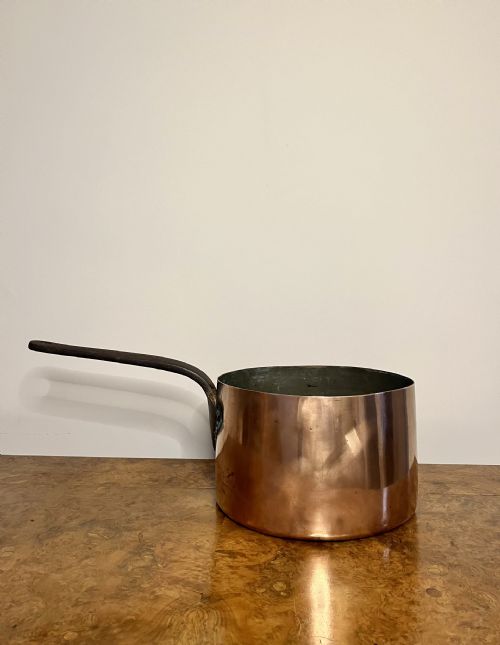


Traditional Copper Saucepan
These traditional copper saucepan examples combine heavy metal and fitted handles, offering both practical kitchen service and classic historic warmth.
Traditional Copper Saucepan
When you search for a traditional copper saucepan, you are looking at heavy metal cookware designed for serious kitchen work over centuries. The pieces available here span the Georgian, Victorian, and nineteenth-century periods, originating from English and French workshops.
You are most likely to encounter individual saucepans or matched sets of three, four, or five pieces. Forms range from single pint saucepans to large lidded vessels, often bearing the marks of makers such as Hodges and Sons or Griffiths Patent.
How they were made
These items rely on heavy sheet copper hammered or formed into deep round vessels for rapid, even heat distribution. Makers joined handles made of cast iron, wrought iron, brass, or wood using sturdy rivets to ensure secure lifting.
Victorian and Georgian examples often incorporate tight-fitting lids and reinforced rims to withstand daily culinary use. The combination of dense copper bodies and contrasting iron or brass fittings defines the physical construction recorded in the listings.
Listings span the Georgian, Victorian, and nineteenth-century periods, featuring materials such as copper, cast iron, iron, wrought iron, wood, and brass.
What varies in quality
The distinction between standard kitchenware and the top of the range rests on thickness of metal and integrity of construction. Heavier gauge copper and robustly pinned iron or brass handles separate substantial service pieces from lighter items.
Completeness of sets and identifiable maker attribution elevate specific pans above unmarked individual vessels. Quality shows in the balance of the handle and the clean alignment of the riveted joints rather than surface shine alone.
Hodges and Sons·Griffiths Patent
The Traditional Copper Saucepan Glossary
- Saucepan
- A deep cooking vessel with a single long handle used for boiling and simmering. These historic versions rely on thick copper walls.
- Georgian
- Pertaining to the period from 1714 to 1830, covering early George III examples seen in these listings. Pieces from this era display traditional hand-beaten construction.
- Victorian
- The period of Queen Victoria's reign from 1837 to 1901, representing the bulk of the nineteenth-century cookware shown here. Victorian pieces frequently feature stamped maker details or patent marks.
- Wrought iron
- Tough, malleable iron worked by hammering, often utilised for sturdy pan handles. This material resists warping under high heat.
Traditional Copper Saucepan: Frequently Asked Questions
How do I date a traditional copper saucepan?
Dating relies on stylistic clues, handle construction, and any stamped maker marks or patent details on the metal. Georgian pieces often show different handle shaping compared to later Victorian items.
Examining the thickness and the method of riveting also helps place a pan within the nineteenth century.
Are these pans still suitable for cooking?
Many traditional copper saucepan examples retain their sturdy metal structure and heavy bases suited for heat transfer. Buyers frequently use them on modern kitchen stoves after verifying the interior lining.
Care must be taken to check the condition of the metal and the security of the riveted handles before regular culinary use.
What materials make up the handles?
Handles on these pieces typically consist of cast iron, wrought iron, brass, or wood. Each material provides a distinct grip and visual contrast against the warm copper body.
Iron and brass fittings are usually secured with heavy rivets through the pan wall.
Why do some pans come in sets?
Matched sets of three, four, or five pans were produced to provide graduating sizes for various kitchen tasks. Surviving complete sets from the Victorian or Georgian periods remain desirable for collections.
Individual saucepans offer a simpler way to start owning historic copper cookware.