


Traditional Butler Table
A traditional butler table combines a removable tray top with a folding stand, offering a portable surface for serving or display.
Traditional Butler Table
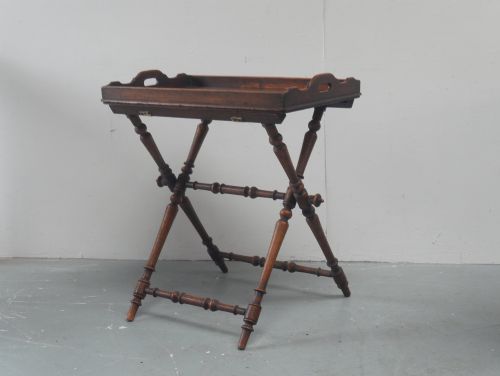
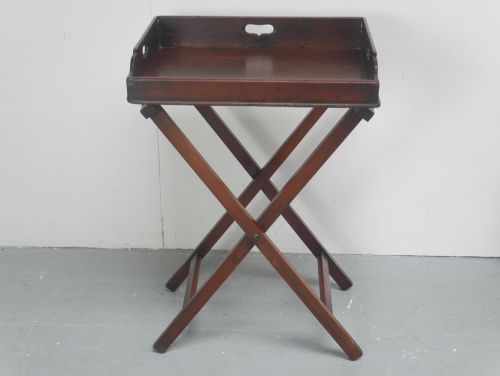
A traditional butler table is a versatile piece comprising a distinct tray resting upon a separate support, designed originally for domestic service and portability. These items span periods from the eighteenth century through the Victorian era and into the early twentieth century, showing remarkable persistence in domestic utility.
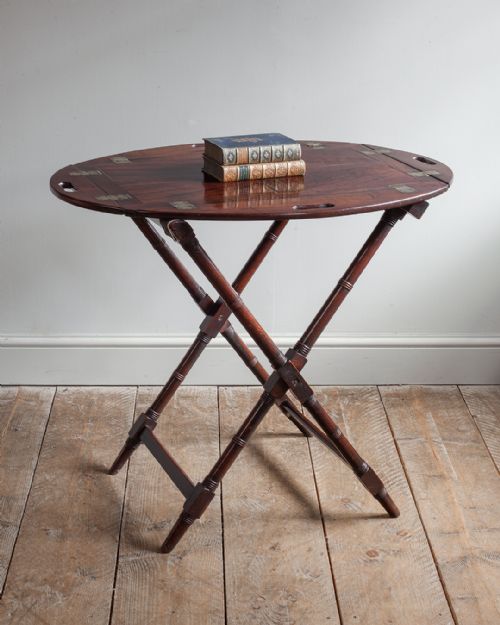
The most common examples encountered on this page pair mahogany or oak trays with collapsible wooden stands, reflecting both Georgian origins and Victorian production. Formats range from simple folding stands to elaborate presentation trays and adapted coffee tables.
Originating in English country houses and town residences, these tables fulfilled a practical need for mobile serving furniture before being adopted into broader decorative schemes. Today, they serve as occasional tables, side tables, or low coffee tables in contemporary rooms.
How they were made
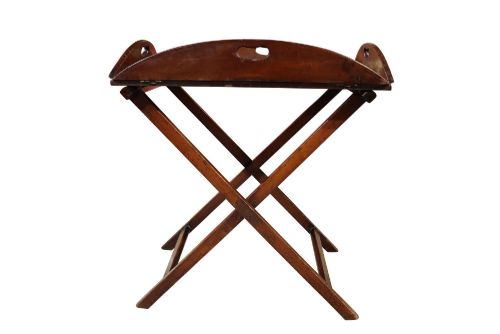
Makers relied primarily on timber construction, selecting dense hardwoods like mahogany alongside oak for durability. Trays frequently feature raised rims, sometimes pierced with handgrips for carrying, joined to folding scissor-action or X-frame stands.
Detailing on these pieces incorporates brass hinges, canvas webbing, or cotton webbing to support the folding mechanism and secure the tray. Surface treatments vary from polished wood finishes to paint and gilding, particularly in Venetian or revival examples.
A butler table lets you pretend you employ staff while secretly carrying your own biscuits.
What varies in quality
The caliber of a traditional butler table rests on the selection of timber and the precision of the joinery in both tray and stand. Superior pieces display carefully figured mahogany or sound oak, with dovetailed or pegged joints that endure centuries of folding and lifting.
Hardware integration also distinguishes finer examples, where brass fittings fit flush and folding mechanisms operate smoothly without excessive play. Original stands paired with their correct trays carry greater historical consistency than later married combinations.
The Traditional Butler Table Glossary
- Butler's Tray
- A shallow wooden tray with hinged or fixed sides, designed to lift off its support. It often includes cut-out handles for lifting during service.
- Folding Stand
- A collapsible wooden base, frequently built with an X-frame or scissor action. This allows the support to be stored flat when the tray is removed.
- Mahogany
- A durable tropical hardwood prized for its rich reddish-brown colour and stable grain. It dominates the construction of eighteenth and nineteenth-century examples.
- Webbing
- Strong strips of canvas or cotton used within the folding structure of certain stands to provide flexible tension. It supports the weight of the tray when open.
Traditional Butler Table: Frequently Asked Questions
What is a traditional butler table?
A traditional butler table consists of a removable wooden tray placed upon a folding or fixed stand. The design allows servants to carry items from room to room and collapse the base when not in use.
Over time, these pieces transitioned from strict utility items into flexible furniture used for serving afternoon tea or functioning as low coffee tables.
How do I use one today?
These tables function well as side tables, occasional surfaces, or low coffee tables in living spaces. The removable tray offers practical utility for serving drinks or displaying objects.
The folding design also makes them adaptable for smaller rooms where surfaces need to be moved or stored easily.
Are the trays removable?
Yes, the defining characteristic of these pieces is a tray that lifts entirely free from its supporting stand. This separation was essential for original domestic service.
When evaluating a piece, checking whether the tray sits securely on its original stand helps determine its period integrity.
What materials are typical?
Mahogany and oak form the primary materials for both trays and stands across the nineteenth and early twentieth centuries. Brass hardware and canvas or cotton webbing frequently appear in the folding mechanisms.
Some decorative variants also incorporate paint, gilding, or carved woodwork depending on the stylistic period.
How do I date a table?
Dating relies on timber characteristics, construction methods, and stylistic cues such as Georgian simplicity or Victorian carving. Eighteenth and nineteenth-century pieces often exhibit hand-cut joints and dense hardwoods.
Later examples from the early twentieth century or revival periods show different machining marks and finishing techniques.